This week our three part journey into the 1916 booklet “The Domestic Cat: Bird Killer, Mouser and Destroyer of Wildlife” written by Edward Howe Forbush and published by the Massachusetts state department of agriculture, continues.
If you’ve not read the last two posts, there we look at the way both the history of the cat and the natural habits of the cat were depicted by Forbush. Forbush, the founder of the Massachusetts Audubon Society, has so far spared no rod in depicting the cat as a bloodthirsty savage who will stop at nothing to murder every sweet bird and critter he comes across.
I would be doing the purpose of this blog a disservice if I didn’t once again point to the fact that this pamphlet was published by an actual state department of agriculture as an educational public resource, and that dozens of similar pamphlets and booklets originating from like minded bird-folk treaded this same path.
The relationship between the government of this time period and the Audubon society is one that I will unpack for you another time, but I do want you to think on just how difficult it would be today to get a state department to publish literally any sort of “opinion piece” on animal services today. Imagine a state sponsored booklet on no kill, for example. Or on TNVR. Or on medical research animals. Impossible is the word that comes to my mind. My point is that the foundations of community cats being villainized, in opinion, and then in law, by the early and questionably researched opinions of a few well connected people are deep indeed, and they extend in a way that can be difficult to contextualize in today’s animal services environment.
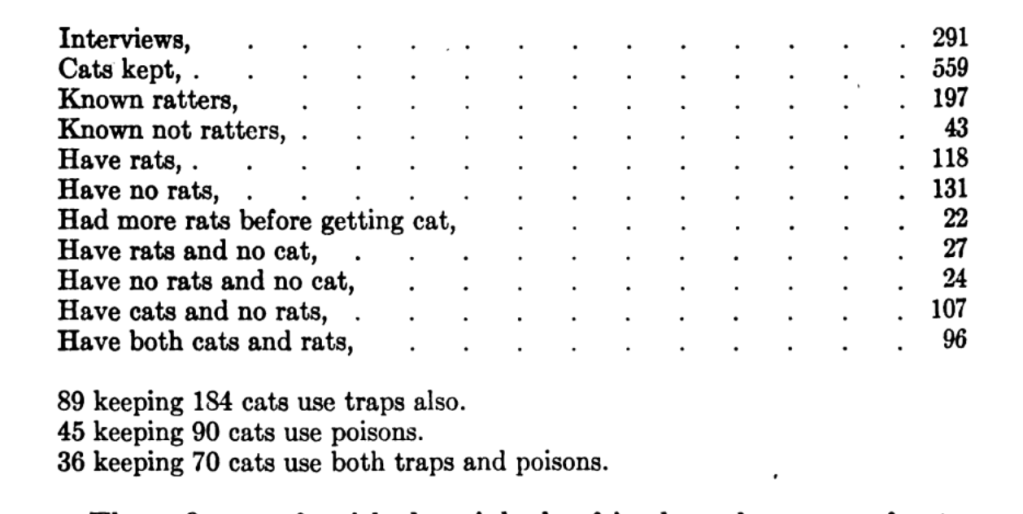
Up to this point in the booklet, the author’s point seems simply to have been that it is in the cat’s nature to kill birds and small critters, and that the birds and critters are more valuable than the cats. There is also what I found to be a hilarious table. The depth of this “research” clearly knows no bounds. The author illustrates how effective cats are at killing rats through his survey results.
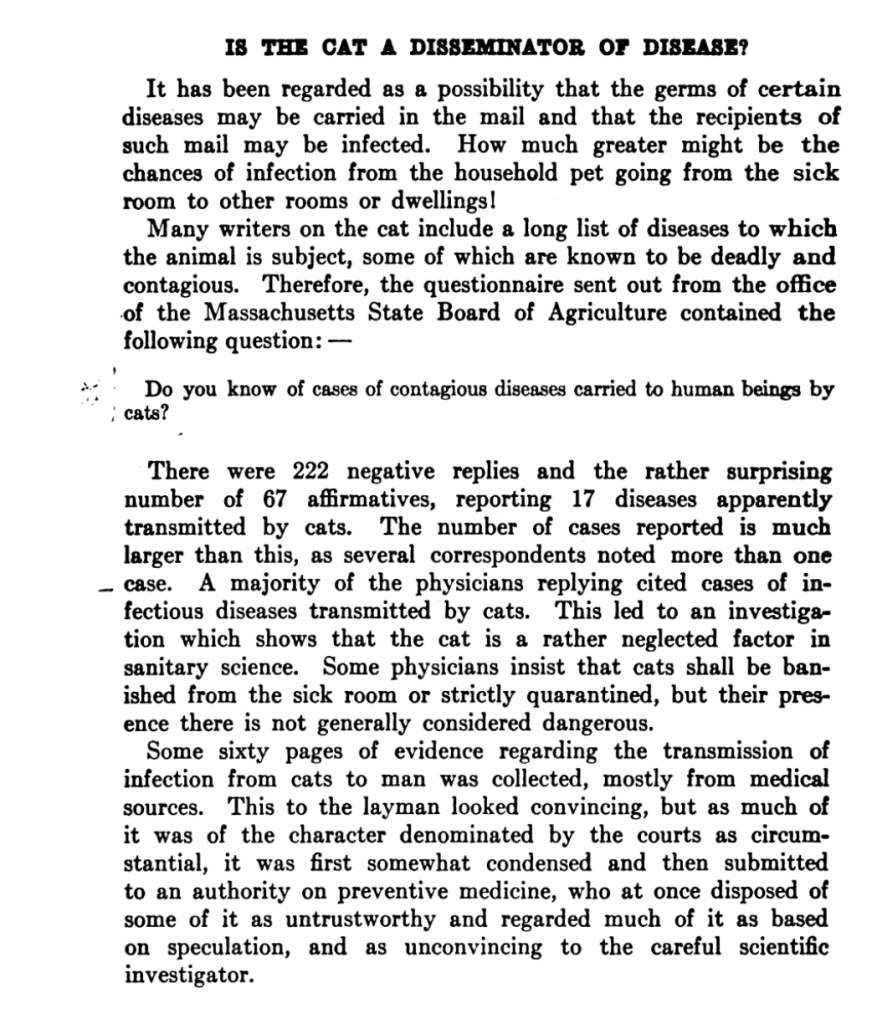
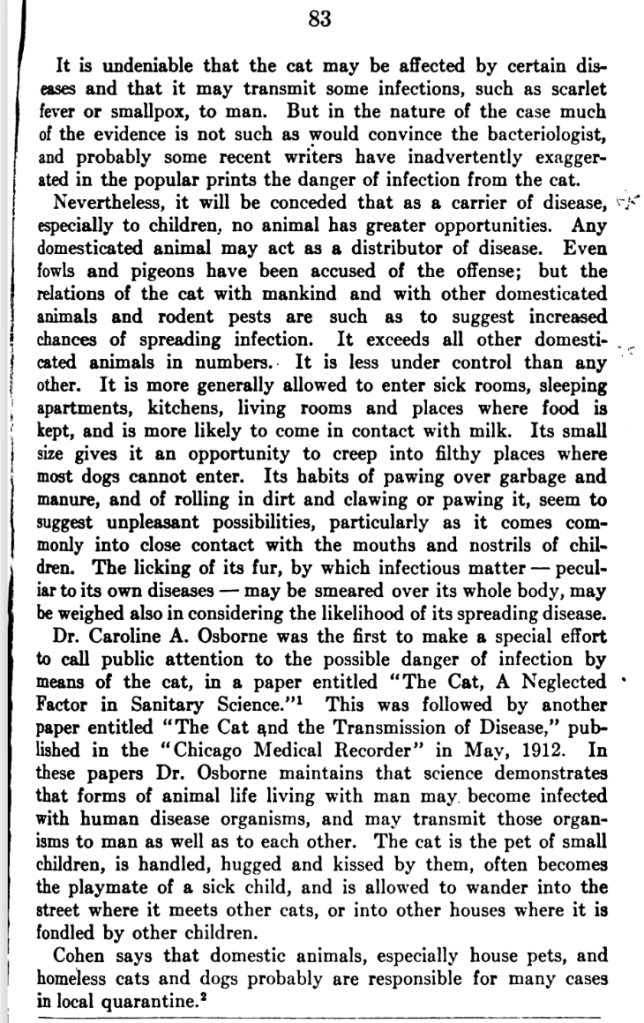
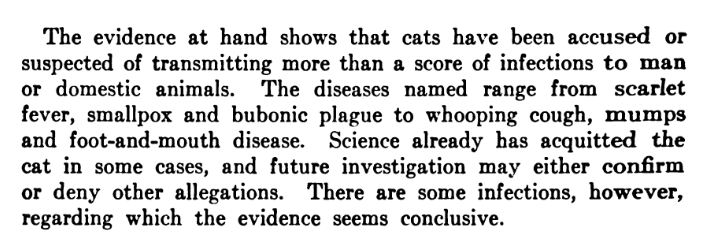
Next, he looks at cats as a disease vector. I’m just going to give you this whole opening section, because I think it speaks for itself very well. I’m going to have to hunt down the two papers mentioned in the paragraphs below.
Here the author establishes that not only are cats bloodthirsty murders, but they also are disease vectors that are likely to cause your children to contract scarlet fever, small pox, whooping cough and the bubonic plague. Don’t kiss your cat, friends. And be careful with your mail, too.
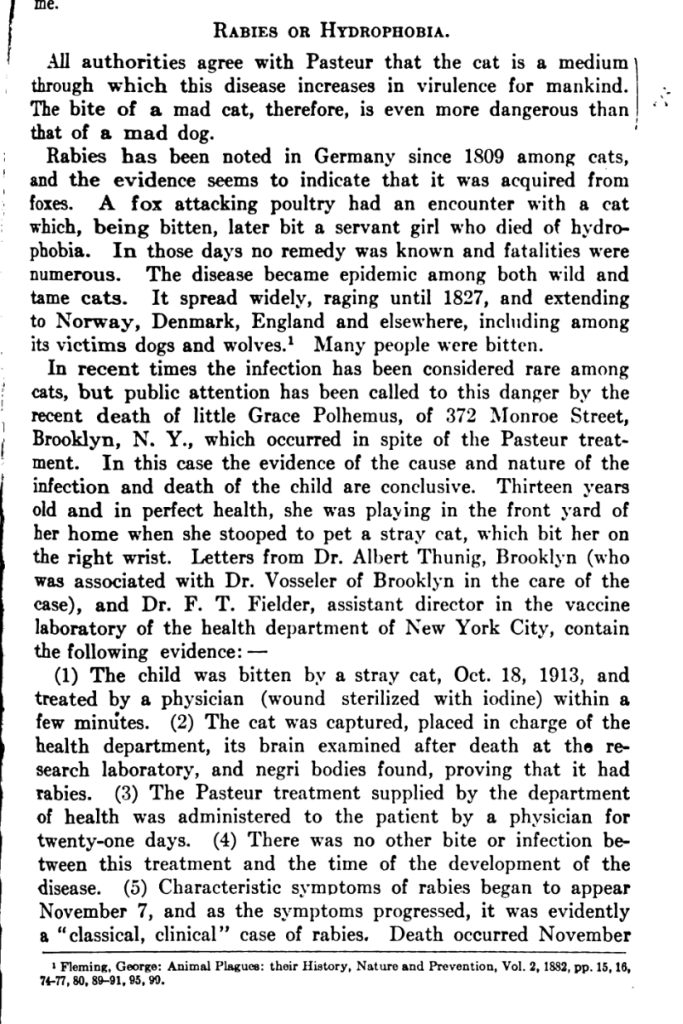
Next, my favorite topic: rabies. In 1916, the state of rabies in the United States was such that we had the vaccine available prophylactically at a few Pastuer centers or, in some limited instances, by mail if you were to be bitten by a rabid animal. We recognized that cats carried rabies. Pets were not yer regularly vaccinated; that would not happen for another 35 years or so. The author takes great care to illustrate, specifically, that cats can and do cause hydrophobia and states that “the bite of a mad cat is more dangerous than the bite of a mad dog” because the disease “increases in virulence” in the cat. He moves on to cover the specific case of Grace Polhemus, a 13 year old girl from Brooklyn who was bitten by a stray cat and died of rabies despite rapid treatment.
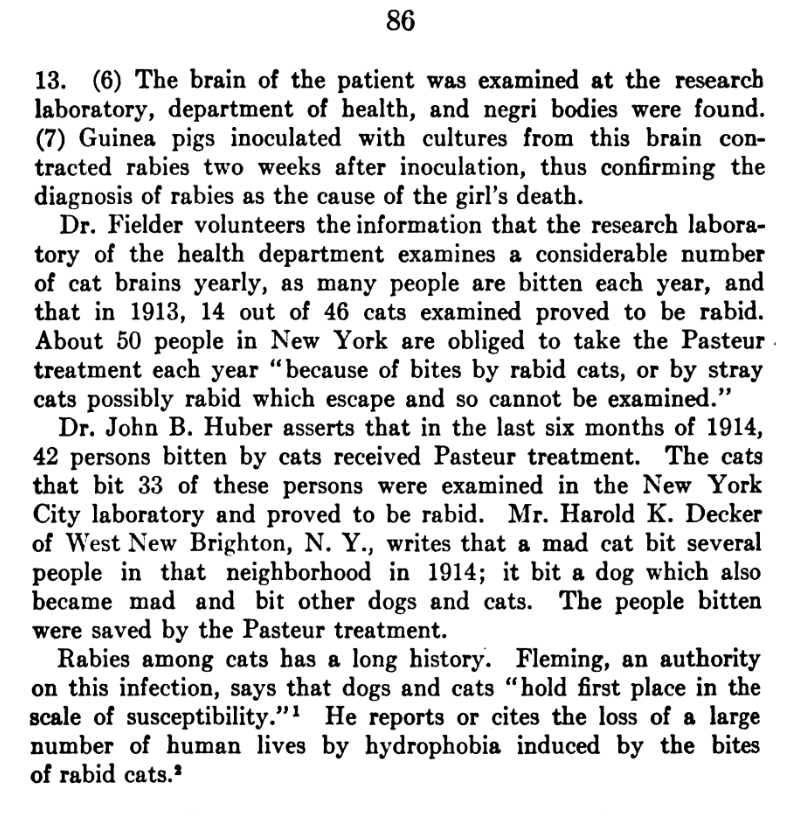
We move through septicemia;
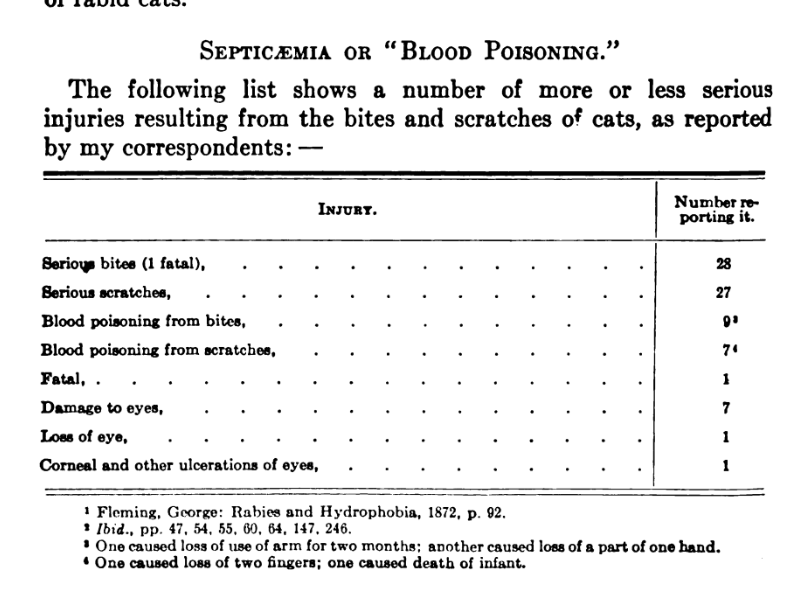
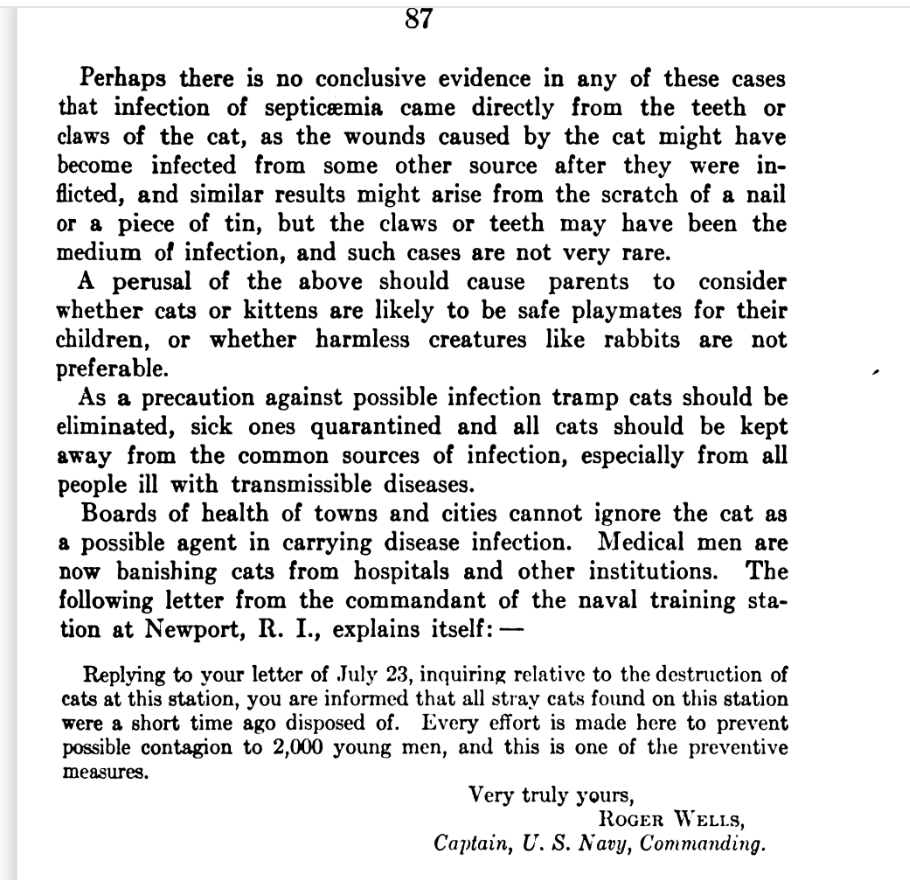
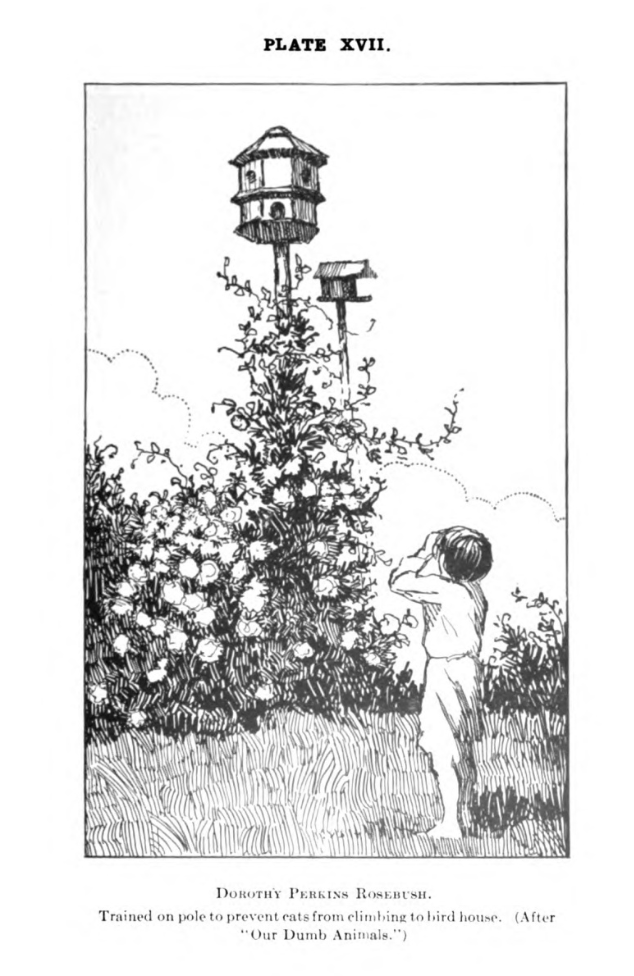
And arrive, finally, at the section about control. The section begins benignly enough, with the recommendations of fencing around chickens and gardens, and the planting of thorny climbing plants around the poles of birdhouses. There’s even an illustration from “Our Dumb Animals,” the monthly newsletter from the Massachusetts Society for the Prevention of Cruelty to Animals.
As we move on, though, it escalates quickly, with a table that illustrates the surveyed “most effective means of control.”
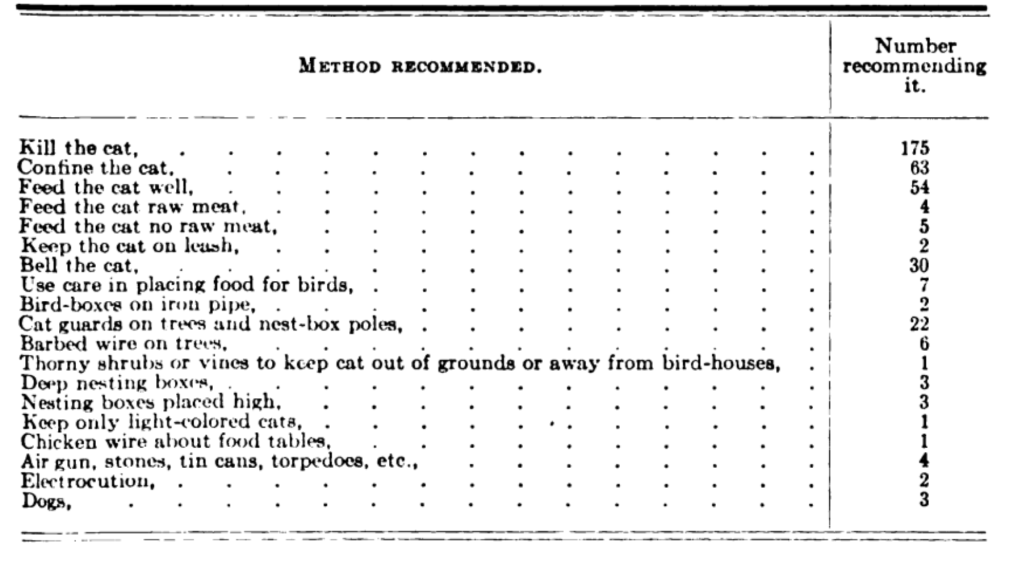
Next week, in our last post on this booklet, we’ll look specifically at some of these recommended methodologies, their implementation, and also at the crux of the whole booklet; recommended legislation. I hope you’re enjoying this early propaganda…I mean…booklet…as much as I have been. If you’d like to read it in it’s entirety, you can find it here.
-Audrey


One response to “The Domestic Cat: Bird Killer, Mouser and Destroyer of Wildlife – Part 3”
[…] and you can check it out in it’s entirety here. You can also find part 1, part 2, and part 3 of the blog at the respective links included […]
LikeLike