
Good morning from the Albany airport, where I’m waiting to catch a flight to Charlotte, so that I can drive to a shelter in Virginia and advocate to undo some of the systemic, harmful bullshit we, as an industry, have set up for animals and for ourselves. Unfortunately, I am feeling tired, I’m sort of in a bad mood, I’m sad, and, to be honest, pretty sick of the fight; of human nature, and the way we love to keep doing the same things we’ve always done instead of evolving. I’ve been in the animal services field long enough to know we all go there sometimes, and today is just my day. Send me a picture of your dog (or any dog) or something. I could use some motivation.
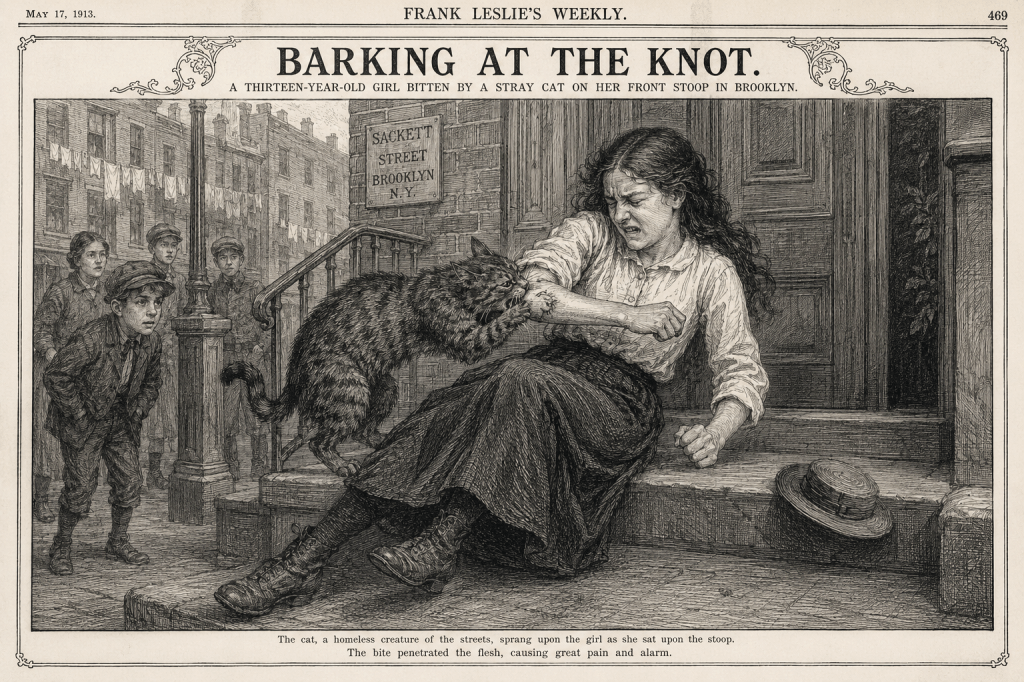
Anyway – To cheer myself up while waiting at the gate, I did what all good and normal people do and took myself down a rabies rabbithole. If you’ve been following the past couple of posts, you know I’ve been unpacking a 1916 booklet written by Edward Howe Forbush, founder of the Massachusetts Audubon Society and published by the Massachusetts Department of Agriculture. The booklet is called “The Domestic Cat: Bird Killer, Mouser and Destroyer of Wildlife.” In short, it’s basically propaganda put out by the early Audubon society about how cats are bloodthirsty dangerous, disease carrying problems that need to be destroyed.
Within this booklet, the author briefly references a case of a young girl named Grace Polhemus, aged 13, who died after being bitten by a stray cat, and uses her case as example that all cats should be rounded up and killed. Having never heard of Miss Polhemus before, I noted the name. Let’s look at what happened.
Our first mention of Miss Polhemus is in the October 18, 1913 edition of The Brooklyn Eagle.
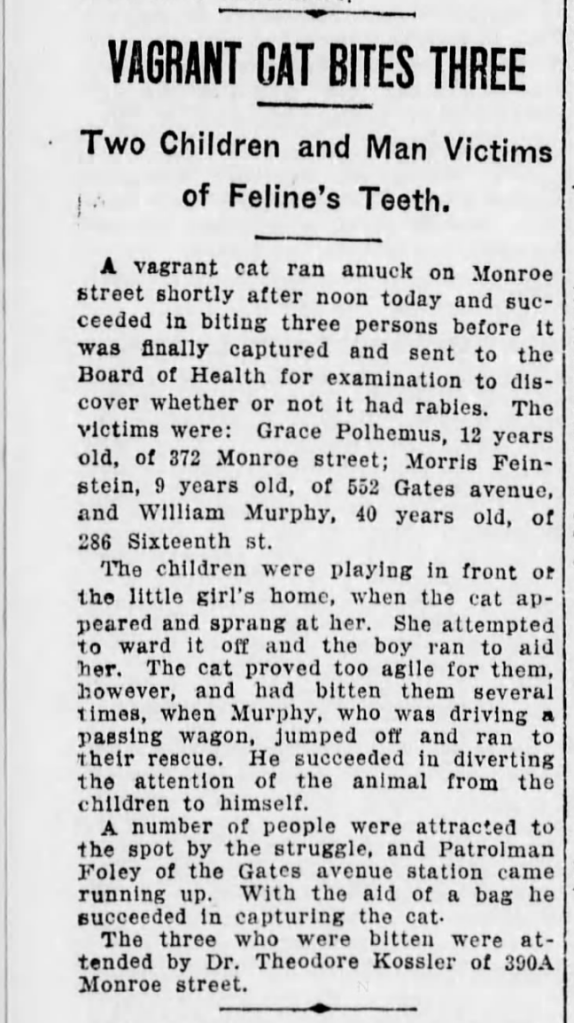
Straightforward enough; a child is attacked by a stray and is bitten and treated. And then a year later, this case explodes across the media like baby Jessica in the well, when Grace, despite her completion of the Pastuer treatment, suddenly develops “rabies.”

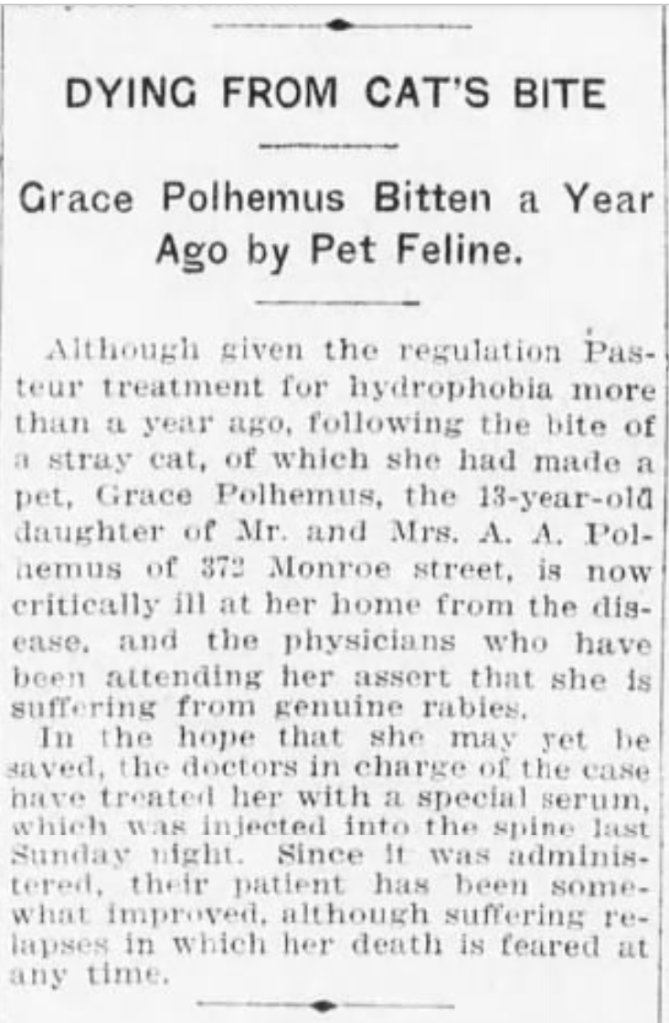
Now, the first and most obvious question here is did Grace actually have hydrophobia? Or was this something else? Grace apparently took the Pastuer treatment, presumably at the center in Manhattan.
We know that the cat was captured immediately following the attack, because the article states a patrolman put the cat in a bag. Forbush, in his booklet, states the cat was tested for Negri bodies, the definitive circular clumps that are seen in the brain tissue of positive cases. He also states that a guinea pig inoculated with the brain tissue of the cat also turned rabid. (Yes, that really was how rabies was confirmed. Go get some water.)
The article above says the cat was held for three days and then died, and was found to be mad. So, sure, let’s assume the cat was rabid.
We know that in this time period, new brands of rabies vaccines were just starting to be developed, following the install of a few Pastuer centers in the United States. Not all vaccines were created equal. There were different kind ways to attenuate the virus and different ways the vaccine was created. In fact, in the 1942 book “Rabies” by Leslie Tillotson Webster, this is unpacked in depth and listed as the single major problem discovered in studies of the efficacy of the vaccine, and the reason that the vaccine was initially disregarded as a preventative measure in dogs. Certain vaccines were simply unreliable.
At this time, all vaccines given post-bite were given in the same way; Two weeks of shots to invoke an immune response that, hypothetically, prevents further development of the disease. When someone is infected with rabies, it travels slowly along the nerves of the body, until it reaches the brain and symptoms become present. It can have a very long incubation period. But a year and twenty days – well – that seems excessive. Still, I wouldn’t call it impossible based on what I have read. I’d love for a medical professional to weigh in here.
So, Grace’s initial symptoms are a fever and slight difficulty swallowing. The same doctor that cauterized the wound, her neighbor, Dr. Vosseler, is called to treat her at home and diagnoses her rapidly with hydrophobia. Her diagnosis is further confirmed by three additional doctors of various credential. Her symptoms rapidly escalate after a sample of spinal fluid is taken. She develops convulsions. Then, she is treated with, get this, an injection in the spine of urea and quinine in the spinal cavity. Soon afterwards she became paralyzed from the waist down (no kidding) and went blind. She’s placed on a pulmotor (which is an early mechanical ventilator) and soon afterwards, she dies.
For myself, while I think it’s possible Grace maybe did indeed develop rabies, I think it’s equally possible that perhaps she will killed through the negligent medicine of the very doctors who were trying to save her; something that was all too common in this time period. Still, Grace’s case became an example referenced by folks like Forbush, calling for the elimination of stray cats. Below, among the news we already know, is a plea from Grace’s father begging for the enforcement of muzzle and leash ordinances and also for the removal of stray cats.

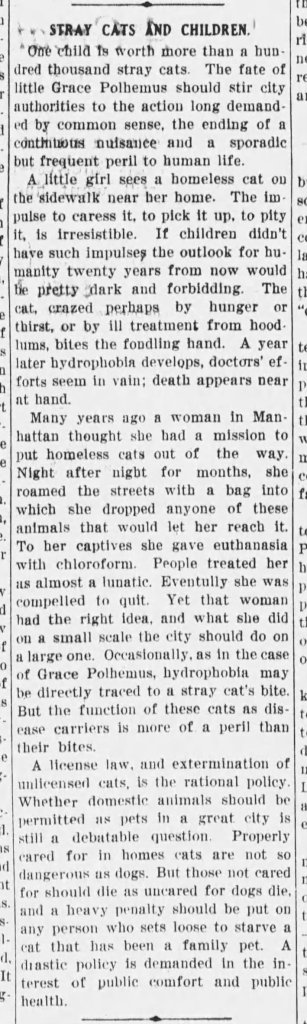
The above is a letter to the editor that is calling for reinforcement of removal of every stray cat. Note the reference to Sarah Edwards and the Midnight Band of Mercy, which is a dark tale if there ever was one.
It’s interesting to me to see the conjunction of newspaper hydrophobia, the publications of the Audubon society, which were fueled by their society connections, the development of modern medicine and our lack of understanding of disease all working in tandem here to villianize the common stray cat. Truly, it was things like this that led, ultimately, to the big mess were in and the reason I’m about to go to Virginia today. My flight is boarding and I’m considerably cheered from this endeavor, so I’ll leave you here. Don’t get bit by any strays.
-Audrey

