Good evening from North Carolina. I have had the pleasure of attending Carolinas Unite this week, which, for those who do not work in the animal services industry, is a learning conference held for the benefit of those working in animal services in North and South Carolina.
I left knowing more about myself (apparently I’m an enneagram 5) and with a refresh into the hearts, minds and struggles of those working in shelters every day (which I no longer do, and miss greatly.) The sessions were great; plenty of wonderful speakers, motivation, and new ideas. One thing about them stood out to me specifically, though; It was how many of them were centered in some way on transparency. Transparency about acknowledging the hard things we see every day. Transparency with each other when we are managing those things. Transparency with our communities about what is happening inside our doors. Transparency about what’s happening outside them. Transparency in our operations. Transparency in our story telling. Transparency in sharing our data. And, primarily, transparency around our needs.
What is it exactly about working in animal services that makes us feel we need to shirk away from being transparent so much so that we had a conference that essentially held the concept as a minor theme?
Obviously it’s a layered answer, right? It’s my experience that humans in general are not very good communicators. We have to practice a lot, and we still often do not get it right. And, transparency is, of course, harder when the topic is hard to talk about. Animal welfare is often hard to talk about; hard to put into words, hard to explain to a layperson. Harder still to express what we are feeling to each other.
That all being said and acknowledged, there are many historical reasons for our lack of transparency and they do greatly influence our animal services culture. I’d like to unpack that a little bit today.
To begin with, lets go back to that period of time when we first began the business of taking stray dogs off the streets. Essentially, that process was a result of the provision of a requested public service. People in the 1800s did not want stray dogs on their streets for a variety of reasons. The main reason was because of rabies, but also because some stray dogs scared horses, some stray dogs bit and chased people, and stray dogs were seen as dirty and unkempt, unreflective of the better society we were hopeful to achieve in the Victorian era. As a result of these things, society themselves pressured municipalities to come up with a solution to remove them, and that solution was dog catching.
It’s best to point out that there was not some committee someplace who talked about the best and most humane way to enact dog catching, either. The first iterations of dog catching were more like dog clubbing; problem dogs were just killed where they were and in front of anyone who happened to be there. Next came bounties; bring in a stray to the pound and get a quarter. Those dogs were killed publicly too; in New York City they were famously drowned in the east river. But when that process resulted in stolen pets and the corruption of the children we were paying to steal them, people quickly became very upset and they demanded much better.
We transitioned then to “professionalization” of the industry in tandem with the evolving humane movement. Professionalizing the industry meant that often times, humane societies took over the practice of killing the animals as they took over or opened the shelters themselves, and they leaned heavily on the concept of removing the death of the animals from the public eye. Removing the visible brutality was part of what the community was asking for at the time…which makes sense. It’s about this time we see in the papers shelter tours that include descriptions of gas chambers and electric cages intended to kill animals talked about for how painless and effective they are. Not only did the killing get removed from being visible…it was also promoted as being merciful and kind. Again, there were not a ton of solutions available in this time period, so make of this what you will.
I want to talk for a second about two concepts. The first is the concept of path dependency. Path dependency is the idea that humans will continue doing the same thing over and over again indefinitely, no matter if the circumstances have changed and the thing they are doing no longer serves the need that they have.
The second concept is that of moral drift. Moral drift is the idea that humans allow path dependency until the thing they are doing becomes misaligned with their morals. At that point the masses will and demand change and path dependency will break. And we know, due to social influence, the morals of society evolve over time.
So, provision of humane death that was accepted, widely, as a tremendous measure of success. No longer would the animals suffer by drowning and clubbing. No longer would the public be corrupted by witnessing that death in the streets. The pets would be painlessly killed by people whose job it was to make sure animals did not suffer. And, originally, because this was considered a success, we very proudly talked about the number of animals that were killed. It was reported as “animals destroyed” in almost every newspaper around the country every week, often written into the ordinances of the towns that the reporting of this number itself was mandatory.
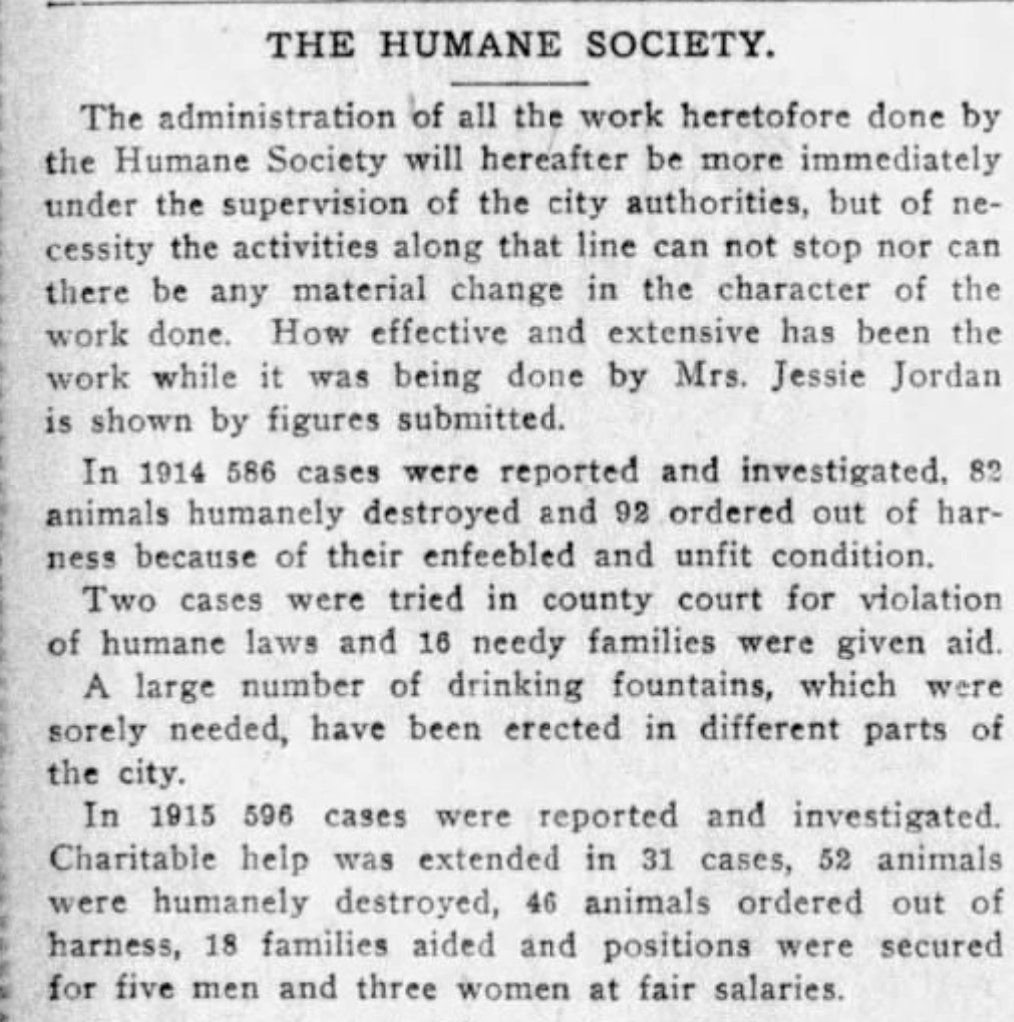
The language that was used to publicly report this metric has changed and changed again. First, around 1850, we saw “animals destroyed.” Then, a little later, in the 1890s, “Animals humanely destroyed.” Then again, a little later in the 1900s “Animals humanely destroyed due to lack of homes” or “Animals humanely destroyed due to necessity.” And so on, and so forth. By the time we got to about 1925, that statistic was generally not reported publicly at all. I chalk this up to the fact that we had grown much more humane as a society in general thanks to the success of the humane movement itself, and that following the first world war, we wished very badly to be absent from death.
And so…we just stopped talking about killing animals in shelters to the public. Completely. From about 1925 to about 1965 you really don’t see much of anything about animals being destroyed unless you really go digging into annual reports. It’s no longer something that makes the papers. We all knew it was happening, but societally, it was accepted as humane and a necessity. And if you look at images of animal shelters from the forties and fifties, the concept of humane death is missing completely. You see friendly images of friendly animal control officers in shiny uniforms; it was the way of society in general at that time. Everything is fine.
It wasn’t until real solutions to killing animals began to make themselves known in the 80s and early 90s that death in shelters started to show up again as a topic of conversation and controversy. This is where both the no birth movement and the no kill movement rise, almost in tandem.
With every progression in vaccines, in spay and neuter, in better buildings, in veterinary care, and in technology, it started to become more and more possible for animals to get out of shelters alive. But that was not our first instinct, even if it was obviously the right thing. And this was all further complicated by the fact that to achieve moral drift, the thing that is conflicting with the morals of society must be visible to the public enough for them to demand a change. But now, the industry had sole control over what people saw and knew, and we were definitely not showing them everything. For years, removing the killing from the public eye had been the right thing to do. It was, in fact, our job to humanely destroy animals and to hide that fact from the public eye.
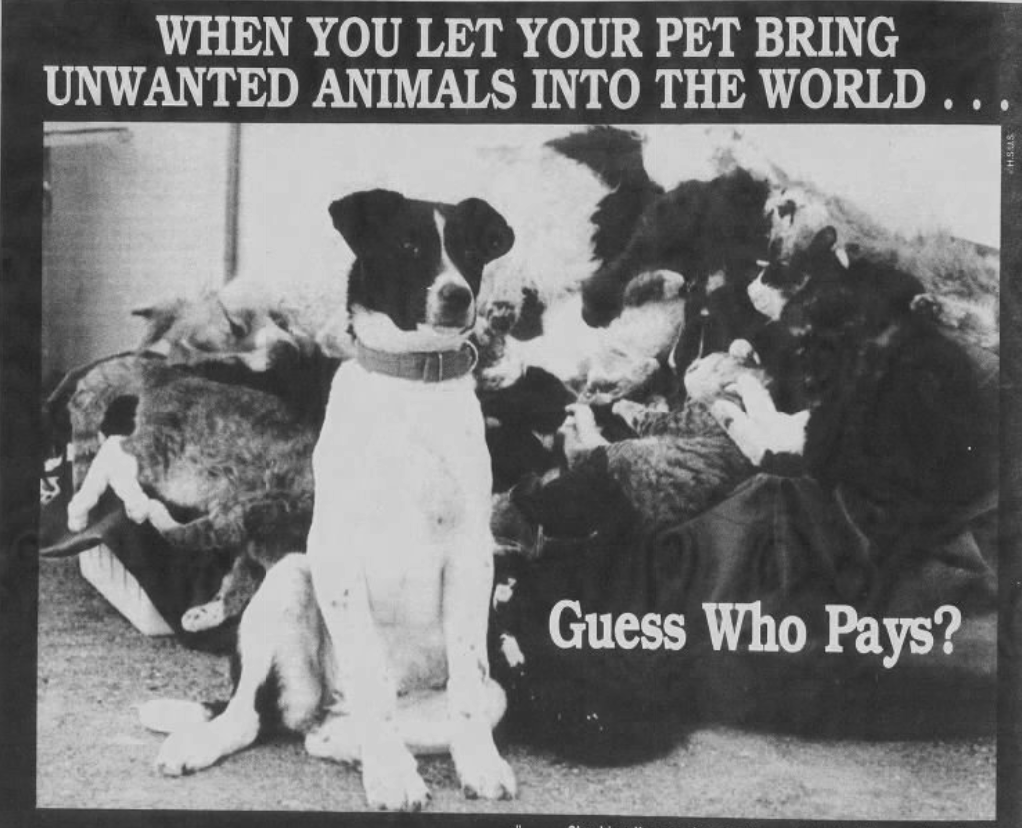
Still, the spay and neuter movement was centered on public facing advocacy demanding people fix their pets and letting people know, loudly, that if they did not fix their pets, other pets would die as a result. Advertisements of barrels of dead kittens and shock language quickly became normalized. Shelter death was back in the chat.
Alongside this, the no kill movement took a different direction; one of accountability, focusing on the intrinsic value of animals and advocating for everything possible to be done to get them out of shelters alive. No kill was then and is now a movement about awareness, making visible what had been hidden because it no longer had to be that way any longer. People want pets to live, and no kill is simply the translator between what is happening in the shelter and what the public wants.
Suddenly and abruptly, a confused and previously uninformed general public was receiving new, necessary, but difficult and, in a lot of ways, highly filtered information. They didn’t know what to believe, but they knew, very rightfully, they didn’t like the animals being killed. And throughout all of this, animal services workers were still going to work every day and still having to face the reality of killing animals.
Look, advocacy is not usually very pretty. And the reality is that the amount of killing in shelters was swept under the rug intentionally by our industry in a time when that made sense for reasons that no longer exist. When another way began to be possible, things did not change overnight. Unfortunately those animal services people who were tasked with doing the killing as part of their job, also while very often trying to save as many animals as they could, sometimes began to be mistreated personally for doing something that had been culturally accepted for more than 1o0 years. Which, unsurprisingly, didn’t lead to their wishing to highlight the needs that they had to prevent the animals from dying. It led to their protecting themselves. And that has been the battle we have been fighting for a long time.
Which brings us to today. In short, my friends, there was a tremendous mess and we’re slowly cleaning it up.
In my humble opinion, though, we’re in a very different place now and this is where path dependency is showing up. We know the answers to how to save the majority of animals that enter our care, and our challenge is very different. We just don’t yet have all the resources in all the places to enact every solution. And yet, a lot of the time we just keep doing the same thing we’ve always done, and we don’t talk about what it is we need to do something different.
In closing, please be brave. The resource that you need to save the life and the reason why that thing is needed is the thing you need to be transparent about, even when it means showing what is behind the curtain. Even when what is behind the curtain is not very nice. And yeah, I get it, you might have been told not to do that because it was your job. That logic goes back 100 years. And someone is going to take it the wrong way and make an asshole post about whatever it is on social media. Sometimes about you personally. That sucks. But not as much as not moving forward.
That necessary resource could be an ordinance change that allows for TNVR. It could be equipment, or supplies, or medical care, or education, a foster program, or fosters, or volunteers, or visibility, or money, or knowledge. Or, very commonly, adequate staffing or a leader committed to change.
Show the data. Ask for the ordinance change. Make the thing visible and point at it. The gap is the issue. Not the person in the euthanasia room. In fact, that person is the person who needs transparency the most. And the public can’t help you demand that change without knowing about the need for it.
-Audrey
 Barking at the Knot