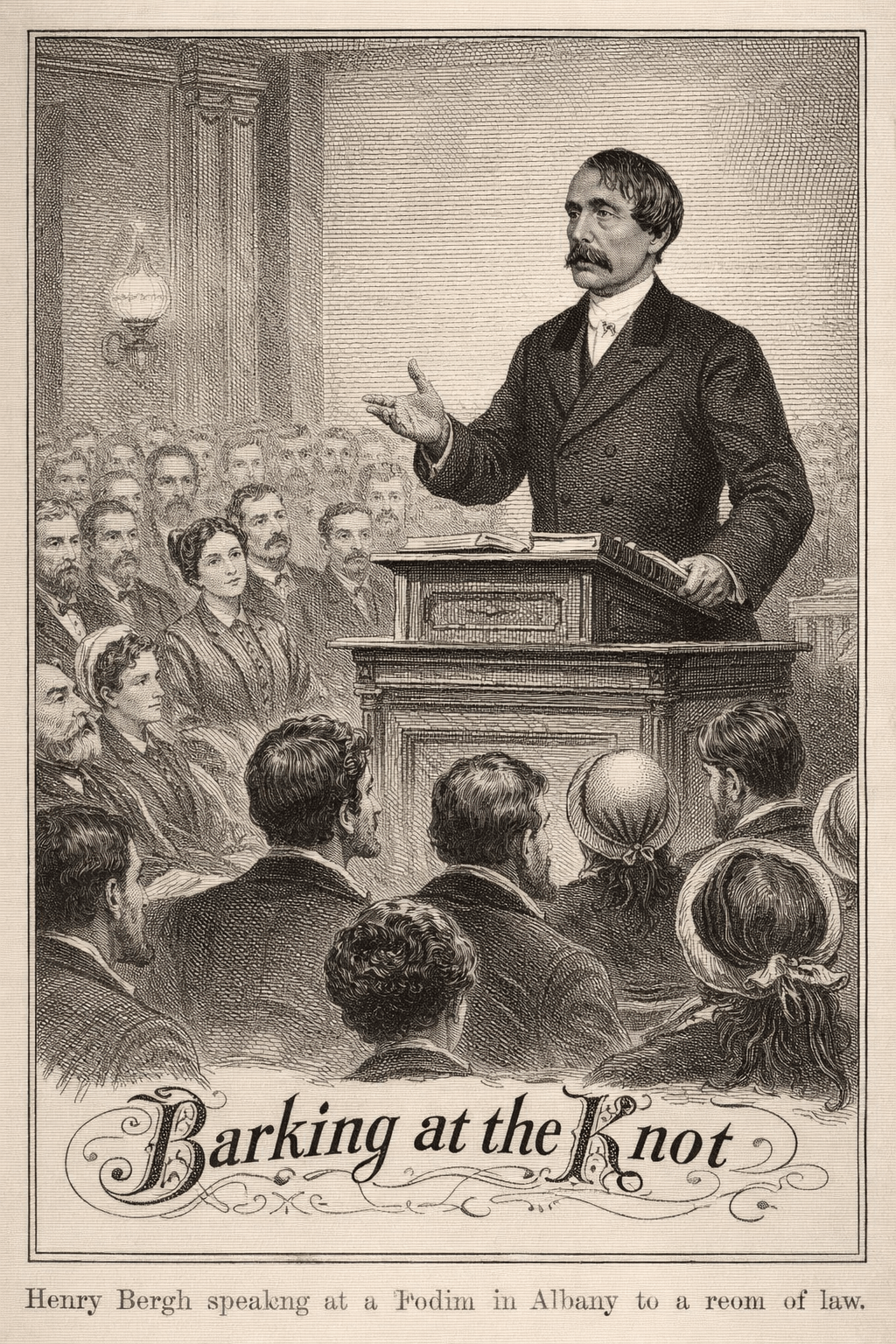
Hello Friends. I’m excited to relay that I’ll soon have the excellent benefit of giving a talk in Anchorage, Alaska at a conference. In subject, I’ll be looking at some very early animal laws and comparing their evolution over time. In my research, I was looking for specifics around the presentation of the second iteration of Henry Bergh’s cruelty laws in New York. Any regular reader of this periodical will know that the original anti-cruelty law was published in April of 1866 with the intention of amending an earlier 1827 act.
The 1827 New York act was as follows:
“Every person who [part one] shall maliciously kill, maim or wound any horse, ox or other cattle, or any sheep, belonging to another, or [part two] shall maliciously and cruelly beat or torture any such animals, whether belonging to himself or another, shall upon conviction, be adjudged guilty of a misdemeanor.”
This law provided only for harming animals of value belonging to another individual; what you did at home to your own stock remained your business. They were, after all, your property to damage as you would.
It was this law that was originally amended by Bergh, and that was brought forth in companion with the original charter of the American Society for the Prevention of Cruelty to Animals in 1866. The formation of this organization also gave the means to enforce it. That right too was codified alongside the amended cruelty law itself. There are a few things notable. One, it still only mentioned animals of value as property. Secondly, it included, for the first time, the language ” himself or another” meaning – what happened in your back yard was not only your business any longer. It’s this sentence that was the pivotal sentence in the movement; although animals were your property, you could no longer maliciously harm them.
Here’s the original amended 1866 law:
“Every person who shall, by his act or neglect, maliciously kill, maim, wound, injure, torture, or cruelly beat any horse, mule, ox, cattle, sheep, or other animal, belonging to himself or another, shall, upon conviction, be adjudged guilty of a misdemeanor.”
And here’s the enforcement piece. The ASPCA was chartered to:
“…provide effective means for the prevention of cruelty to animals throughout the United States, to enforce all laws which are now or may hereafter be enacted for the protection of animals and to secure, by lawful means, the arrest and conviction of all persons violating such laws.”
Soon, though the deficits of the new laws became clear; a new act was written. The second act sought to make a number of changes; it including provision of food and water, made it illegal to torture or overdrive an animal; it outlawed animal fighting, and made abandonment of “sick or maimed” animals illegal. It also required, for some reason, the registration of any dog who pulled a cart? I am not sure about that one. I think maybe that was some politics…
Most notably, though, was the addition of the language “or any living creature.” The law applied to all living beings.
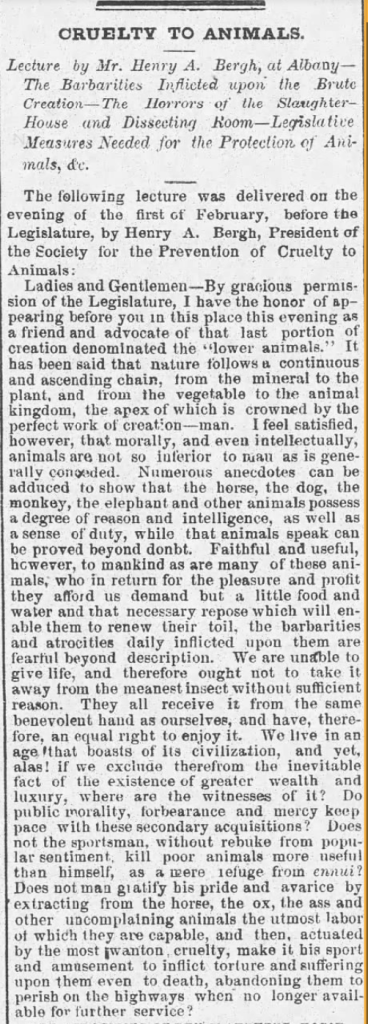
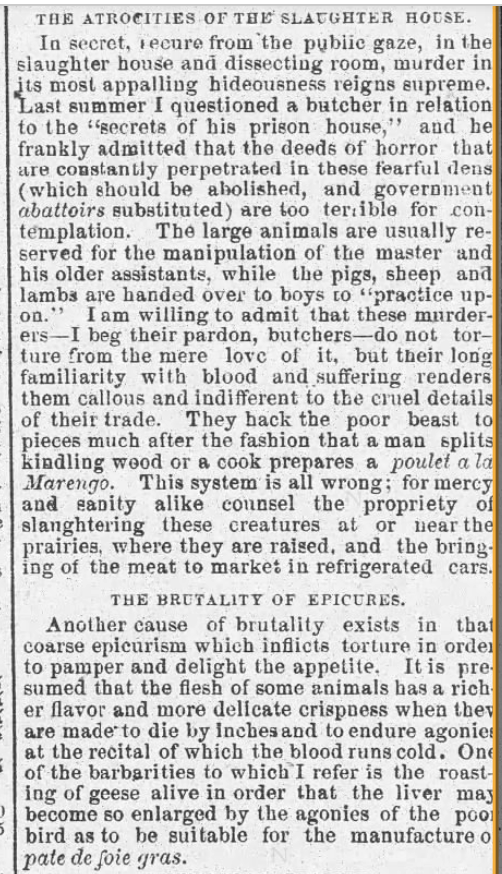
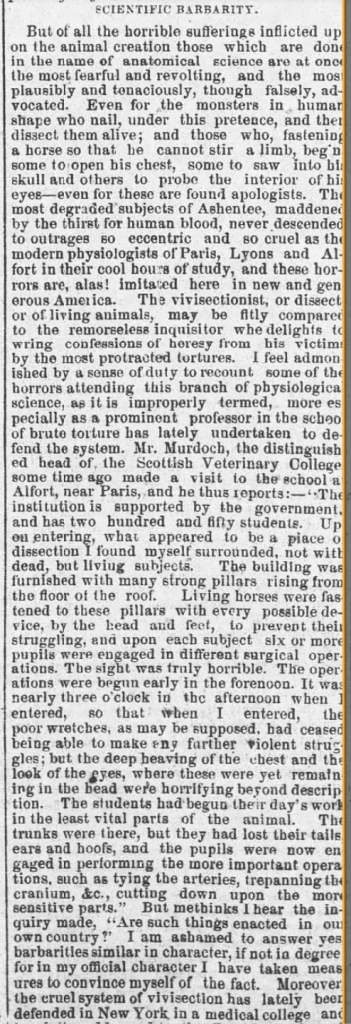
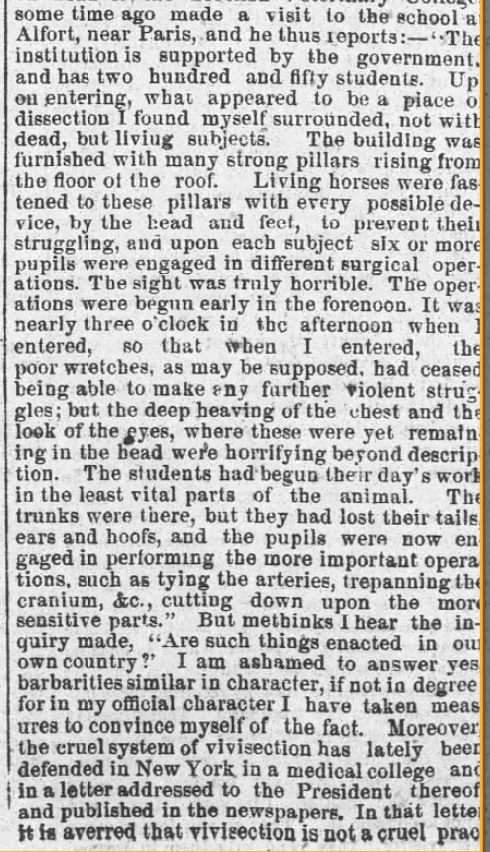
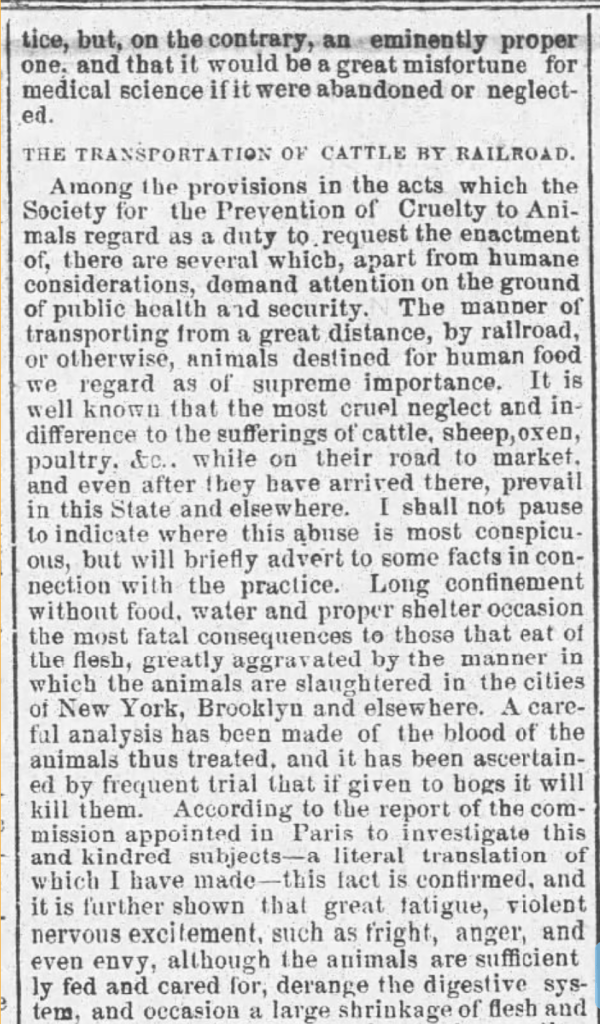
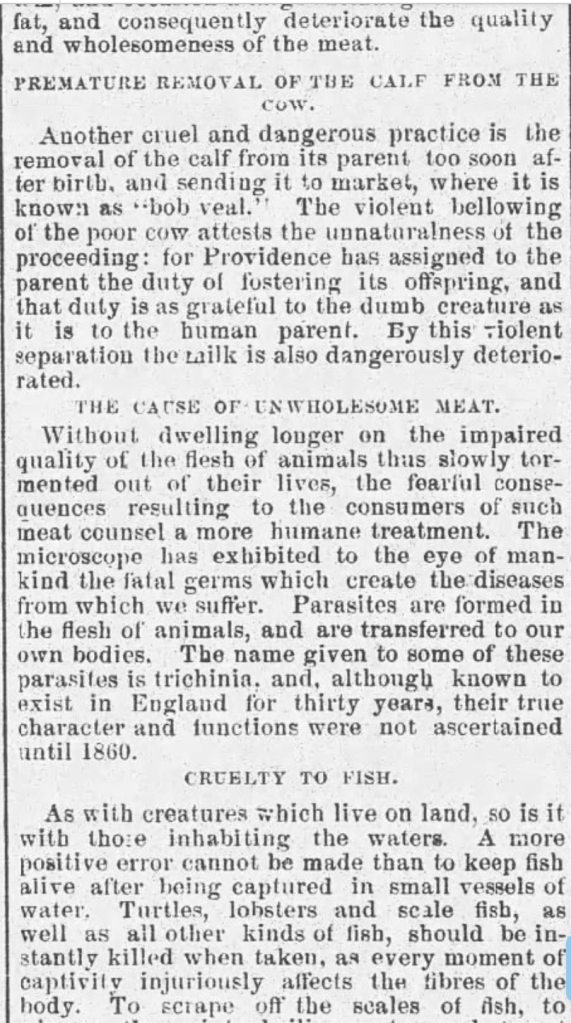
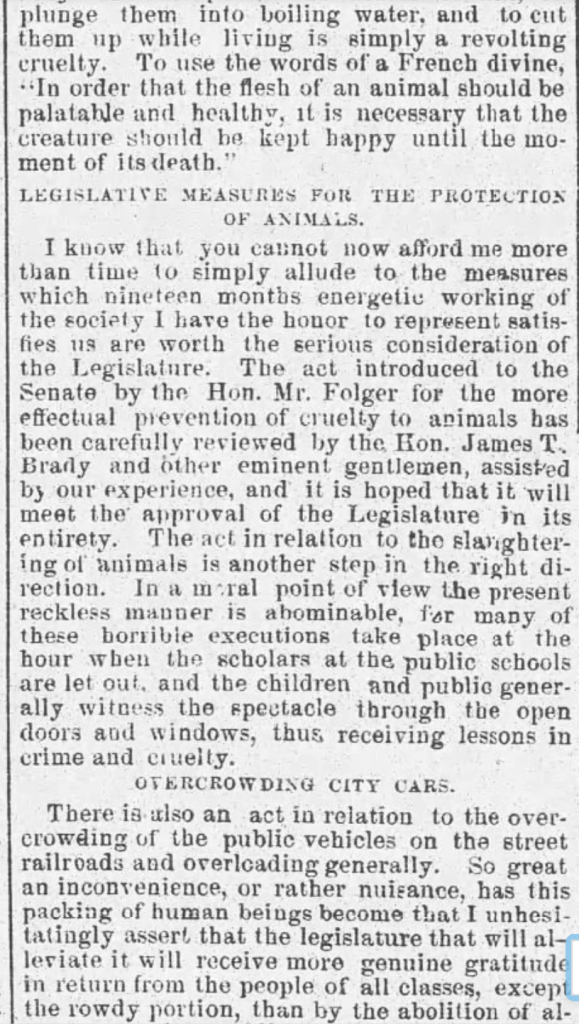
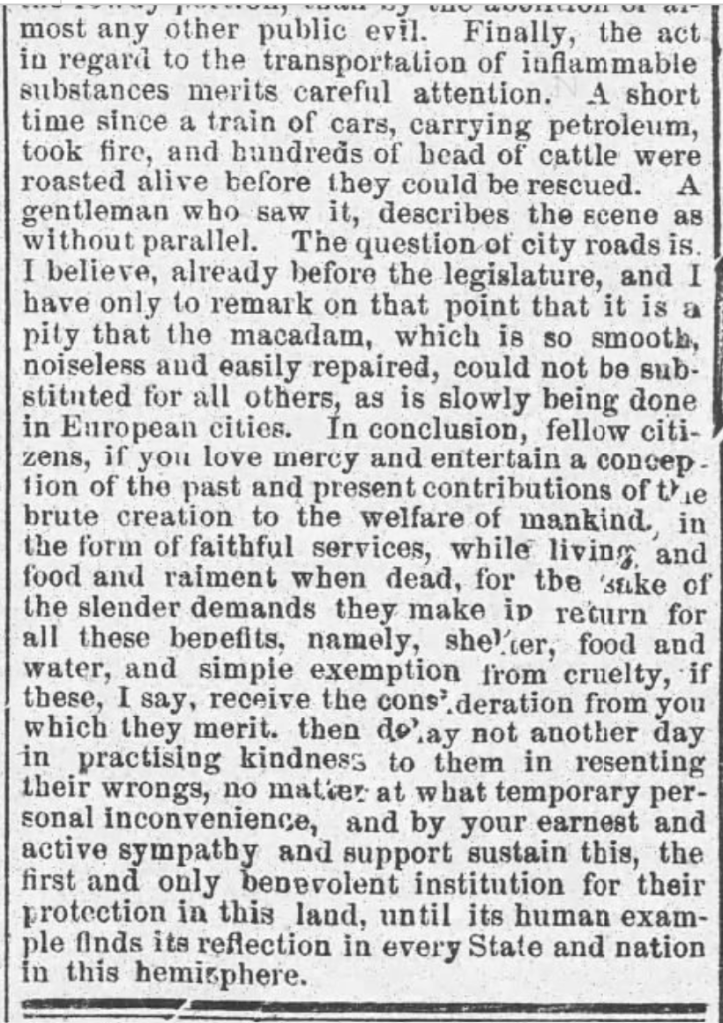
It was this amended version of the law that Bergh was advocating for on Friday, the first of February, in 1867. Below, you’ll find his lecture in it’s entirety. I’d not seen it before this morning and truthfully, I could not wait to post it here.
Of note: You’ll notice plainly in this article that it does not mention companion animals. It’s a fine example of the early narrative of the humane movement, which did not regularly consider the sheltering and care of dogs and cats as part of it’s primary work until much, much later on. In addition, the introduction is reflective of that bible verse the movement repeatedly pointed back to; God has given us dominion over brute creation.
And to close, please consider yourself warned; I have said before that Bergh was quite a shock and horror personality. This article is illustrative of that; it’s content is intended to paint a picture of the horrors animals were suffering at this time, and it certainly does do this. It is not pleasant to read. Still, this is one of the most complete representations we have of his character.
Your thoughts are welcome. Until next week.
-Audrey