
Good day, and happy New Year! I hope you all have had a wonderful holiday season. I myself am recovering from some sort of Christmas plague, probably brought on by too many pre-holiday work trips and too much unwholesome but delicious holiday food. In any case, I hope you’re feeling better than I am. I look (and sound) like I have tuberculosis, and not in that Victorian “ethereal beauty standard” kind of way.
In any case, this time of year, many newly acquired holiday cats and dogs are settling into family life. It makes me very happy to think of all the former shelter pets snuggling with their new people, enjoying the finale of Stranger Things on a soft blanket with a new stuffy, confusing their new owners with their behaviors as they try and get used to a whole new life.
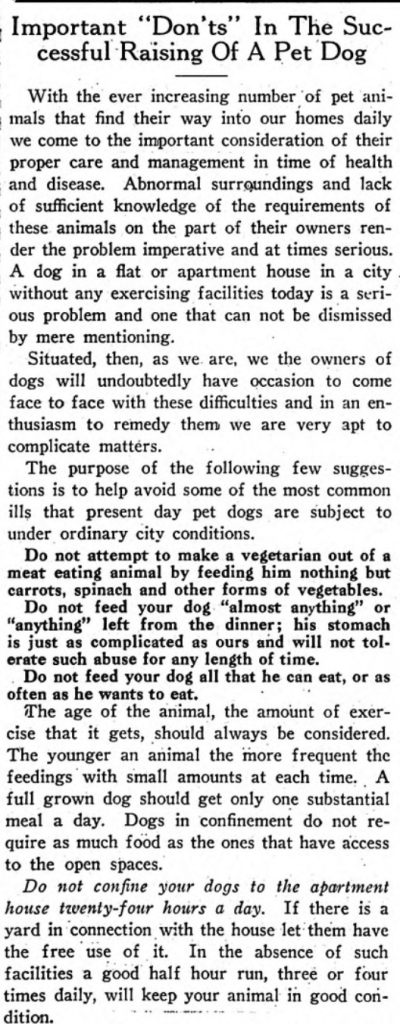
We all know that this time of year we tend to get the most interesting questions from new pet owners, so I thought this week I’d share some advice given to new pet owners in the April, 1928 issue of “Our Animals.” Our Animals was the monthly periodical of the San Francisco SPCA, and cost ten cents to purchase, or a dollar a year to subscribe.
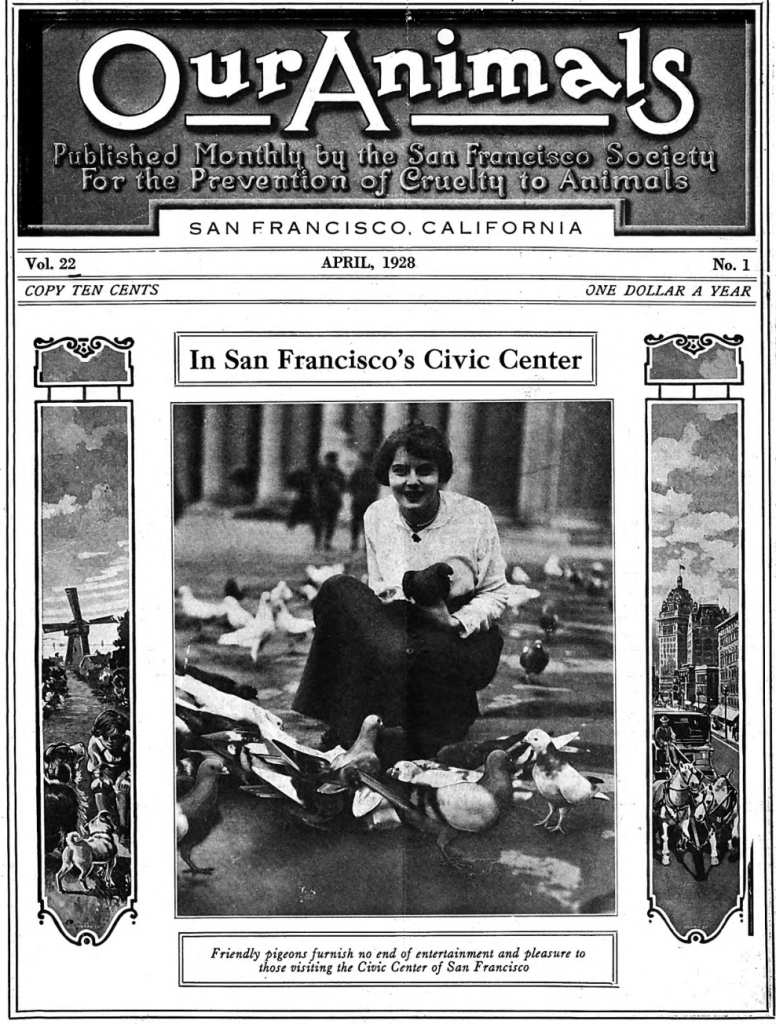
Like other monthly animal welfare magazines of this time period, the articles contain primarily charming stories of individual animals and stories of rescues that the Society had conducted. Notably absent in the 20s and 30s are the monthly stats about the number of animals humanely destroyed, which, in prior decades, would have served as a measure of progress and been dutifully reported. Following the first world war, we see these magazines turn away from all talk of death, and instead, (for the most part, if not always) focus on positive stories. Note this, because it’s a turn toward the lack of transparency around shelter death we see so commonly later.
The monthly “Animal Health” article was written by Dr. G.M. Simmons, the resident Veterinarian of J. Sanborn Doe Memorial Hospital for Animals. While regrettably, I could not find a photo of the good doctor, I did find this ad from his hospital in the back of the magazine.
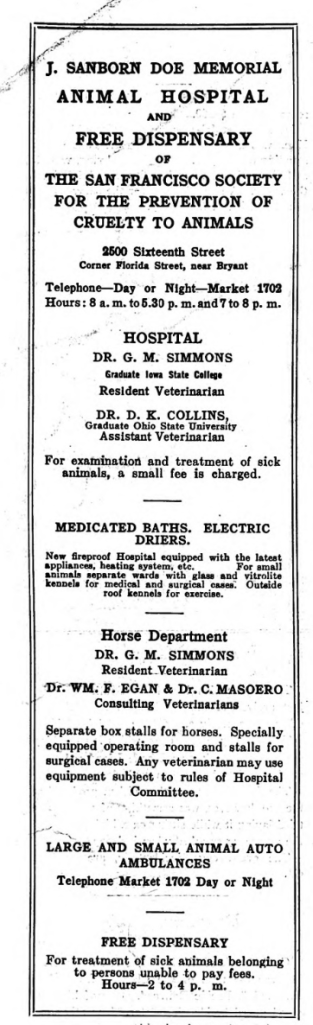
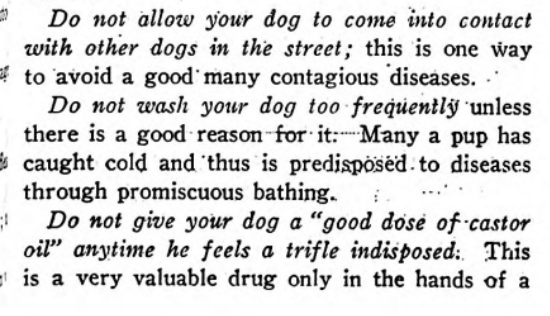
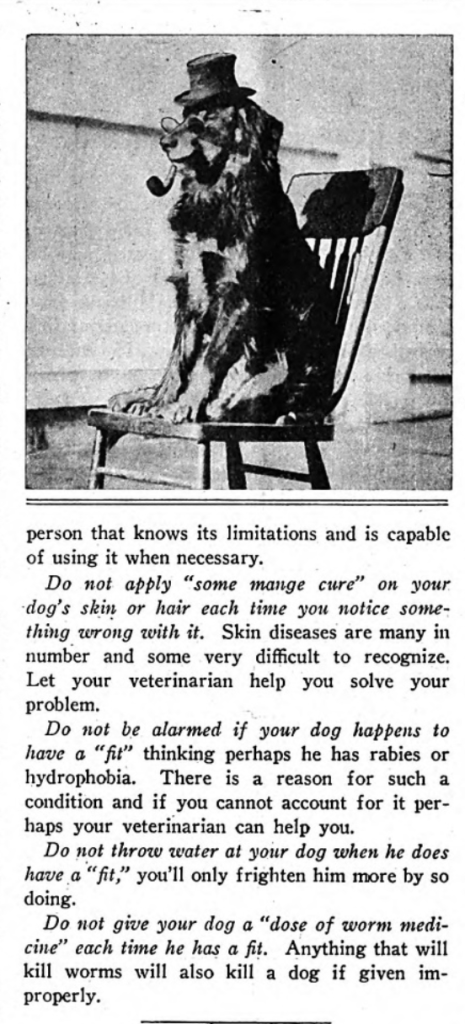
Dr. Simmons provided some solid advice in this month’s article to new pet owners, including not treating illnesses yourself without the assistance of a veterinarian, letting your dog get plenty of exercise, and making sure not to bathe them too often. Many dogs will agree that this latter bit is particularly important.
A gem hidden within the advice and reflecting on the context of the time is the advice about rabies.
“Do not be alarmed if your dog happens to have a fit, thinking perhaps he has rabies or hydrophobia. There is a reason for such a condition, and if you cannot account for it, perhaps your veterinarian can help you.“
California had been relatively rabies-free before a 1909 outbreak in coyotes brought the disease more prevelantly into the dog population. According to this document, called “Status of Rabies in the United States in 1921,” at this time in California, doctors would have had access to the Pasteur treatment by way of the mail and also for free, in the state labs, if one could get there. Still, the most common association for most people during this time is that rabid dogs needed to be immediately disposed of, as hydrophobia was generally considered to still be fatal. Many people, even at this late stage of the treatment implementation, were still wary of vaccines and of the Pasteur treatment. Although at this point in time the cause of rabies had been firmly agreed upon by science, in many locations history and folklore still won out. The short of it was that rabies was still very, very scary and it would not be uncommon for someone to immediately shoot or otherwise kill a suspected rabid dog…so, it’s good advice to ask your veterinarian before doing that.
I do wonder what “having a fit” consisted of….does this mean zoomies? I feel like it must. I’ll have to look into this.
I’ll let you discover the rest of Doctor Simmons’s advice below. I’m going to go have some more tea.
-Audrey