Good morning to you from sunny (and noisy) Foxboro, Massachusetts, where I’m lingering in the breakfast room of a Hilton Home 2 alongside a probable Christian soccer team in advance of a meeting later today.
This week, I want to talk about how the timelines of the Industrial Revolution, the development of the rabies vaccine, and the beginning of the humane movement diverged and led us to a place where the mass round up, impoundment, and killing of street dogs became normal.
A caveat to this piece. To my great surprise, I’ve developed an actual following on this blog and many regular readers are outside of the United States. This piece talks about what happened within the U.S., but I’d encourage anyone working in the movement to protect our companion animals to discover what led to their own systems.
This is an ugly topic, to be sure, but also an interesting one that warrants the time taken to understand it. If you work in an animal shelter, the best question you can ask yourself may be why you’re doing something the way you’re doing it. We have a problem in this movement with historical precedent.
In my (relatively informed) opinion, the primary reason for the historical precedent of bringing dogs to a central location for impoundment was rabies. Without the societal pressure on a young and developing government to prevent the spread of a highly misunderstood disease by culling EVERY SINGLE street dog, we very well may have been left with a society that had a “go along to get along” attitude for street dogs; Don’t bother us, we won’t bother you.
Instead, because of the complicated overlap of the unfolding timeline between industrialization, the advent of the humane movement, and the development of the Pasture treatment, what we ended up with is a broken system where we impound everything in the name of public safety but also have a moral permission to kill adoptable, placeable dogs instead of save them. Alongside that, we have what essentially amounts to a near-total elimination of the original sickness that caused so much fear and trouble to begin with. I’m going to break down some of these factors, but there are dozens more. This isn’t meant to be all encompassing; I’m just looking to give a snapshot.
During the industrial revolution (roughly 1760-1840) we saw large amounts of people moving into urban areas for what amounted to the promise of opportunity. In theory, but not always in practice, these places promised better wages and a potential of social mobility. In addition, a decline in agriculture, advances in transportation and other emerging technology made city living attractive, if crowded. In addition to this, large influxes of immigrants were migrating directly into rapidly forming urban centers.
For our purposes, and what I see so often misunderstood, it’s important to know that these cities were growing extremely rapidly while government itself was still figuring out how it worked. At the jump, there was no dedicated groups of experts sitting around a table trying to figure out the best and most humane way to manage dogs. We couldn’t even figure out sewers and housing, much less compassionate care for strays.
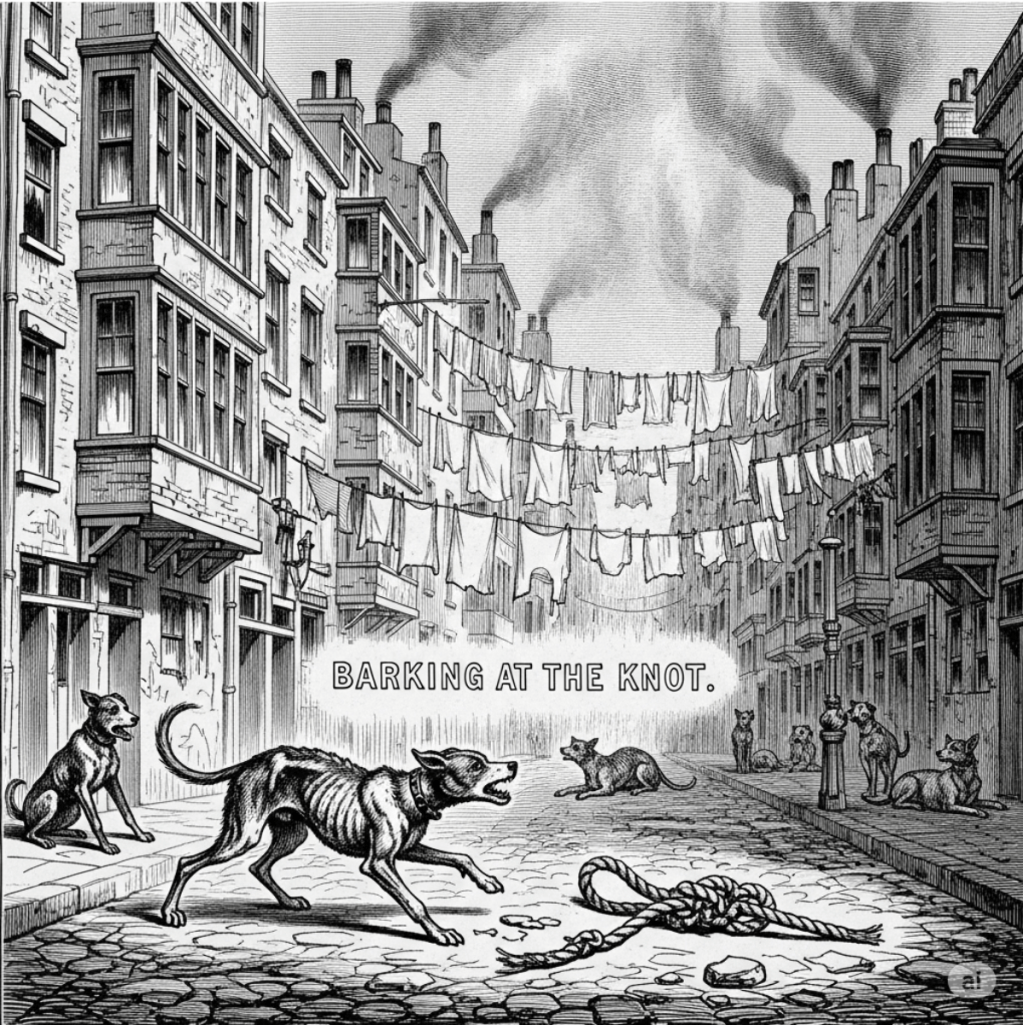
Instead, like most other problematic things like crime, community members excised neighborhood management and took care of things themselves. Much like the original police officers were no more than glorified neighborhood watch, the original ACOs were community members who would dispatch a biting dog themselves. Similarly, compassionate community members would care for those pets in trouble. Strays minding their business were generally left alone. And so it would have went, aside from rabies.
It’s important to understand that during this time period, there was absolutely no cure for rabies. In fact, people weren’t even sure what caused rabies to begin with, because we did not even understand germs. I’ve written about this before, but to reiterate (and greatly simplify) during this time period we were transitioning from the belief that people had fluids in their bodies that could become imbalanced and cause them to be sick to a different theory about miasma – that inhaling bad air could cause internal lesions, leading to illness. Germs were not a thing. At all. We did not have any understanding of microbiology.
Now, overlay this with what was known of rabid dogs. Sometimes, when a dog bit someone, they died a terrible, agonizing, horrific death. But did all dogs have rabies? Was rabies in people the same as rabies in dogs? Did being scared by the dog cause rabies? When you add in that due to the methodology of disease progression, onset can be several months from the bite, rabies was just about the most terrifying thing there was; and that translated to strays.
People were very afraid. There was no cure. It was very reasonable to be scared.
And there were a lot of stray dogs on the streets in these rapidly growing areas. In fact, there were a lot of all kinds of animals; we still kept our livestock alongside our homes during most of this time. They were a part of every day life, and it was normal to see them, but given the increased density in population, dog bites were becoming more common.
Now overlay another factor – tenement housing. Tight, cramped, apartments. Many, many children. And where did those children go during the day? Outside. And what do children like? Dogs. And so, it’s been well documented that the most common victim of dog bites during this time period were children.
Now overlay the new steam powered printing press, which really took hold in the 1850s. While print media had previously been a benefit of the elite, suddenly everyone had access to a daily rag. Victorians LOVED a sensational story, and nothing was more sensational then the bite of a rabid dog. If you’d like a fun time, go to archives of any major city newspaper and type in the word “hydrophobia” for any time between 1850 and 1930. You will find cures, you will find obituaries, you will find letters to the editor. You will find it almost every day. This absolute press onslaught escalated public perception of the danger far beyond what it actually was.
Now, every stray dog becomes a perceived threat. You see how easy it was to get here?
And so cities started providing financial bounties for the impoundment of EVERY stray dog as early as 1811. Stack that with the financial despair of this time period and fifty cents a dog was a boon. Those community members who were dispatching problem dogs began to round up strays for profit, and when that system got overblown and corrupted in the 1860s, it was professionalized.
And here we are.
By the time Henry Bergh, Carolyn Earle White, and George Angell showed up in 1860s and 1870s with our first true anti-cruelty laws, we were far, far beyond the point of impounding dogs to kill them. We were doing it; the path was set. All we could do was make it more humane. So we developed better and kinder methods to kill strays, and we removed it from the public eye so we wouldn’t be societally traumatized.
But we were also well before the development of the Pasture treatment, which could be administered following a dog bite to prevent the development of rabies. The treatment wasn’t discovered until 1885 in Paris, and not available reliably in the US until 1890. Even then, it could be difficult to access for most families. So every dog was still a threat.
And we were at least fifty years from accepting that the treatment even worked, because vaccination itself was founded on germ theory – microbiology. It wouldn’t be until 1913, when Hideyo Noguchi proved beyond a doubt that rabies was cause by a germ, that this would be commonly accepted. And we wouldn’t have the capability to vaccinate dogs until the 1940s. And it wouldn’t be law to do so in all fifty states until the 1970s.
Nor did we have the resources we have now to even begin to live outcome pets. This was a perfect storm of circumstance, and there is so much more I’d like to share, but this post would become a novel and I’ve said what I need to say.
By choosing to work in this field we have a responsibility to understand why we do the things we do. We also have the power to change how it’s done. This may be the first time in history where enough resources are available to us that we really could rewind the clock on our history of mandatory impoundment; However, it hinges on being brave enough to make radically different decisions. No one is suggesting that we let strays take over the streets, and there will always be a public safety component to this work that is very important. But the system is broken, because the problems have changed. It’s time to shift from bringing pets in to a place where we focus on keeping them in homes. History can inform how to move forward, and much like circumstances aligned to cause a system of intake, we now have the resources to become a system of pet retention and responsible ownership.
So knowing this, how does it change what purposes an animal shelter pursues now for the public good?
-Audrey


One response to “An Unfortunate Series of Events (or Why We Impound Every Stray)”
[…] could have live outcomes with the resources available. (If this is new information to you, read this piece […]
LikeLike