
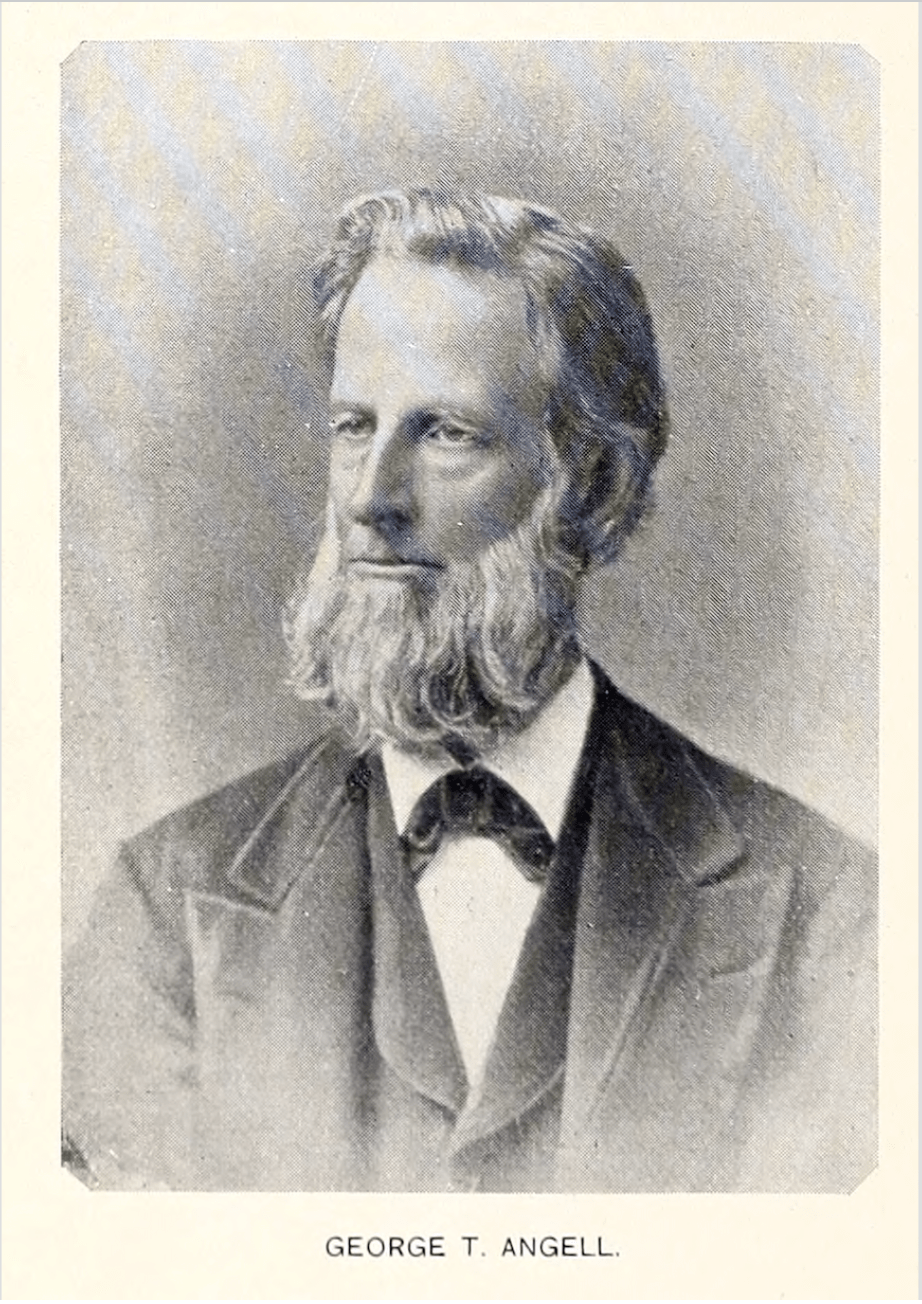
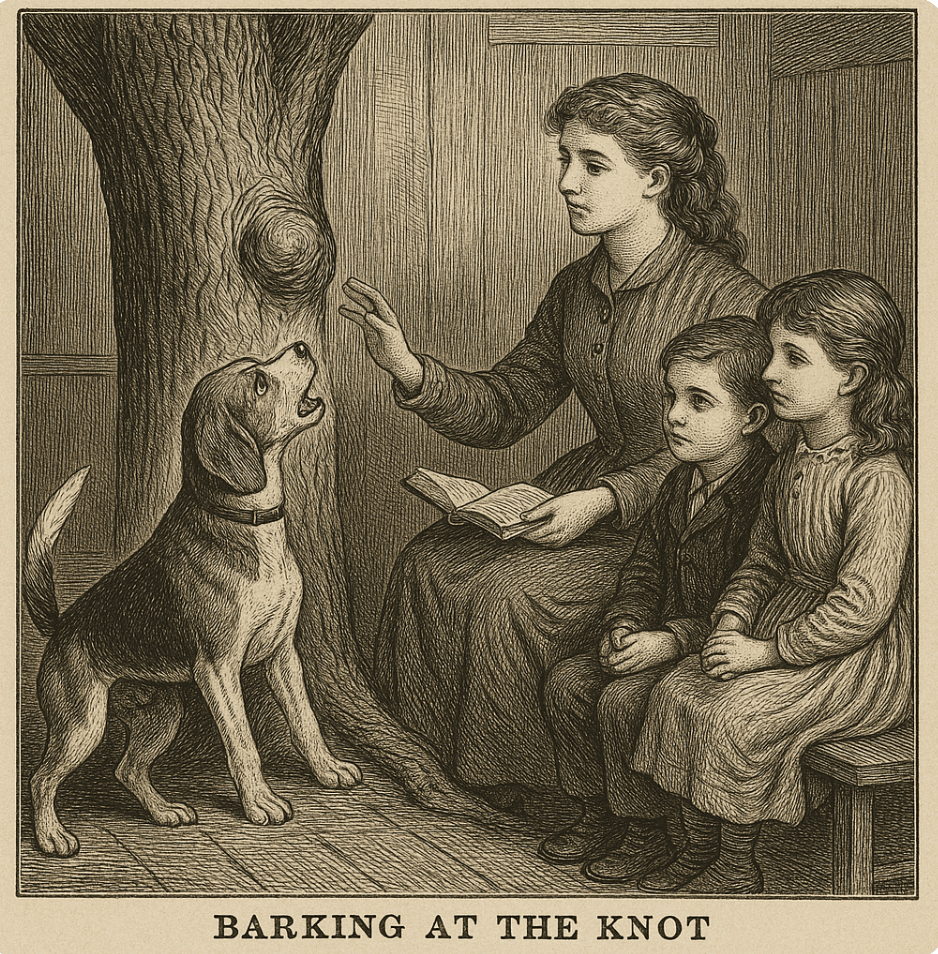
Everyone in animal welfare has a story to tell; We all have something to say about why we are here and the things we have seen. Our experiences within this work shape our beliefs about the movement, and those experiences can be quite intense; There’s not one of us that hasn’t been told we should write a book.
Truly, we all want the same thing. We want empty shelters, pets in good homes, for no pet to suffer in cruelty or for lack of resources. Ultimately, we want to be out of a job. It’s how we think we should get there that differs between us. It turns out, this has been true all along, we just used to be better at recognizing we were in it for a common goal.
(The drama between our “factions” is surely the most exhausting piece of the industry to me and I’m very grateful for those who do not choose to participate in it.)
Like our predecessors, we often see the worst of people, and sadly, the worst of what we see often translates to the ways we do the work. Even if we are aware of it. Even if we take steps to counteract it. Even though we know and believe that most people are good. We are and always will be a movement founded and progressing on influencing society’s moral wrongs and ill beliefs about animals and what it is we feel they deserve.
The crux of it is this: our morals and personal beliefs are a deeply individual thing. Today, our morals and beliefs may shape our own work, perhaps the work of an organization, perhaps a strategic plan or, for a few of us, contribute to the betterment (or not) of the industry as a whole.
However, during the birth of our movement, the morals of a few key individuals shaped the foundations of our entire field. In the next couple of weeks, I want to look at three of our most well documented forbearers: Henry Bergh, Caroline Earle White, and George Thorndike Angell. I’ll examine some of their personal beliefs around how to cause people to treat animals with compassion and we’ll take a look at how those decisions still affect us today.
To understand this concept fully, it helps to understand where we started when these key leaders decided there was a need for change in the first place. Society long had a history of belief that animals were here for our use, and further, could not or did not think or feel pain. There was some religious reasoning for this, in that it was taught that animals did not to have souls. The common teaching is that this was true since they were not created after God’s image.
There are also some scientific considerations. Charles Darwin’s On the Origin of Species had been published in 1859, introducing the concept that we were not so different than our animal companions after all. Here in time we also begin to see widely publicized debates about the ethics of euthanasia for people ad the concept of the provision of a humane death (with hydrophobia widely used as a case example, a story for another day.)
The animal welfare movement also began following an interesting period in history called the Romantic era. While we tend to think of “romantic” as meaning a love defined by intimacy and passion, this era was more about the notion that God’s love applied to all of us, and that we should all try and practice that love with each other and compassion as a character trait. This was a marked change from the “hellfire and brimstone” preaching that proceeded it, and during the Victorian era and it translated directly to the concept of Victorian gentility, and how to be of the highest moral character.
Our movement also was born following the abolishment of slavery, and while it’s critical not to equate the two movements, abolitionist language often influenced animal welfare arguments.
So with these things as a contextual foundation of the time, at the baseline of our movement was the initial question “Do animals deserve consideration and compassion, or do they feel the effects of our cruelty?”
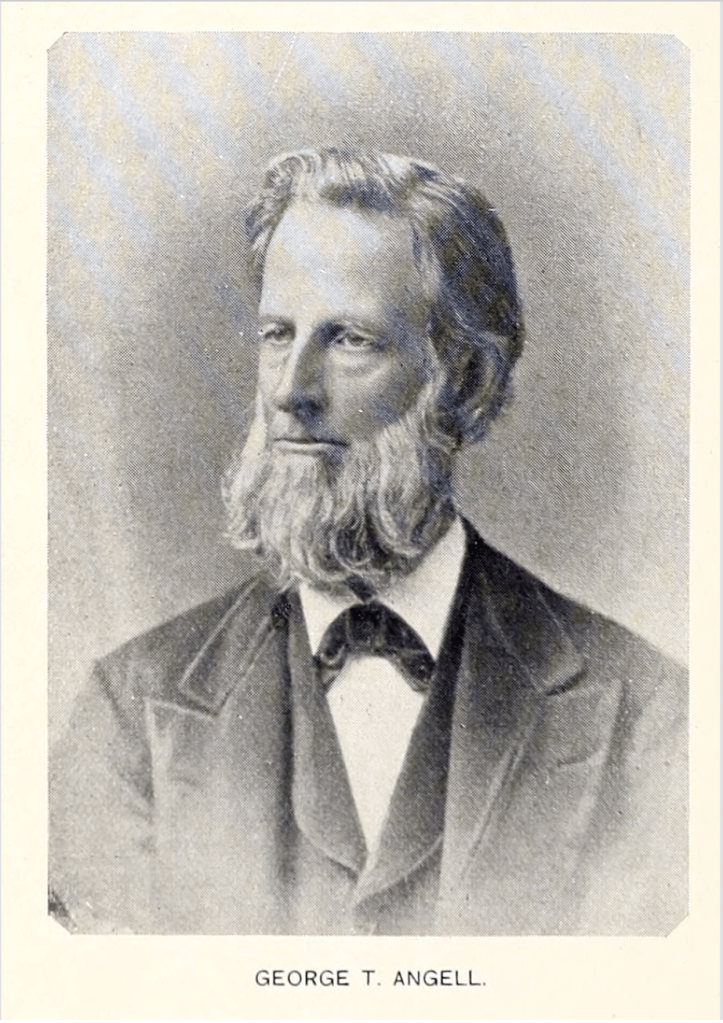
When I look at our predecessors, while I respect Henry Bergh’s fiery personality and admire Caroline Earle White’s bravery, I think I am most personally similar in my beliefs to George Angell. George Angell was born into a deeply religious family in Worcester, Massachusetts in 1823. His father died when he was quite young, leaving him penniless and to be raised by relatives. He attended Dartmouth, graduated as a lawyer, and soon achieved significant financial success despite rather rocky beginnings.
In the winter of 1868, a horse race took place wherein two horses were tasked with pulling a heavy sleigh load from Worcester to Boston. While it should have been a snow race, the snow cover the day of was light, making the horses’s burden even more inhumane. One racer pulled his horse halfway through, and the other horse made it to his destination as a winner of a 500 dollar prize. Neither horse would live. One died of colic immediately and one of kidney failure resulting from the strain several months later.
When George Angell heard about the race, he sent an open letter to the local paper imploring that “It is high time for somebody to take hold of this matter in earnest. I for one am ready to contribute both time and money.” With Emily Appleton, who had already began to establish a society for the prevention of cruelty in Boston, together they founded the Massachusetts Society for the Prevention of Cruelty to Animals, or the MSPCA.
While many people compare George Angell to Henry Bergh, they are not so similar. While Bergh was quick to make a public spectacle in the name of animals (or sometimes his ego, my personal opinion) George Angell came at the problem from the lens of education. Upon the founding of the MSPCA, he quickly followed in Bergh’s footsteps when he and Emily Appleton passed a similar cruelty law to New York’s within Massachusetts. Following that, however, his plan for enforcement differed wildly.
Angell describes the task as three-fold. “First, to protect the dumb animals. Second, to convert human brutes into merciful men, and third, to educate the children.”
While Henry Bergh quickly went on to make arrests in the street, one of George Angell’s first moves was to release a periodical to “Every household in the state.” Our Dumb Animals, similar to Zoophily, which we talked about last week, published news of the new cruelty law, stories about animals, and anecdotes from readers who exemplified kindness, like this one below.
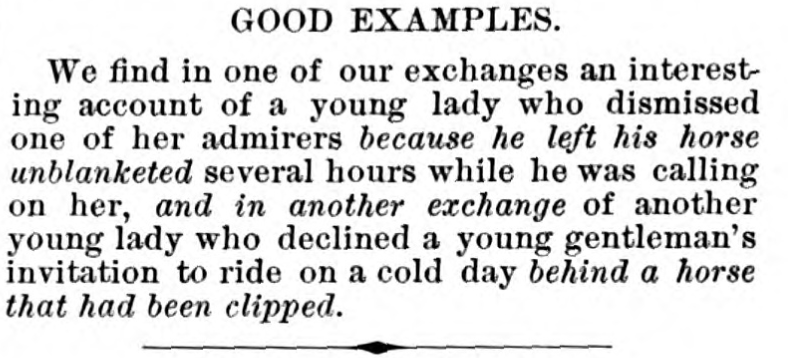
Our Dumb Animals was published in this manner every month from 1868 all the way until 1970, with the first issue reaching over 200,000 households. It’s also notable that policeman delivered more than 25,000 of them.
Angell also worked to found the Bands of Mercy, a nation-wide network of humane education clubs for children. Focused on bringing lessons of kindness directly to children, these “brave bands” provided children with stories, examples, and tangible ways to care for the animals they encountered. One notable story about the Brave Bands was published in the Journal of Zoophily by a chapter leader. He explains that it is his belief that all little boys are born with cruelty in their hearts and tells of a boy who nailed a cat to a board to light it on fire, and another child who cut out the eyes of a kitten with a knife and filled them with sand. Gruesome as these stories are, the chapter director says that he remedied the situation by providing the children with some rabbits and the task to care for them humanely, along with some seeds to grow the rabbits some food. This “gave the boys as task that they took to heartily.”
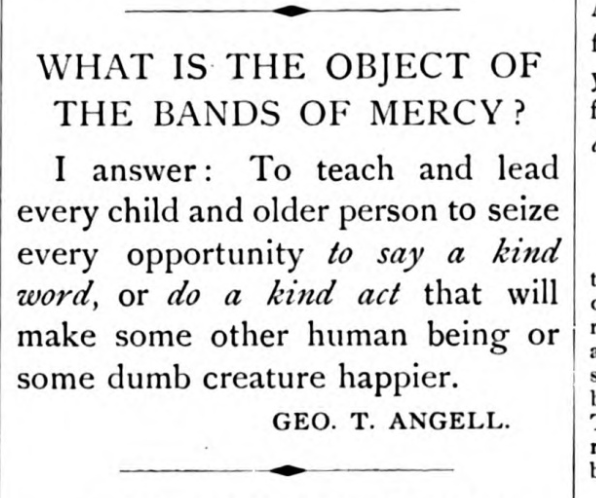
This change in approach did not go unnoticed by the media. The New York Times, in November of 1870 published an article called “The Boston Bergh” which cheekily joked “A Boston affair is nothing if not a little better, a little more advanced, than anything of it’s kind in New York.”
It goes on to further discuss the tactic of “Moral Suasion” as the primary mode the MSPCA tends to work, saying “This rational will accomplish more than force.” and “This moral power is not to be applied by getting into wrangles with angry and unreasonable men on the very source of their brutality.” Noting that humane education will result in “that a man would as soon lay a cruel blow on his wife or mother as on his beast.”
These methodologies of approaching the task of imparting compassion and kindness to animals from the view of education still very much resonate in our field today. Community education programs still provide a cornerstone of our work of teaching people compassion. We use education campaigns like “Wait until 8” to stem the flow of kittens into our buildings. “Let wild be wild” teaches people how to safely and humanely interact with wildlife, while spay and neuter education and community cat campaigns impact thousands of animals each year.
Our schools still also reflect humane education as a core tenet of sheltering. Many animal shelters employ humane educators tasked with visiting schools and teaching children how to interact appropriately and kindly with pets. Shelters also have programs in house geared to children, like reading to pets.
Today our Animal Control Officers also learn about how to bring humane education to help owners retain their animals instead of defaulting to bringing animals into the shelter. Compassion over punishment as a method of animal control continues to evolve, and without question we were lucky to have George Angell as one of our founders. When asked why he spends so much time and money talking about kindness to animals when there is so much cruelty to men, he replied simply “I am working at the roots.”
-Audrey


One response to ““I am Working at the Roots.””
Another wonderful article with a message I fully embrace! I look forward to learning more about Henry Bergh, Caroline Earle White, and George Thorndike Angell! – Steven Martinez
LikeLike