This week I had the opportunity to sit in on an exceptionally good pathway planning workshop in New Jersey. For those of you who don’t work professionally in animal services, pathway planning is an operational process that’s used in animal shelters to ensure a pet’s intake to outcome experience in the shelter, called “length of stay,” is as short as possible while also preserving every possibility for a live outcome.
Operationalizing pathway planning is difficult, though. Shelters are perpetually overcrowded and understaffed. There’s a lot of tasks for each individual animal. There are a lot of moving parts. Many hands. Animals with individual circumstances to consider. The workshop was exceptional because it addressed every piece of pathway planning and made it feel super approachable. I was also motivated by the fact that someday, AI will catch up and automate it all, reducing the length of stay like magic.
Still, there was one thing I couldn’t stop thinking about all day; How much of a reduction of population could have been achieved in the shelter if we thought about intake differently to begin with? Would we even need to spend two days on pathway planning if most of the animals never came in? How many didn’t need to be there? How many had people who would be willing to take care of them already or just needed a different solution? It’s my experience that this tends to be many more animals than we think it is without exploring options.
In fact, defaulting to intake is a lot of the reason I started studying the history of animal services to begin with. I simply could not understand why we repeatedly defaulted to intaking animals that there were obviously many other ways to help. I saw it happen every day as a shelter employee for nearly 20 years. Finding out how an animal came in used to be a bit of an obsession. I used to walk the kennels and ask my team “Whose dog is that? Why is this dog here?” And you know what? I sent a lot of pets home. Return to owner was my favorite outcome type.
We, as an industry, take people’s pets away that have homes and just need a little help to stay in them. We take in pets from in front of people’s houses and we don’t knock on the door to see if they live there. We take an injured or sick animal from a desperate owner, treat the animal, and then give it to someone else even though the animal already had a perfectly good home where they were loved. We make people have a piece of paper that proves they own the animal, and if they don’t have the paper, we take the animal away.
We do this All. The. Time.
We are getting somewhat better. It’s not everywhere anymore. It’s not everyone. But it’s still far, far more common than it should be. Even the best of us tend to intake first and ask questions later.
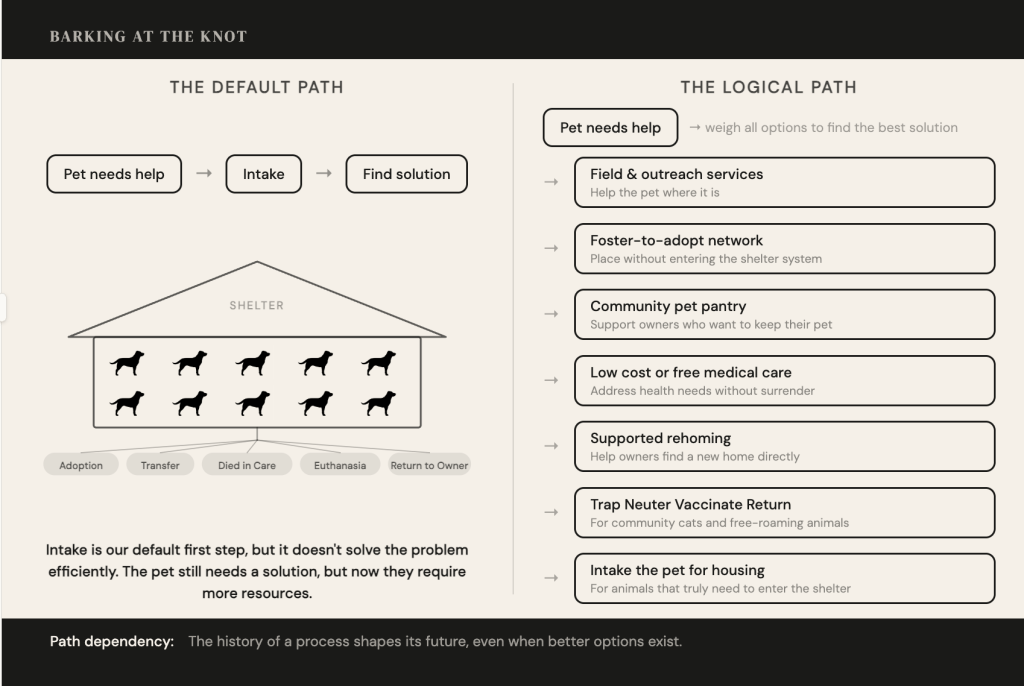
And, crazily, a lot of the most simplistic lifesaving programs that people are afraid to try are are simply programs where we are asked to reconsider intake as a default option. TNVR. Return to home in the field. Pet food pantries. Low cost or free vet care. Finder to foster. Shelter supported rehoming. Things that we know, by data, work.
In fact, we even name the processes that defer animals from entering the shelter by using other, logical, lifesaving solutions things that include the word intake.
Managed intake. Intake diversion.
If there is one term I can’t stand, it’s managed intake. Not because managed intake is the wrong solution. It’s the absolute right solution. It’s because managed intake is the wrong term for what we’re trying to do, which is simply to consider every other solution, including partnership with the community, before intaking an animal as a last resort to a place where they will be exposed to extreme confinement, illness, and potentially be killed.
It doesn’t matter how awesome your shelter is; these things are unfortunately true and these things cause harm both to animals and to people. I worked at a 90% save rate facility for years and every day I saw things that absolutely sucked for both pets and people that were the direct result of entering the shelter. This is not our fault, but it is our reality.
Managed intake itself is so widely misunderstood that there are entire facebook fandoms obsessed with “eliminating” it, perpetuating a myth that any other type of lifesaving that defers animals from physically entering the shelter immediately is a cruelty, even if entering the shelter ultimately kills them. That is crazy. It is path dependency on steroids. It is akin to cosplaying the victorian pound masters themselves.
I have broken down the reasons we intake as a default solution about a thousand ways in this blog, hoping to help people understand why we have the system that we do. I’m going to give the reader’s digest condensed greatly simplified conference presentation version below, but if you want some detailed explanations of any of these things, go back and read the archives. Or email me and I’ll spend an hour on the phone with you and we can talk about it. Seriously.
Here we go: We started out with nuisance pets being controlled by community members, because that’s what policing looked like before policing became a thing. Sometimes, lose pets were brought to an impound lot that was intended for livestock and if they were not reclaimed, they were killed. But for that to happen, generally, the animal needed to be causing some kind of significant issue. Otherwise, it was live and let live. Then, we started migrating into urban areas and populations and animal interactions became much denser, so dog bites became more abundant. First, we controlled them just the same way but then, we added in a great fear of rabies that was perpetuated and exaggerated by the steam printing press, the love of sensational print media, something called newspaper hydrophobia, the fact that rabies caused a horrible death, the fact that there was no vaccine, and the fact that a lot of bites were happening to children in the summer.
So, municipalities responded to public outcry around potentially but probably mostly not rabid stray dogs by placing a bounty on their collection, and people caught the stray dogs and brought them into the pound, where they were inhumanely killed. Because cities paid citizens to bring the dogs in, an unfortunate consequence was that children and dog brokers started to steal dogs to be paid. People did not like having their pets stolen and another public outcry ensued. Animal control was “professionalized.” Municipalities hired the dog brokers that were stealing dogs in the first place, called them dog catchers and paid them by the number of animals they brought in. Licenses were created so that you could prove you owned your dog so that animal control officers couldn’t steal it. Animals were killed by clubbing and drowning in pounds. It was all very corrupt. Pound is a terrible word.
Then, the humane movement entered the chat and public private contracts ensued in some places and it became not so socially accepted to kill animals so cruelly. Animal Services was “professionalized” for a second time and we learned to kill animals humanely, tout that as a success, and to remove killing from the public’s visibility. We established a fundamental lack of transparency as an industry. We established contracts and budgets based on the amount of animals that came in.
And boom, we had an entire shelter system based on intake. Funding based on intake. Contracts based on intake. Laws based on intake. That is still the system we have.
Path dependency is a concept wherein historical patterns and precedents influence the way we will continue to handle things, even if what we’re doing is no longer logical. In other words, but this is the way we’ve always done it. The system is perfectly designed to produce the results that it is getting.
Intake is no longer always the logical solution and we need to stop thinking of it as our first line of defense. The bottom line is this: some pets need to enter the shelter and some pets do not need to enter the shelter.
There will always be pets who need intake to get help, and that is a fundamental part of what we do, of who we are. It is an important part. It is a valuable part. It is intrinsic to who we are as an industry. We will love those animals and we will do our best to help them. But housing animals in a building because they need some help getting to a new home is one of many available options to help pets. How we view intake is important. It’s not a default option. It is one solution of many.
100 years from now, when people look back at this era of animal services, what I hope they will remember of us is that we were the people who figured out how to break the traditional intake model. We have the potential to do that, deferring one nose at a time. That’s not “managed intake” or “intake diversion.” It’s common sense.
-Audrey
 Barking at the Knot