Good morning from Pensacola, Florida, where my husband and I are outrunning snowstorm Hernando, set to bring 18 inches of snow to my hometown in the northeast. This week, in honor of my vacation, I’m bringing you some content around my favorite historical animal welfare influencer, rabies.
Why is rabies my favorite? (and why am I so obsessed with it?) Well, many important, influential and smart people in the animal welfare space point to all manner of things being responsible for the modern day structure of animal control, and the historical precedent of impound. Some say it had to do mostly with livestock damaging crops and the early town pound model. Some think the social reform movement drove us to single out and label stray dogs in relationship to filth and poverty and round them up. Some think licensing was the great evil. Some think it was politics and some think it was about a show of governmental power. Some people even think it had to do with capitalism, but those people are definitely not right. Anyway.
Me? Yeah…all those things mattered. They had significant impact on the policies that developed within the system…but the system itself? Public safety was the real driver of a system founded on impounding animals, because public safety was square one. How we decided what was safe, who was safe and what “safe” looked like came later…and nothing was a bigger threat to public safety in relationship to dogs than rabies was before the vaccine.
Even today, when I am trying to figure out a community’s potential receptivity to a new program that may displace intake as a default, like TNVR, or (god forbid) managed intake, I look first at who governs their animal control. If, historically, rabies was a threat to livestock early on, 9 times out of 10 the animal control will be under the Department of Agriculture. People? Department of Health. Sometimes it’s as singular as finding the first case of rabies and identifying how it was managed. Find the rabies and you can and quickly understand a community’s entire culture around public safety and pets.
For me, nothing, and I mean absolutely nothing on the planet, pisses me off more than the fact that we still, to this day, primarily have an animal control system that defaults to intake as the primary method of management, leading to the deaths of hundreds of thousands of innocent pets. We fund shelters based on intake, we staff shelters based on intake, we set our programming up based on intake, our contracts are based on intake…and intake as a default model, frankly, is bullshit. Do we need to sometimes house pets in our shelters? Yes. Absolutely. Do we need an entire system that defaults to intake as our first response? No. Is intake an effective primary solution? Absolutely not. Do we actually know and understand what would solve the problem, and yet instead dedicate millions of dollars to impounding animals instead? Yeah. Yeah we do.
See covid if you don’t believe me.
Or try this exercise. Take an hour. Close your eyes. Pretend you have to manage the animal services agency in your town, but you’re not allowed to have a shelter and you can only euthanize for irremediable suffering. What did you make? Does it look like what you have? No?
OK…climbing down off my soapbox now….Point being, study the history of rabies and you can find all the places where we screwed up, community by community. And, as Maya Angelou said, “When you know better you can do better.”
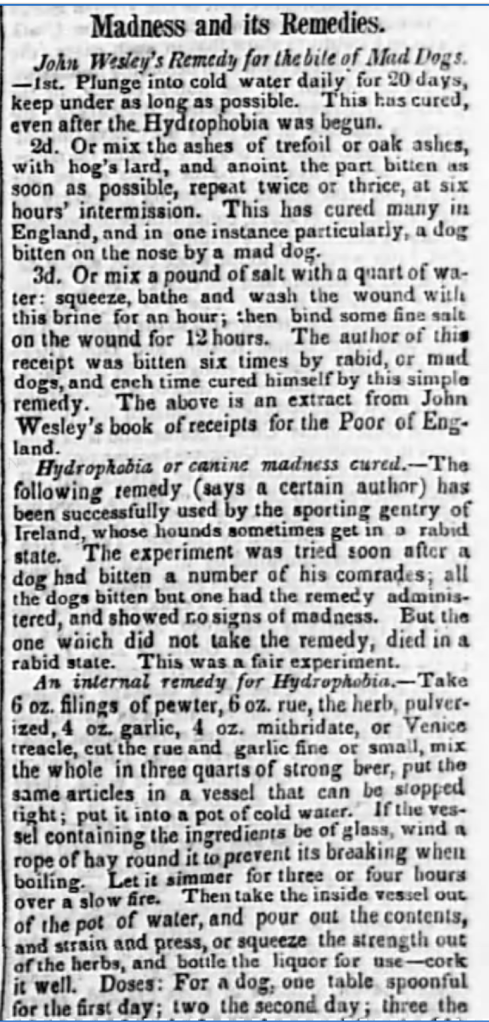
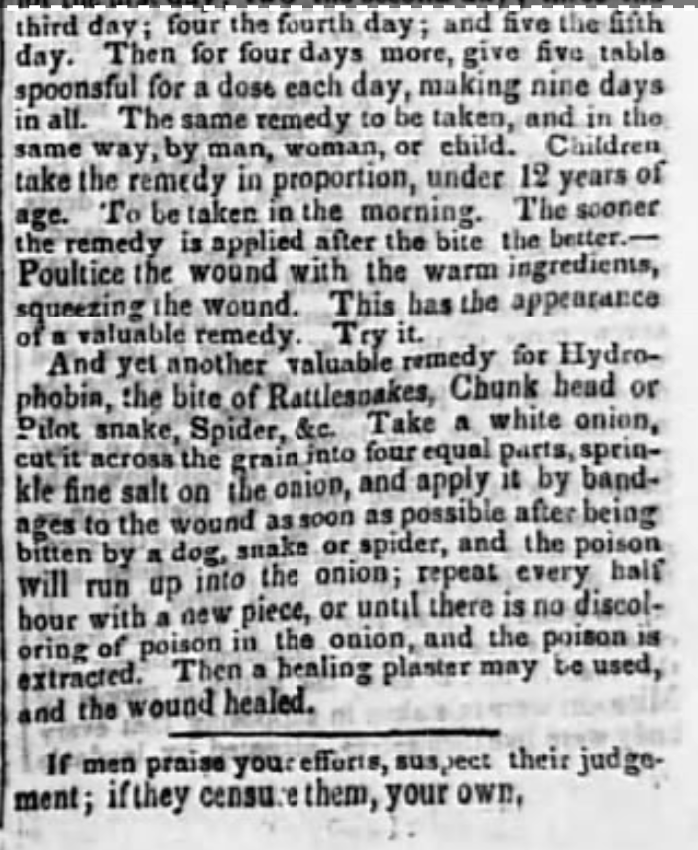
I’ve covered cures a lot so I’m not going to deep dive into why this was in the paper. TLDR: Rabies was scary and before there was a vaccine, there was a lot of folklore about what to do if you were bit by a rabid dog. I’m sure some day I will run out of ridiculous historical cures for rabies to write about. It hasn’t happened yet, and it continues to be fascinating to me. If you want to read some other posts on this topic, you can do that here and here.
And today, from the Poughkeepsie Journal, August 17, 1844, I bring you an article that recommends cures. During this time period, it was common for people to send their cures into newspapers to benefit all parties, and during outbreaks, calls for cures by the papers themselves were common. There are many articles just like this, and rather than unpack this one, I’m just going to post it here for you to read.
-Audrey
 Barking at the Knot