Guest Post by James Rodgers
Unruly dogs ran at large along muddy thoroughfares, disturbing the peace, spreading disease, and spooking horses pulling carts and carriages. So, naturally, animal control was invented to solve those problems.
False.
Certainly, those conditions existed, and something did need to be done. But addressing animal-related disorder was not the primary project.
From its earliest forms in North America, animal control was never only about animals. It was also about people, specifically, about judging whether people were orderly, respectable, and fit to live within a particular vision of society.
This moral dimension is not a footnote. It is the through-line.
As I write this, Roscoe, our resident shelter dog, is eating what was supposed to be his dinner. At a sturdy ninety pounds, he is unmistakably carrying extra weight. No one could accuse Roscoe of missing meals.
They could, however, judge my fitness as an animal guardian. That judgment has deep roots.
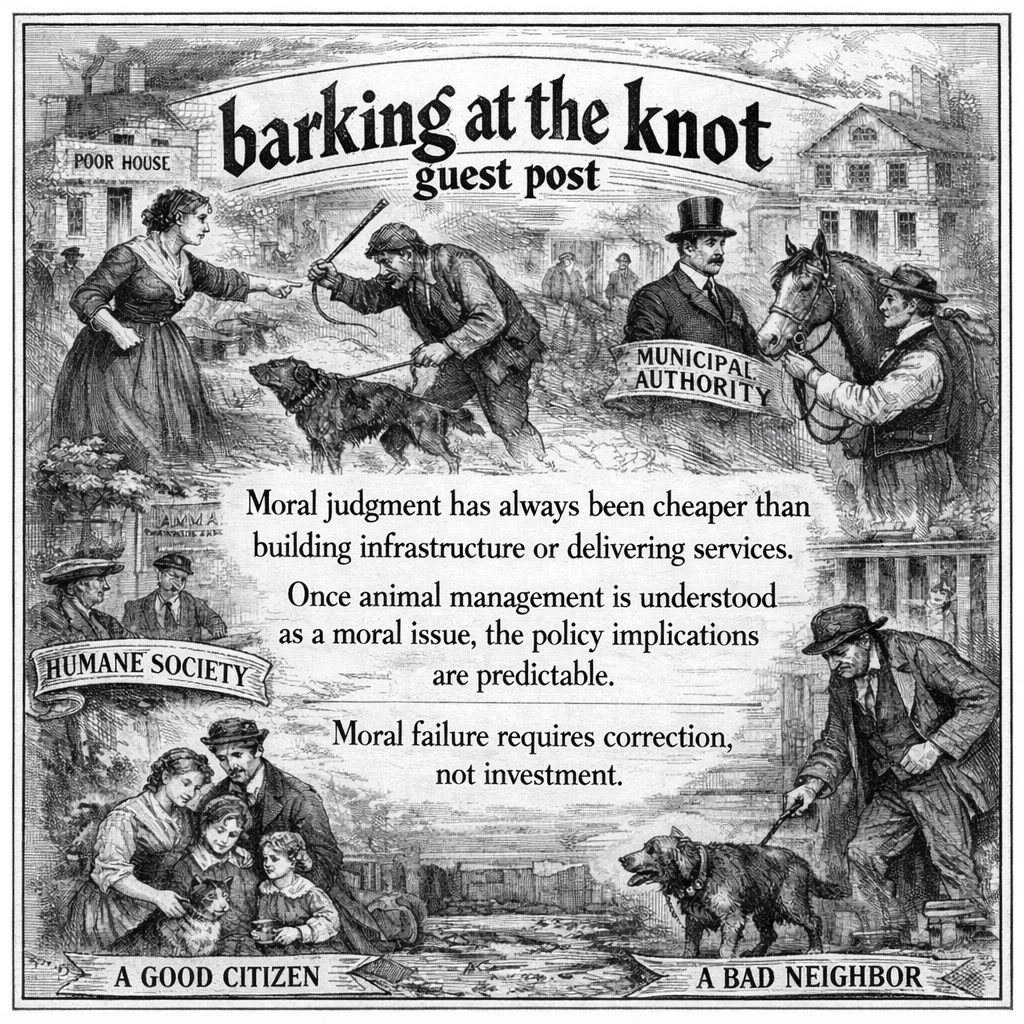
Nineteenth-century animal regulation developed alongside a broader project of social reform. The same institutions that sought to discipline poverty, regulate public behavior, and impose standards of cleanliness and domestic order also took a keen interest in animals. Humane societies, municipal authorities, and reformers framed animal treatment as a visible indicator of character. How one kept animals was assumed to reveal something essential about one’s fitness as a neighbor, a parent, or a citizen.
This logic was rarely applied evenly. Urban reformers worried about cruelty in working-class neighborhoods. Rural and Indigenous communities were scrutinized for disorder. Free-roaming animals, communal animal care, or practices that did not align with middle-class domestic norms were read not as cultural difference or structural circumstance, but as moral failure.
Animals became evidence.
This framing allowed animal policy to do double duty. It addressed concerns about public order while reinforcing social hierarchies. A poorly managed animal population did not simply signal a lack of resources or infrastructure; it was taken as proof that a community lacked discipline, care, or responsibility.
Moral judgment has always been cheaper than building infrastructure or delivering services. Once animal management is understood as a moral issue, the policy implications are predictable. Moral failure requires correction, not investment. Education, enforcement, and punishment become the preferred tools. Structural support becomes optional.
This helps explain why early animal control systems assumed conditions that did not exist everywhere: secure fencing, surplus labor, stable funding, consistent enforcement, and a tax
base capable of sustaining them. Where those assumptions held, the systems functioned tolerably well. Where they did not, the systems faltered, and the failure was blamed on the
people subject to them.
In Canada, this pattern took a particularly consequential form. Municipal animal control systems grew around tax-funded infrastructure in settler towns, sometimes staffed and supported by early humane societies and embedded within local governance structures. Indigenous communities, by contrast, were granted authority on paper but denied the means to operationalize it.
Colonial law extended municipal-style animal control provisions into Indigenous contexts while simultaneously withholding the fiscal and administrative mechanisms required to make them
functional. Communities were not simply under-resourced; they were structurally prevented from building and sustaining animal management systems comparable to those operating in settler
municipalities.
When these arrangements predictably failed, the response was not to question the design of the system itself, but to increase scrutiny and blame. Animal-related incidents were recorded less as animal-specific failures than as indicators of disorder, irresponsibility, or moral deficiency within the community, reinforcing existing judgments while the absence of infrastructure remained unaddressed.
These judgments did not exist in isolation. Many of the communities deemed incapable of managing animals were also deemed incapable of managing land, children, and governance.
Animal policy became one strand in a broader fabric of colonial assessment, where failure was presumed and evidence was selectively gathered to support that presumption.
The passage of time has not dissolved this logic; it has merely updated its tools.
In contemporary animal welfare culture, moral assessment increasingly travels through visibility. Standards of “good” guardianship are performed publicly, often through social media, where access to immediate veterinary care, specialized diets, and rapid intervention is treated as baseline responsibility rather than contingent privilege.
These norms function less like policy than like folklore: shared stories about what good people do, repeated often enough to feel self-evident. In this sense, education has long functioned as
the delivery mechanism for moral correction, while folklore supplies the curriculum.
For families in rural, remote, and Indigenous communities, many of which have long been denied consistent access to animal-related resources and infrastructure, matching these expectations is often impossible. The gap is not one of care, but of capacity. Yet the judgment attached to that gap can be severe. Historically, assessments of animal care have bled easily into assessments of parental fitness.
That relationship has not disappeared. For communities already shaped by the intergenerational trauma of children being removed after authorities deemed parents unfit, contemporary
judgments about “irresponsible” pet ownership do not land in a vacuum.
When families fail to meet dominant standards of pet care, animals are labeled at risk. Rescue is framed as the obvious solution. Dogs and cats are removed and rehomed elsewhere,
frequently into urban, non-Indigenous households, while the conditions that produced the perceived failure remain unchanged.
What presents as compassion is often inseparable from judgment. Animals are removed, but the people they came from are quietly indicted. Moral frameworks are resistant to evaluation. If a program fails, the explanation is always close at hand: people did not care enough, comply enough, or learn enough. The system itself remains largely unquestioned.
This is one reason animal management has remained so dependent on volunteer labor, philanthropy, and episodic intervention. Moral narratives are persuasive, but they are poor
foundations for durable public infrastructure. They explain persistence as personal failure rather than systemic design.
In contrast, systems built to measure outcomes, physical and mental injury reduction, disease prevention, and community safety, require institutions to assess whether the system itself is
functioning. That shift moves responsibility away from character and toward structure. It also exposes how many long-standing approaches were never designed to succeed under the
conditions in which they were deployed.
None of this is an argument against caring about animals, nor against the individuals who have worked in good faith to reduce harm. It is an argument for recognizing how deeply animal policy
has been shaped by moral judgment, and how that history continues to influence contemporary practice.
If animals have long been used as evidence against people, then changing outcomes requires more than education or enforcement. It requires confronting the historical frameworks that made
judgment easier than investment.
In my current work with Increased ACCESS, an Indigenous-led organization focused on building durable community animal management systems, these legacies surface regularly in policy
conversations and funding decisions. Understanding where they come from does not resolve them, but it helps explain why they persist.
History does not tell us what to do next. But it does reveal when a system was never designed to work as promised. And recognizing that may be the first step toward building something that does.
***
James Rodgers is the interim Executive Director of Increased ACCESS, an Indigenous-led organization working alongside Nations to support the development of community-owned animal management systems in rural and remote communities across Canada. He is also a co-founder of CARE Network Animal Shelter and the founder of Mission Pawsible, British Columbia’s first non-profit mobile veterinary clinic.
James’ work focuses on reframing animal-related challenges from issues of charity or compliance into questions of public health, infrastructure, governance, and land use. He collaborates with Indigenous leaders, veterinarians, researchers, and funders to help communities move from episodic interventions toward durable, locally governed systems.
Through initiatives such as the Indigenous SPCA project, Increased ACCESS is exploring new models of community animal management rooted in Indigenous self-determination, contemporary practice, and long-standing cultural teachings, rather than adapting conventional sheltering approaches.
James writes regularly about animal care systems, public health, and policy at IncreasedACCESS.org and on LinkedIn.
 Barking at the Knot