Hello, my friends, from frigid upstate New York. I’m excited to bring you the conclusion of this case example; while this may not have been the most serious piece of content I’ve ever brought you, I do hope you have found it interesting and intriguing. I must admit, researching it has been so much fun. If you missed parts one and two, you can find them here and here.
When we last left this story, the three men responsible for the attempted blackmail at Star Ice Cream had just been bailed out by a man named Harry Senft, who was, in turn immediately arrested. Police announced they thought he may be a head of the The Arsenic Club. From the Times Union, April 14, 1910:
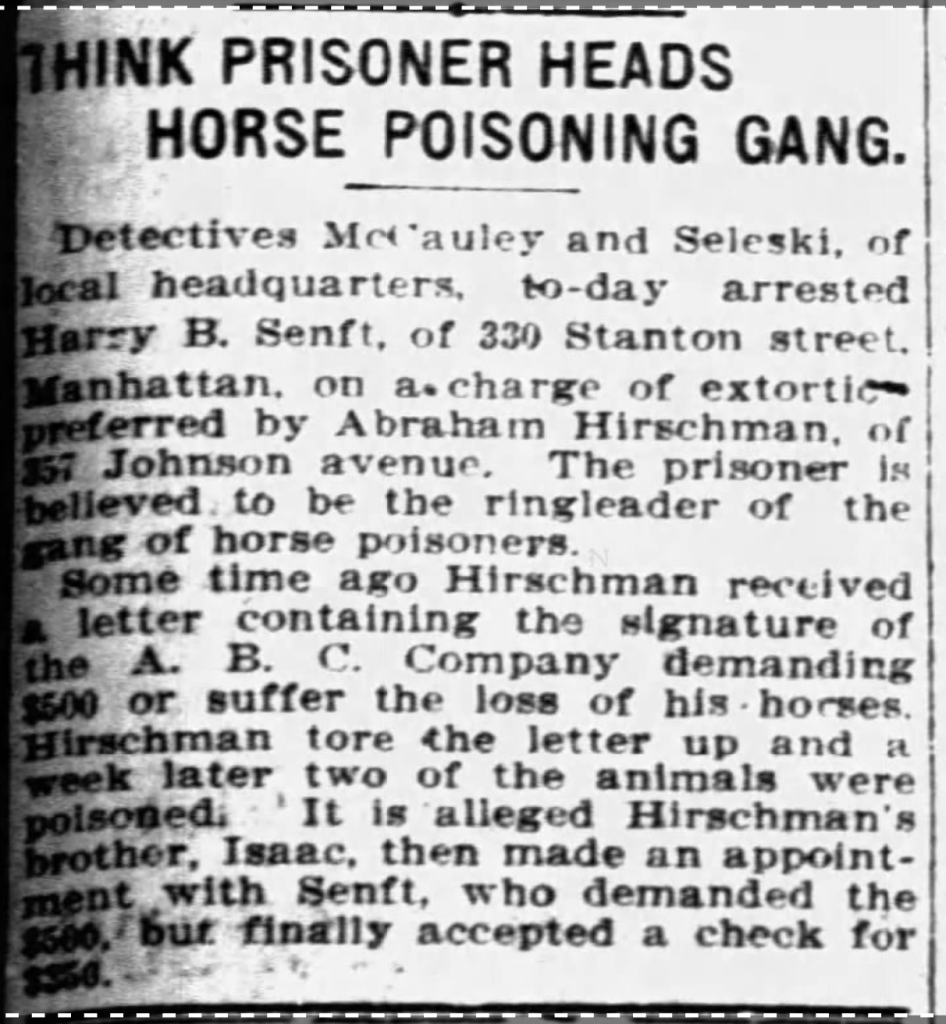
Harry Senft was a 40 year old stable proprietor located on Stanton Street. Police had been looking for him because in November of 1909, Abraham Hirschman, a house wrecker, had received a letter stating that if he did not give 1000 dollars, all his horses would be poisoned. He was told by phone to meet a man at the corner of 7th and 3rd, and when he arrived he was met by a well dressed young man who demanded payment. When Hirschman asked for a few days to get the money together, he quickly found two of his horses killed. At a second arranged meeting, the price of 500 dollars was agreed upon, and then subsequently, it was Harry Senft who came to collect it. When Hirschman learned of the arrest of the four other men who were to be indicted, he reported Senft. When Senft then arrived to bail out his companions, he was swiftly arrested. This brought the total criminals captured to five.
On April 22, all five men were brought before a judge and indicted. Harry Senft, Joseph Toblinsky, Hyman Gilman and George Foersch were charged with extortion, while George’s not-so-intelligent brother, Harry Foersch, was charged with attempted bribery.
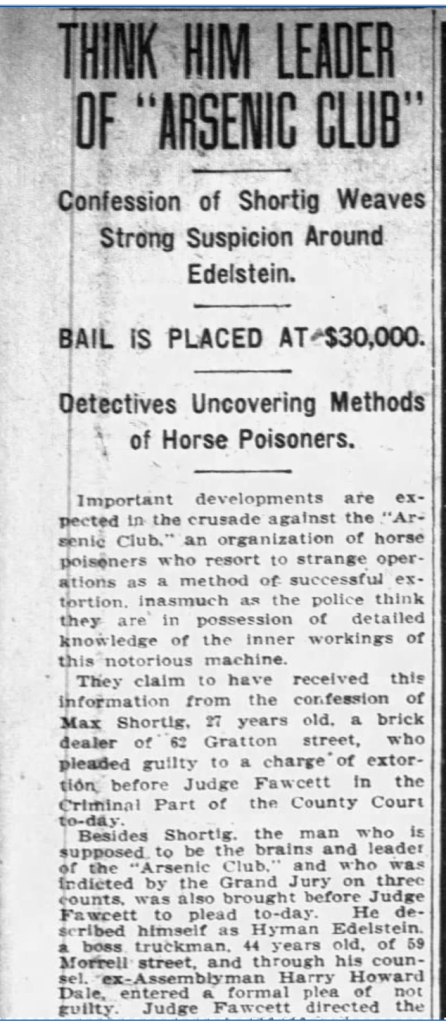
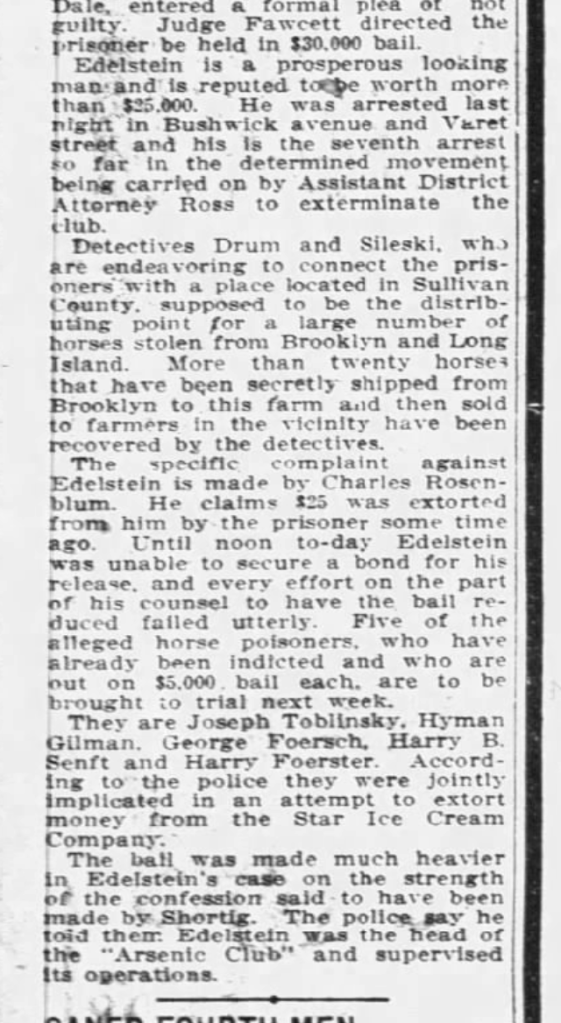
Very soon after, two additional arrests followed, with the capture of 27 year old second hand brick dealer Max Shortig and another man, Hyman Edelstein. Max Shortig is reported to have “squealed” the inner workings of the club to the district attorney, giving investigators a complete picture of the situation at last, and resulting in Edelstein’s arrest. Edelstein, it seems, was truly the head of the Arsenic club. Edelstein is described as a 44 year old, prosperous looking truckman from Williamsburg. He was was discovered, after a confession from Max Shortig, to be employing not only the men conducting the blackmail, but also a troop of small boys who would do the poisoning itself by feeding the horses lumbs of sugar containing arsenic. A nickel was given for each horse.
His bail was set at 30,000 dollars, an exorbitant sum for the time.
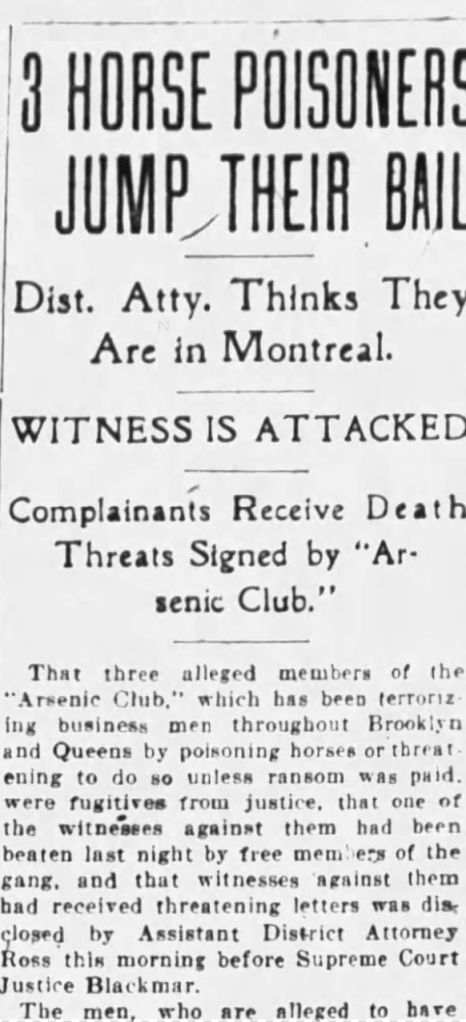
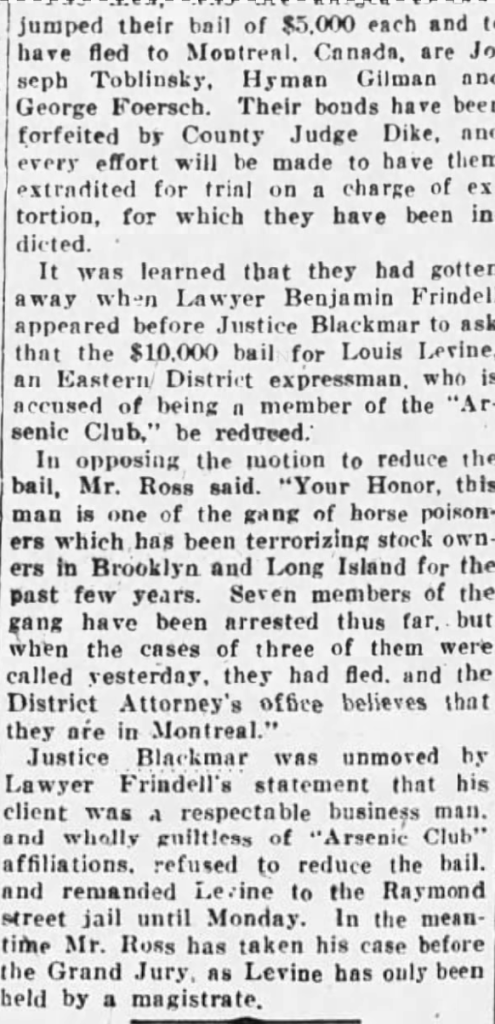
And then, just before the trial was to take place for all seven men, three of the men jumped bail and fled to Montreal. Joseph Toblinsky, Hyman Gilman and George Foersch would not be recovered for some years, when they were found in California and arrested. This was discovered by the press at the hearing of another man, Louis Levine; he was the most recent low-level arrest for blackmail, and he was also the first sentenced. He received 15 years, and it was reported that his wife fainted when the sentence was read.
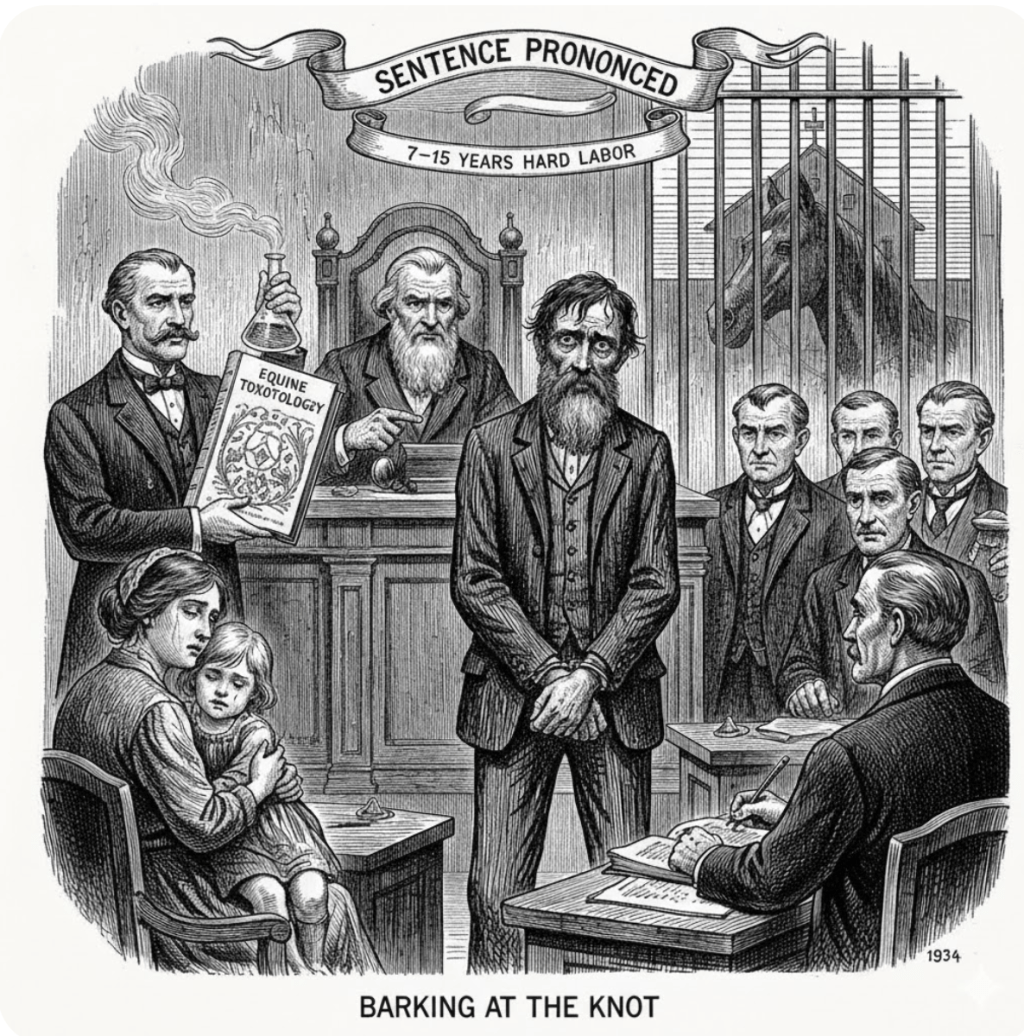
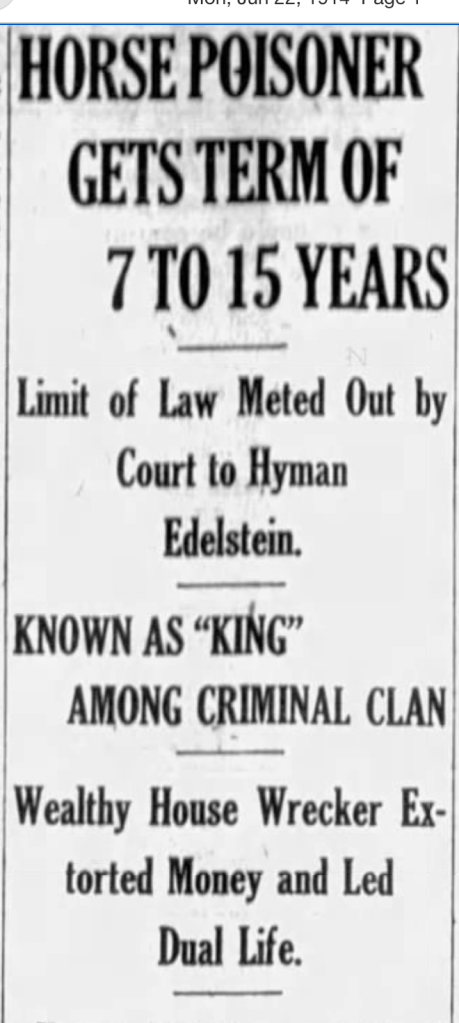
Interestingly, the other men were not convicted until 1914, although why, I cannot seem to discover. In the end, though, Hyman Edelstein was sentenced to 7-15 years in Sing Sing, the maximum sentence, after a sensational trial that lasted more than two weeks and was covered by papers across the country.
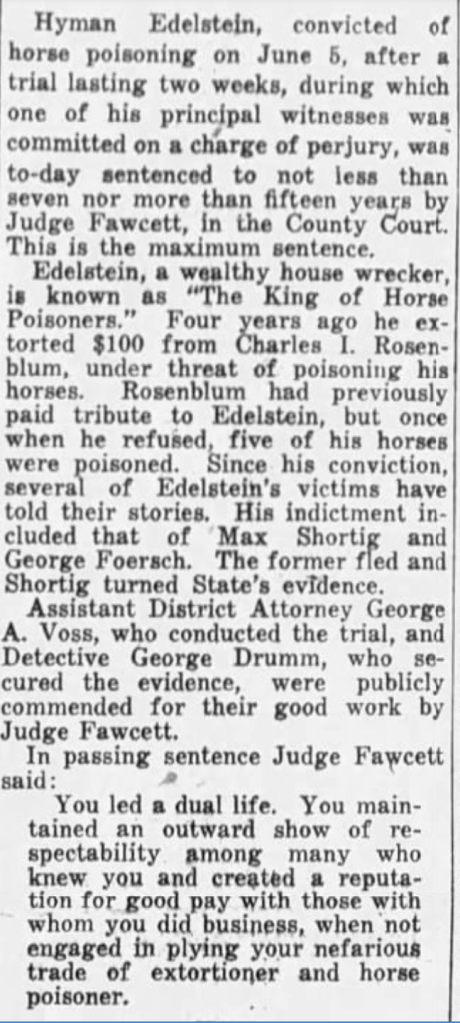
Despite Hyman Edelstein’s conviction, horse poisonings attributed to the Arsenic Club continued to pop up around the city for several years to follow. Whether this was truly their gang or simply copycat criminals remains to be discovered, but I will leave this story here.
Next week, we’ll have a guest post in the form of James Rodgers, of Increased Access and Indigenous SPCA. He’ll offer a perspective on early animal welfare in Canada and it’s impact on indigenous people.
For now, friends, I will leave you.
-Audrey
 Barking at the Knot