If you haven’t read the first few chapters of this story, you can find them here: first, second, third, and fourth.
It was shortly after David Belais of The Henry Bergh Humane Society announced that the organization would continue work within New York City regardless of their legal right to enforce cruelty laws that complaints about the finances of the A.S.P.C.A. suddenly showed up in the paper. The Armstrong Bill that had been submitted recommending they gain police powers was defeated in February of 1904. In April of that same year, the Washington Post describes Col. Joel B. Erhardt, Vice President of the board of directors of the A.S.P.C.A., “began an effort to ascertain the exact condition of the organization’s finances” by introducing a resolution requesting the president “employ accountants to report in detail the true condition of the societies assets, liabilities, receipts and disbursements, the examination to cover the preceding five years and the salaries to be expressly and individually stated.”
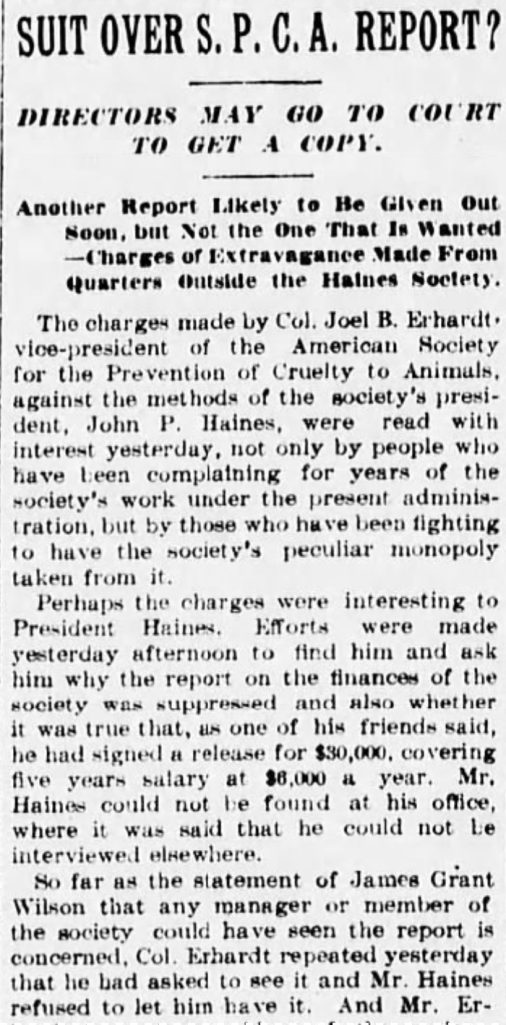
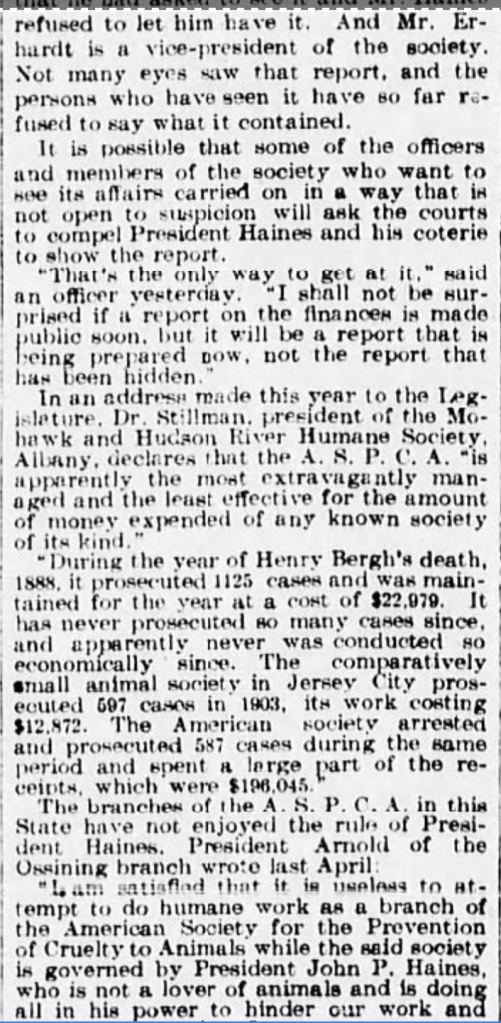
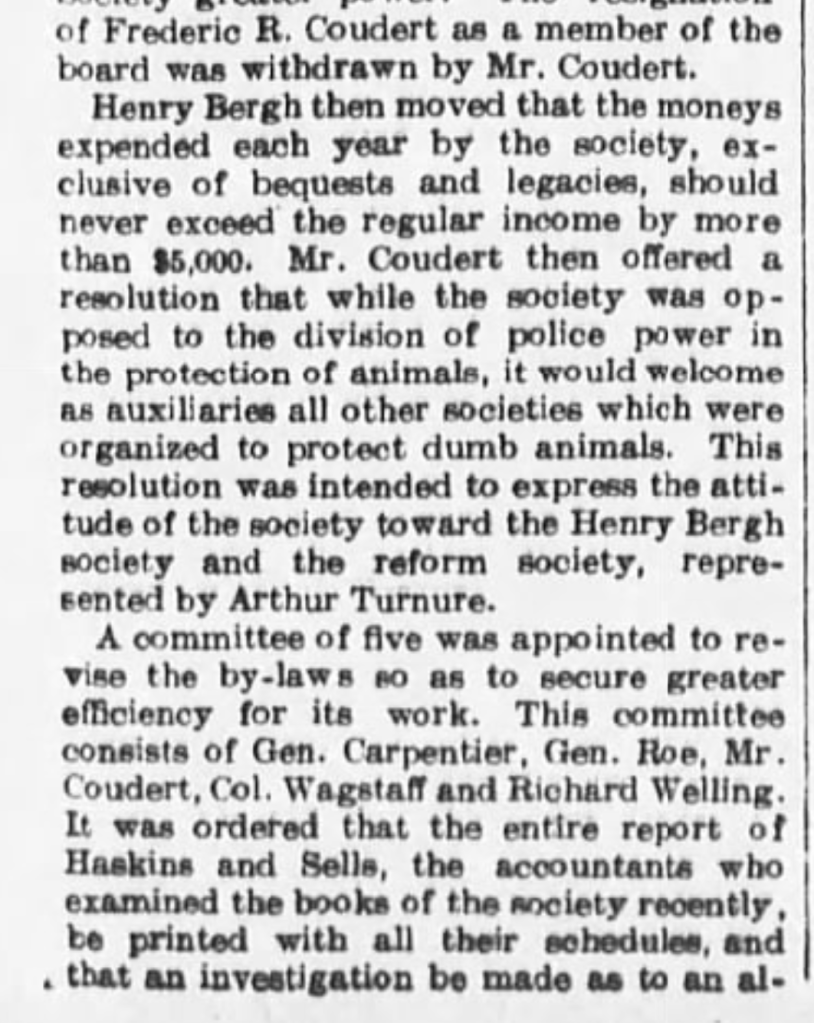
While the audit was conducted, much was made in the papers in the following weeks about the inability of several members of the board to access the report.
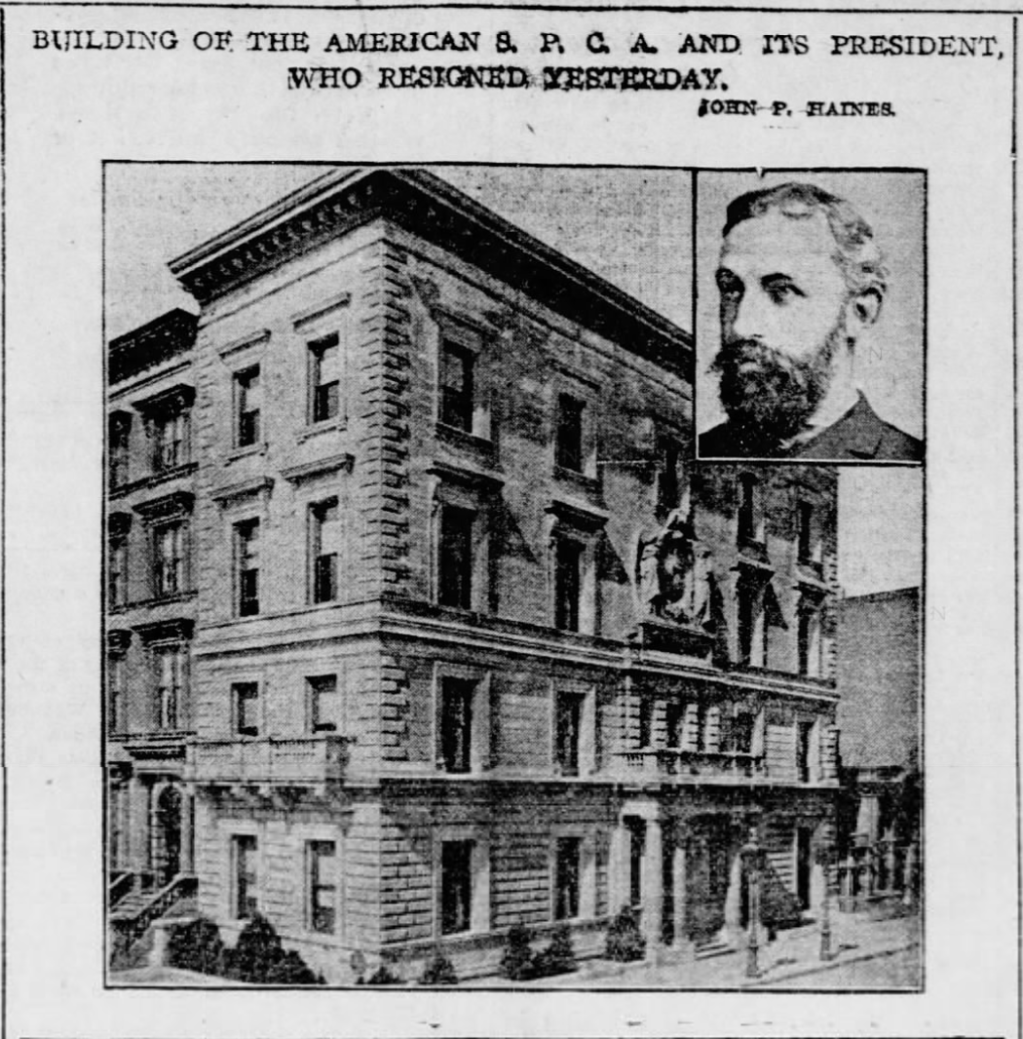
The article below is from the June 27, 1905 edition of the New York Herald.
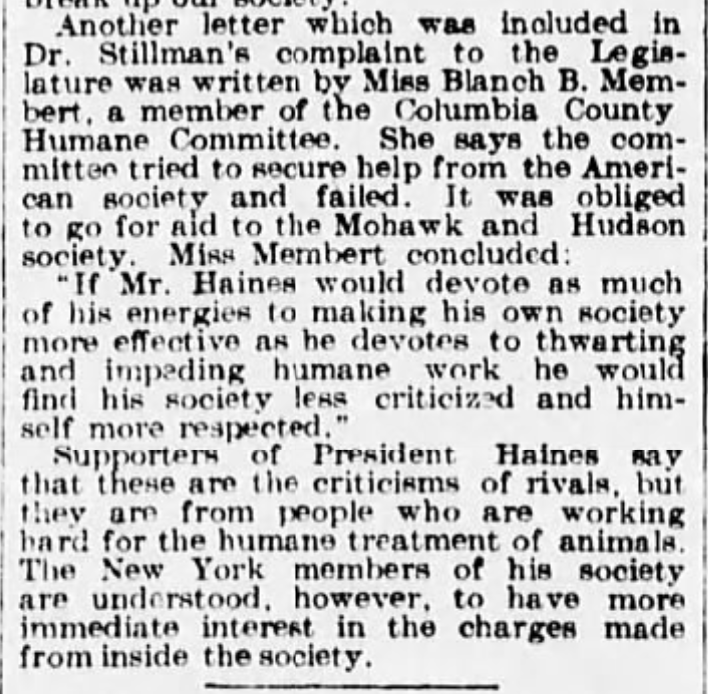
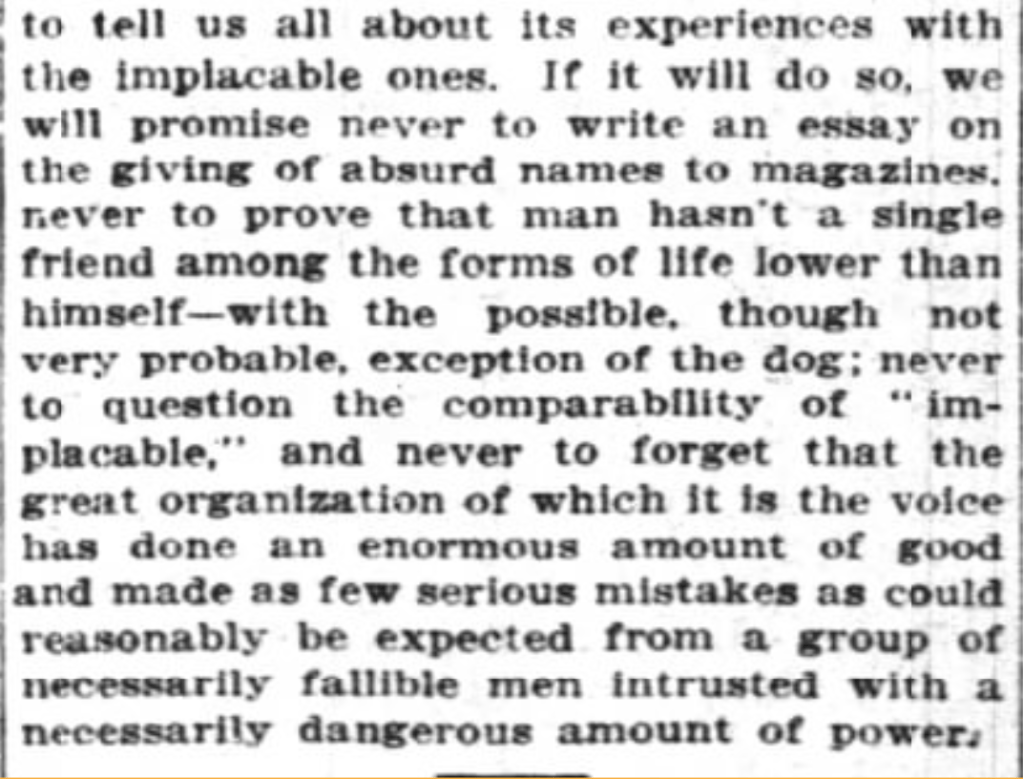
On the surface, it seemed that the complaints began internally with a board member, but one must read between the lines. As we have learned in telling this tale, the society had many enemies for many reasons. It’s likely that the internal complaints originated with the powerful advocates within the Henry Bergh Humane Society, who were deeply integrated with New York’s high society socialites. John P. Haines considered them such a problem that the April 7, 1905 edition of Our Animal Friends quotes the following from his hand:
“It is unfortunately true that our society has made many enemies, some of whom have sworn vengeance against us. In some of our work we have been obliged to antagonize powerful interests and wealthy corporations; In other parts of it, we have been obliged to antagonize certain aspirants to social distinction, and the hostility of the latter has been even more implacable than that of the former.”
This comment was so unusual that it was noted in the article below, in the April 7, 1905 article in the New York Times.


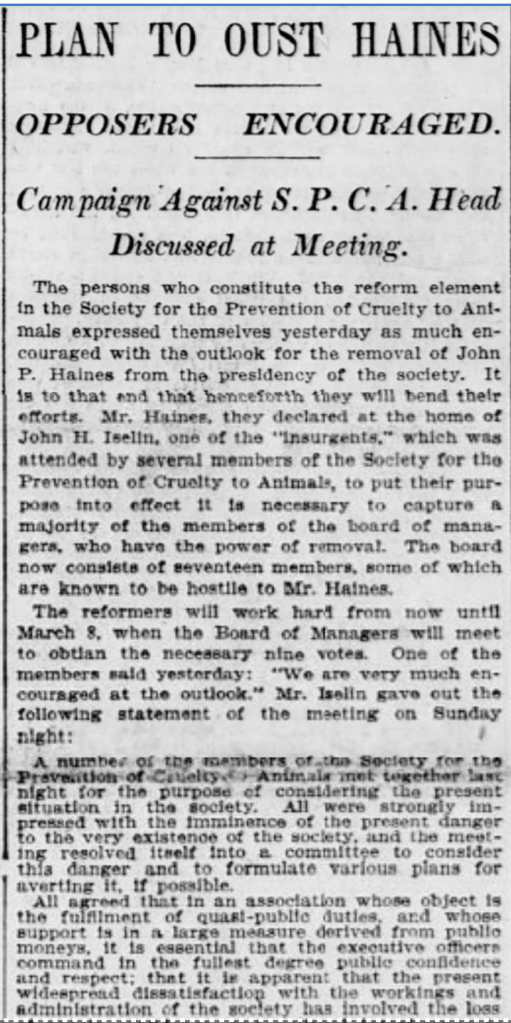
While the audit of the books revealed nothing more significant than a (10K) math error, the scuffle over the report itself being released was enough to draw attention to how the Society spent it’s funds. These complaints, and others around the society’s ability to fulfill it’s function – which encompassed everything from the amount of time it took for the agency to respond to complaints, to the lack of agents, to the expenses of the office building on Madison Avenue – became more and more targeted against President Haines as time passed. In late February of 1906, A group of advocates affiliated with The Henry Bergh Humane Society, spearheaded by the wealthy and influential Arthur Baldwin Turnure (he would later go on to found Vogue magazine) formed a new organization – The American Society for the Prevention of Cruelty to Animals Reform Committee. In the media, this group became known as “The Outsiders.”
These advocates swiftly filed a complaint with the Attorney General’s office, requesting him “to begin an action under section 1781 of the code of civil procedure” to oust from the office of the A.S.P.C.A. it’s officers, and require them to render an accounting of their trust. Their stated purpose was to remove President Haines from his position by influencing the board of managers to take a more holistic view of the inefficiencies within the organization that were coming at the hands of John P. Haines.
In what is possibly the most interesting piece in all of this; in addition to the Reformation Associations’ formation and within the same week – but barely mentioned in the papers – a bill is introduced again in Albany by Assemblyman Francis to give police powers to The Henry Bergh Humane Society.
The below from The New York Tribune, February 20, 1906


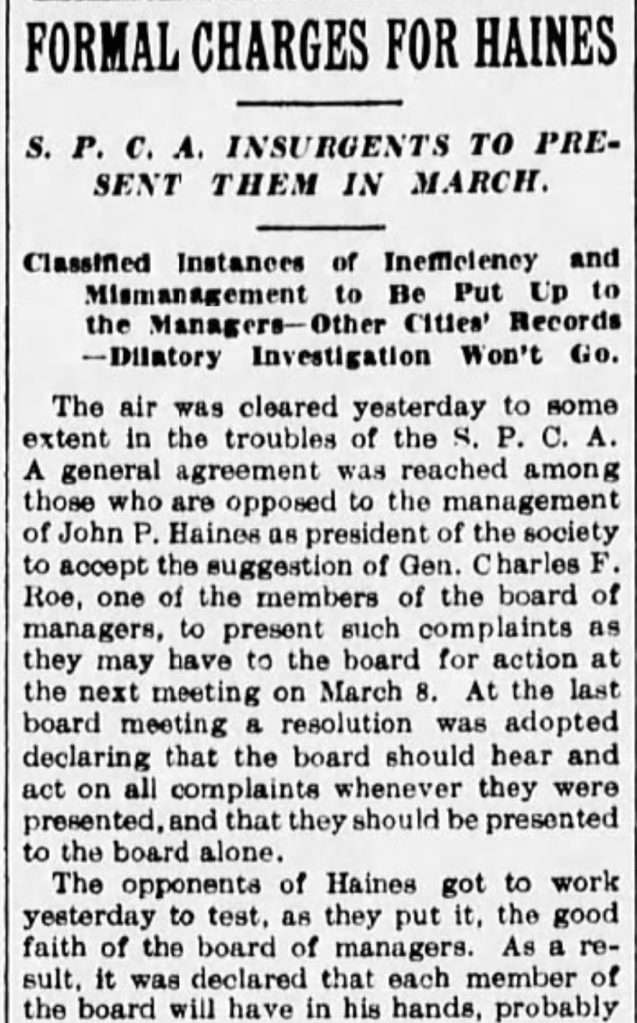
The article below is from the February 21 edition of the New York Herald.:
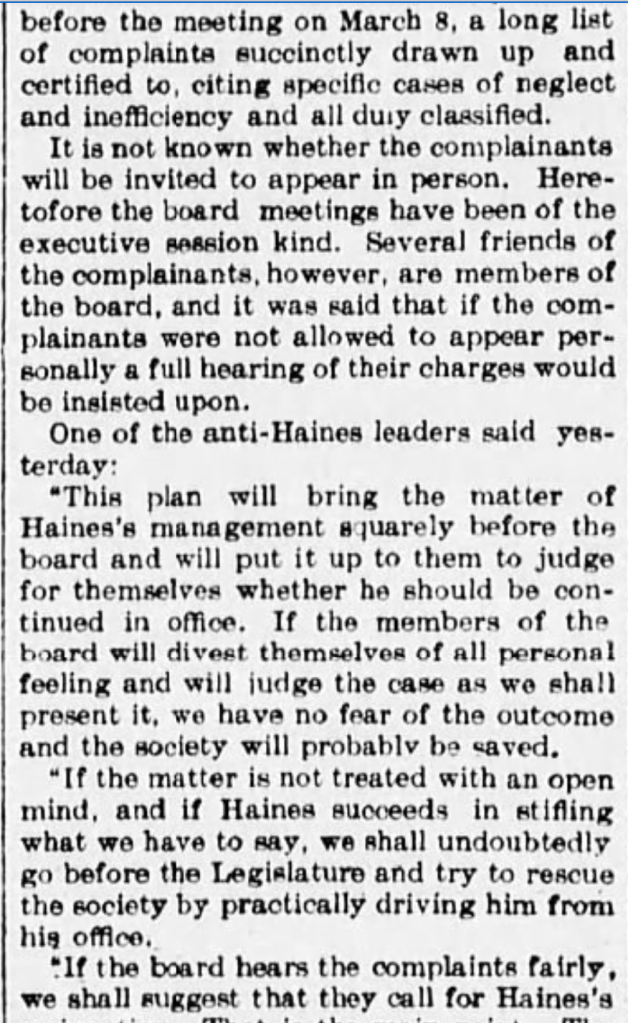
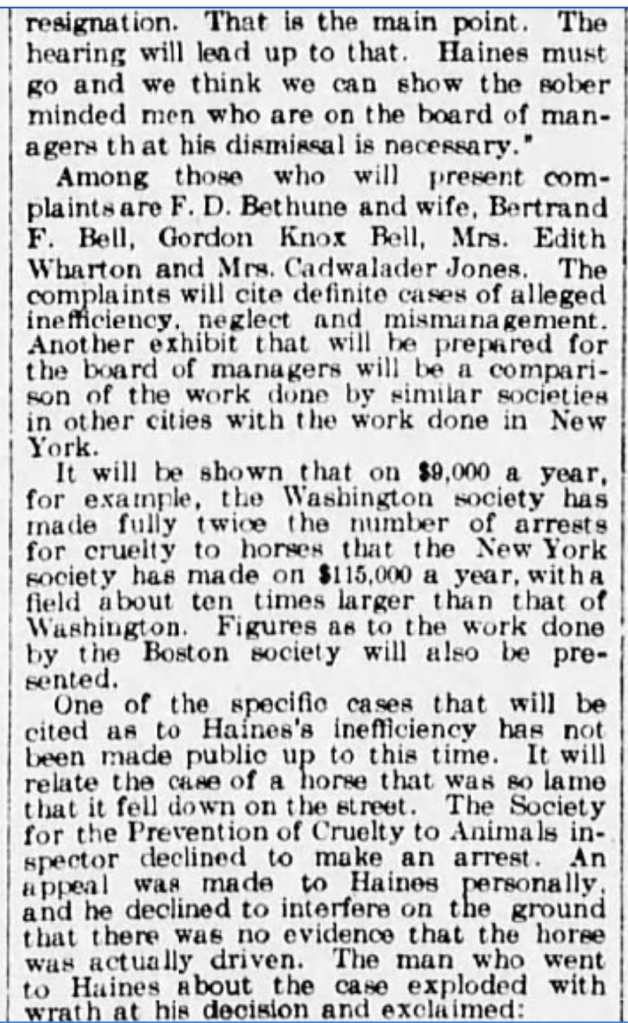
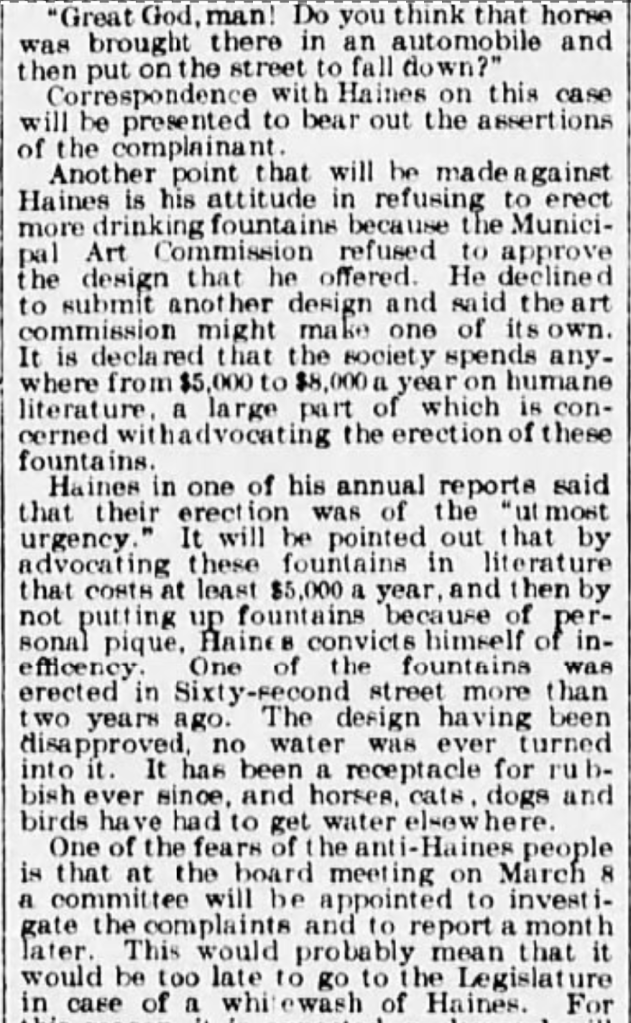
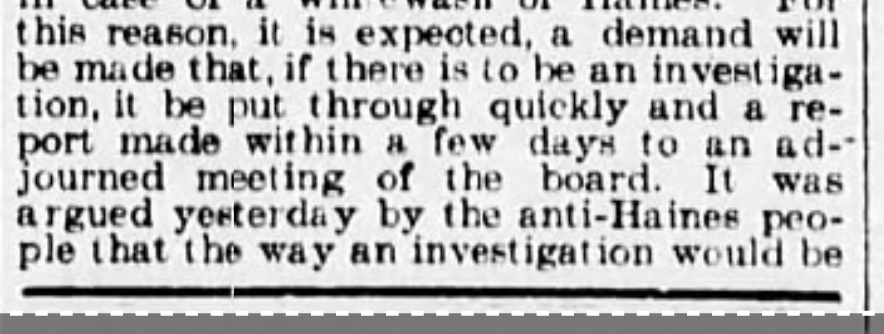
On February 28, a hearing was held in Albany surrounding the powers of the Henry Bergh Humane Society; papers reported the hearing as a “semi-investigation of Haines and his activities.” Initial articles said Haines would attend the hearing, but he did not appear.
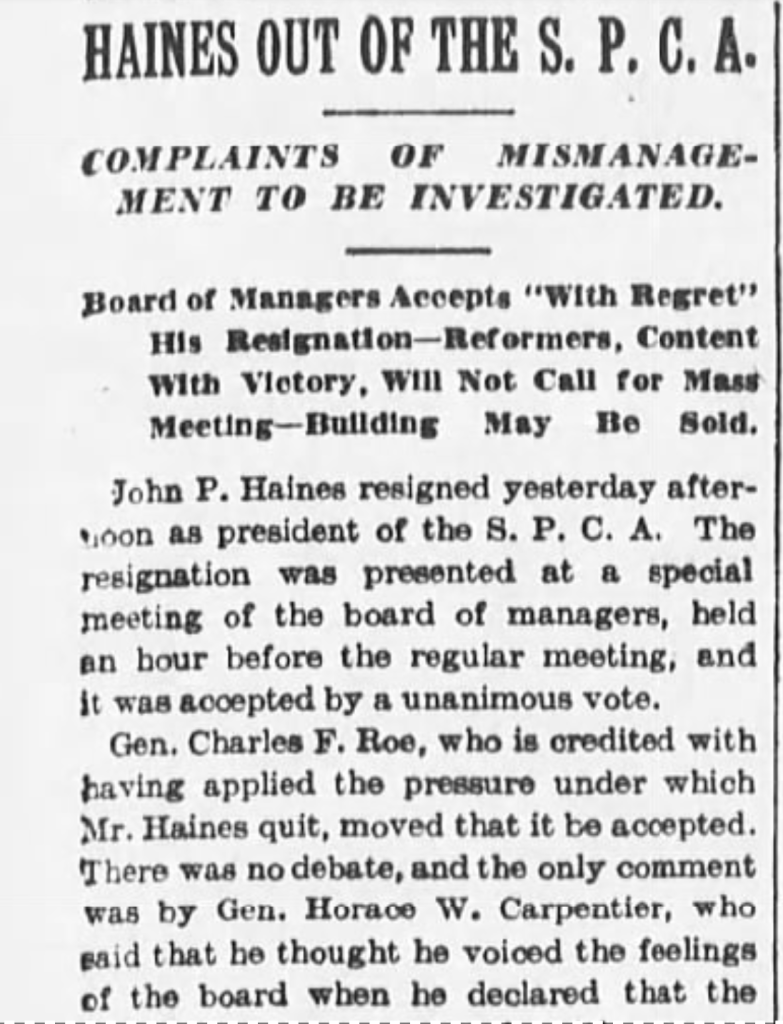
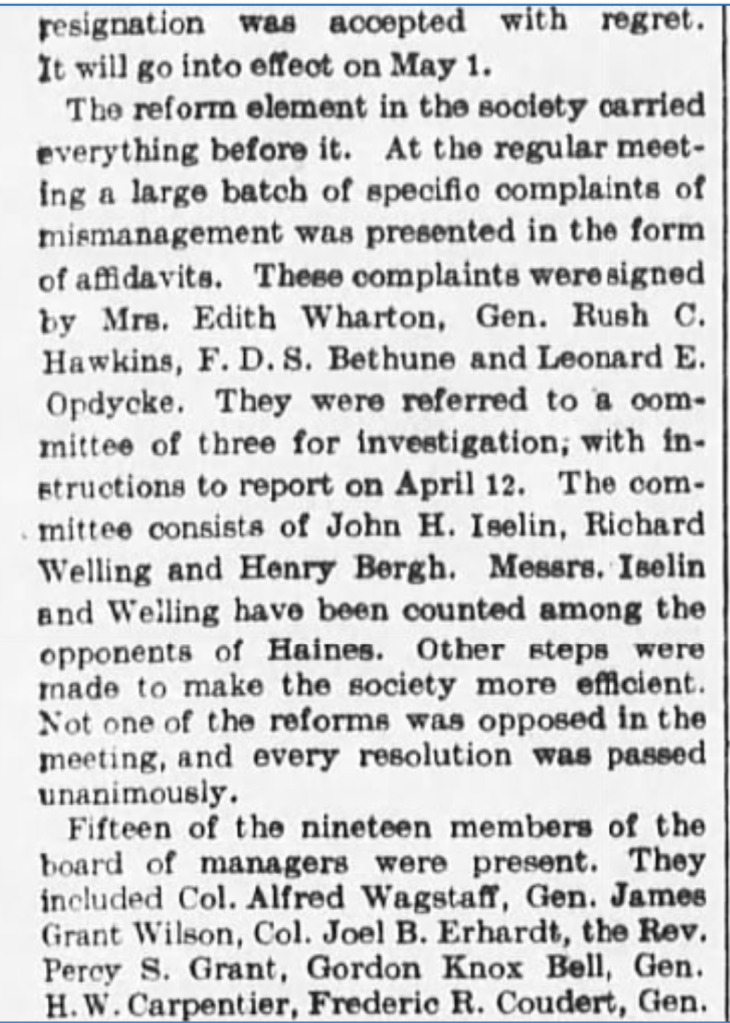
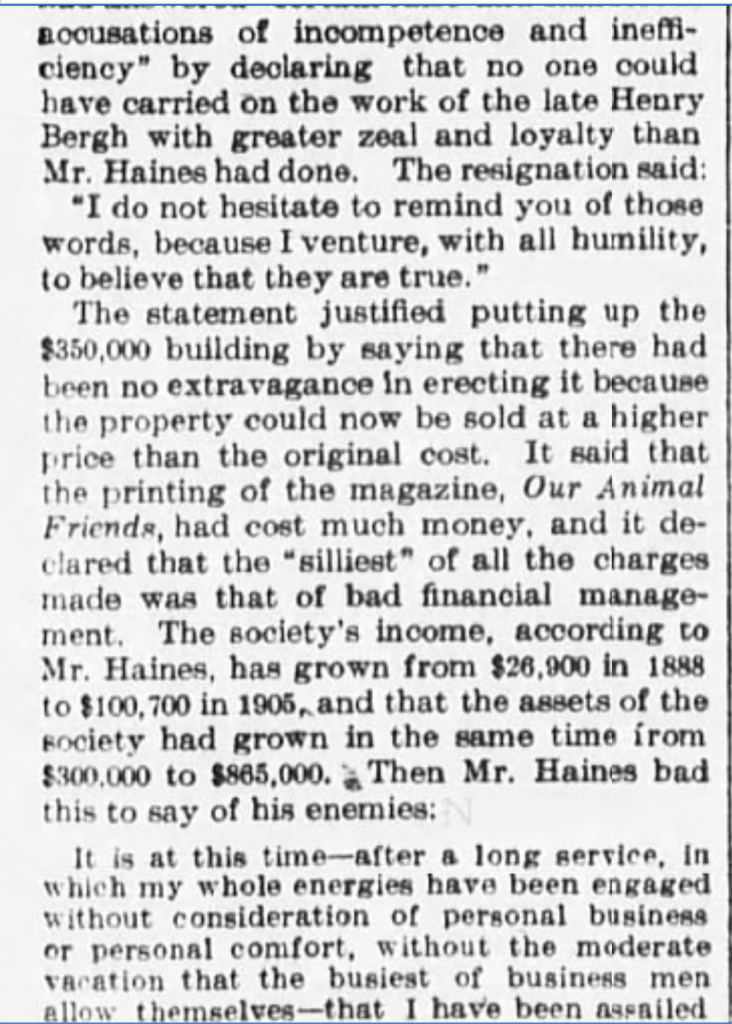
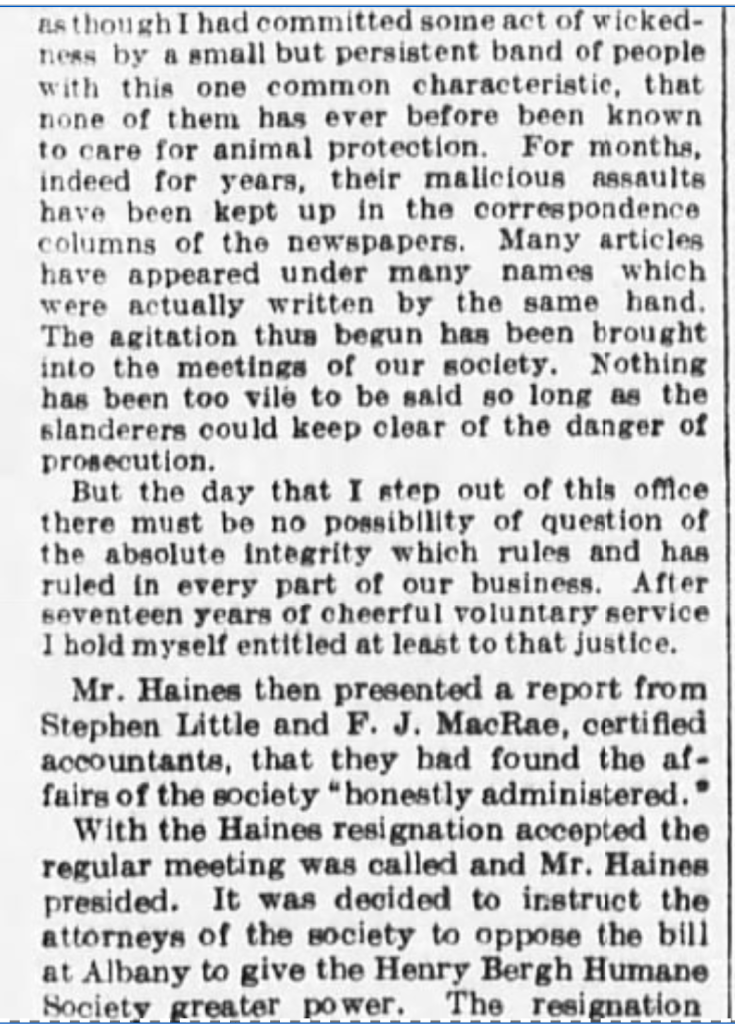
By March 9, 1906, in response to the rising pressure from the Reformation and the press, the board of managers of the A.S.P.C.A. had reached an agreement to hold a meeting where complaints would be reviewed.. The board agreed to “hear and act on all complaints, whenever they were presented, and should be heard by the board alone.” With 15 of the 17 members of the board of managers present, they required a vote of 9 affirmations to remove Haines from office. The meeting was held behind closed doors and lasted for more than three hours. At the conclusion of the meeting, the board of managers and President Haines came down in the elevator and invited the press up, where Haines passed out copies of his resignation letter, which had been dated the day prior.
Although I have not been able to find it in it’s entirety, I have found this section below.
“It is at this time – after a long service in which my whole energies have been engaged, without consideration of personal business or personal comfort, without the moderate vacation that the busiest of businessmen allow themselves – that I have been assailed as though I have committed an act of wickedness by a small but persistent band of people with one common characteristic, that never before has one of them proposed to care for animal protection. For months – indeed for years – their malicious assaults have kept up in the coorespondence columns of the newspapers. Many articles have appeared under many names which were actually written by the same hand. The agitation thus begun has been brought into the meetings of our society. Nothing has been too vile to be said, so long as the slanderers could keep clear of the dangers of prosecution.”
-Resignation letter of John P. Haines, March 9, 1906


The Reform Association continued to meet, although they had no real authority to govern the organization. They met for the first time following the March 10 meeting at the Waldorf Astoria in early April, in order to pass a series of resolutions to lay a path for their future work. Among those recommendations, that Col. Joel B. Erhardt should serve as the future President pro-tem of the A.S.P.C.A., and, of course, the recommendation that police powers should be granted to The Henry Bergh Humane Society. That measure was, unsurprisingly, approved unanimously in it’s support.
On March 22, 1906 the bill to give police powers to the Henry Bergh Humane Society passed the assembly unanimously, although it barely made the papers. It was signed by the governor on May 18 of that same year. They assumed a new name, the New York Humane Society, and still exist as a small animal rescue organization today, although they obviously never gained the prominence of the A.S.P.C.A..
The below from the New-York Tribune:

While this story continues in history (and in it’s drama) I’ll end my time with it here. It’s hard to imagine or relate to what exactly was happening within the A.S.P.C.A. in the early 1900s to impact it’s operations. I think there probably was some truth to the failure to provide adequate services to the animals of New York City – the size of the city, the rate of it’s growth and the level of cruelty are all things that would have created impossible odds for the agents of the A.S.P.C.A.. I also believe that the people who held the power in New York City then were high society, and they were not quiet in their personal contempt for Haines and his influence on their sport. There’s a lot to be said for advocates who see an injustice and choose to spend their time, money and effort to address it; we need those people within this movement in order to continue to push forward. Whether ousting John P. Haines in order to gain police power for a secondary society was the right thing…well…history continued to played itself out, and we can all decide that for ourselves.
I hope you’ve enjoyed this tale; I know that I’ve enjoyed researching, writing, and preserving it immensely. There are many lessons to be learned within it. I’d love to know what you took away.
-Audrey
 Barking at the Knot