
Good morning from the lobby of a hotel in Atlanta. I’m attending the AAWA Conference. Today, I’m bringing a bit of a darker tale from the 1890s. This period of time, for reference, was just before the time period that ASPCA took over the animal control contract in New York City (1894). When that happened, one extremely notable addition was the intake of cats. Municipal animal control in New York City had previously been a strictly dog-driven public safety operation. However, as crowding in NYC neighborhoods increased and the sanitation movement continued to remove sources of food for the cats, cats themselves became much more visible. The newspapers of this time period were full of complaints around howling, yowling, fighting and spraying – and also full of stories of home grown “solutions” to deal with the cats themselves. Among the most visible stories in the papers is that of Sarah Edwards and The Midnight Bands of Mercy.
In 1890, a group of 5 Manhattan women came together to form a sanctuary in a dilapidated, rented farmhouse. It’s intention was to serve as a refuge for stray and homeless cats, under the name of “The Society to Befriend Domestic Animals.” While well meant, the Society eventually lost it’s physical location in 1893 due to all the problems commonly associated with keeping more than 150 animals confined to a domestic household. It’s here at this point that the Society took a dark turn, forming The Midnight Band of Mercy.
You may remember that Bands of Mercy is the name that George Angell gave to the MSPCA’s Humane Education program. The language was well disseminated into society by 1890 and often adopted by humane organizations.
The Midnight Band would “work between the hours of 2 am and 4 am” and professed to “care for more than 2,000 cats across Manhattan each month” providing meat on the first night, catnip on the second night and fish on the third night of each week.
Darkly, The Midnight Band of Mercy would also kill stray cats with chloroform when they found it the most humane thing to do. This could be because the cat was ill, or was a nuisance and there was fear they would be killed in a crueler way. Over time, the killing escalated until the “humane removal of cats” became the primary objective of the organization.
In June of 1893, a member of the Midnight Band, Sarah Edwards, was arrested for violation of the sanitary ordinance after laying a dead cat in the gutter outside a butcher. Sarah expressed in court that she had received a letter referencing some unwell cats in a nearby neighborhood and when she went by to care for them, discovered an unwell cat and poisoned it with chloroform to relieve it’s suffering. She then laid the deceased cat in the ditch, in front of the butcher, who called the police. Ms. Edwards was released with a reprimand.
*Note that either the original reporter mis-took her name for that of her roommate, or that Sarah herself lied about it. In any case, the article below refers to her as Sarah Hollister, but it is Sarah Edwards.
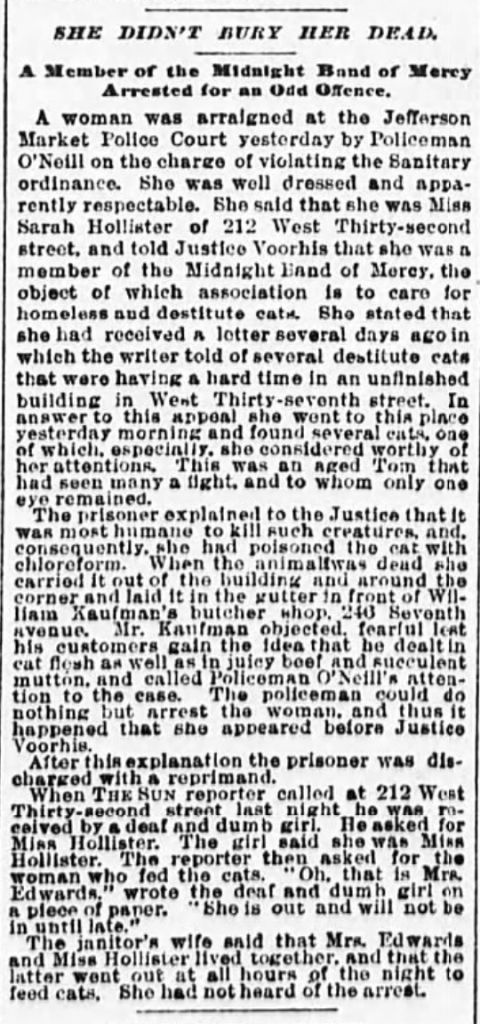
This first story of Ms. Edwards and The Midnight Bands of Mercy attracted the attention of the local papers, and soon this article, and a few others like it, were published, illuminating that the Band had disposed of more than 8,000 by use of chloroform and adding that the Band intended to soon bring their services to Columbia Heights.

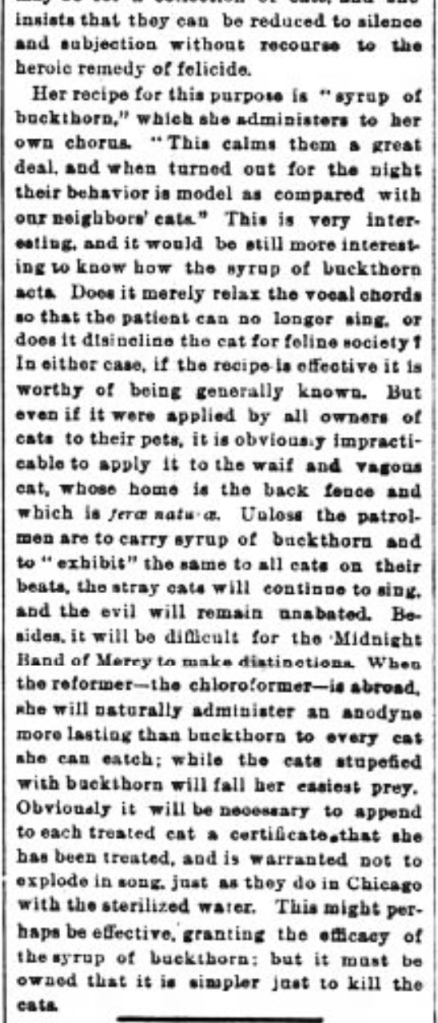
Soon, the media attention already very present around the stray cat problem honed in on the Midnight Bands of Mercy, with citizens writing in their opinions. The opinion piece below is from the New York Times, July 23, 1893. It’s commenting on the letters to the editor published and received in regard to the Midnight Bands.

Of course, the attention to the Midnight Bands of Mercy also drew the attention of the ASPCA. While the animal control contract was barely overlapping this time period, of course the ASPCA had been responsible for prosecuting cruelty cases in the city since 1866. This would have included Sarah Edward’s case.
A few months later, Ms. Sarah Edwards shortly found herself back in court, this time charged with cruelty to animals after being arrested with six dead cats in a basket when an officer saw her kill a small kitten. The below is from the Evening World, October 5, 1893.
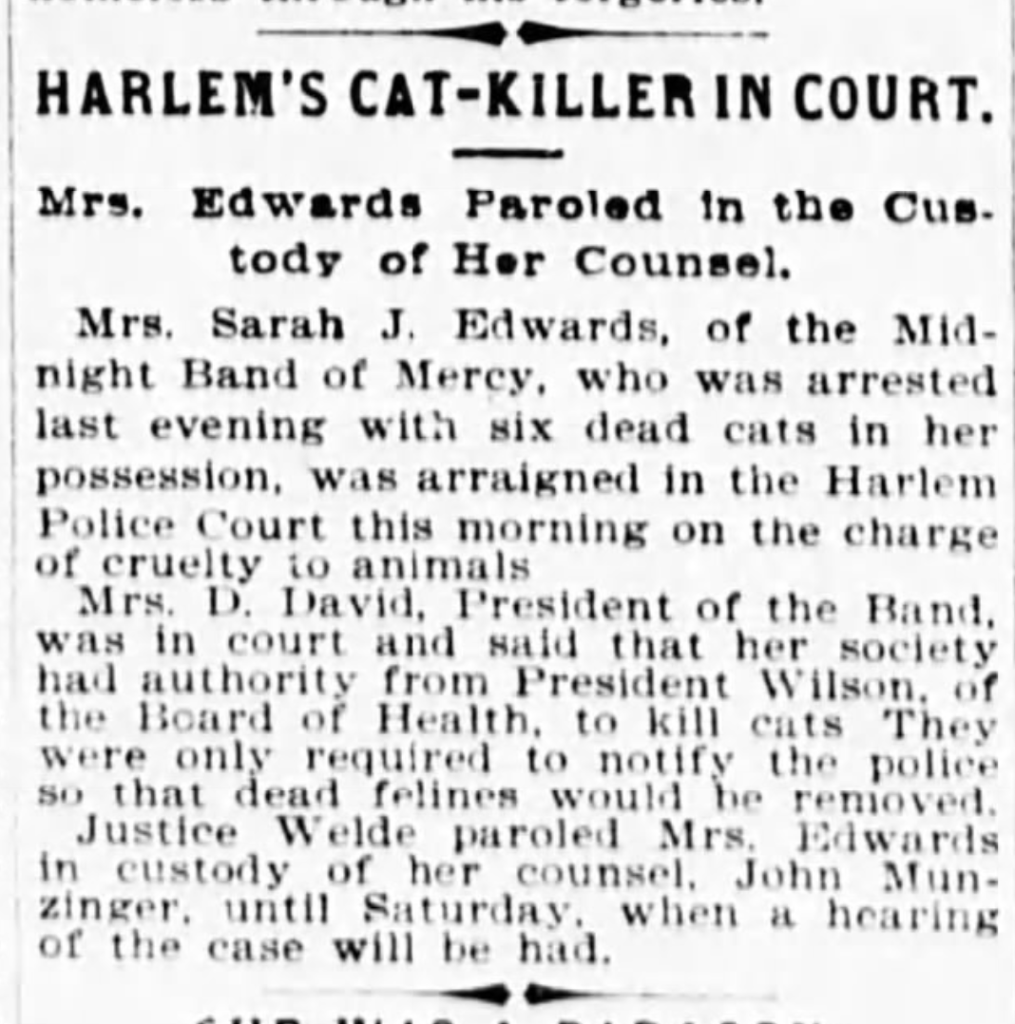
And this below, from the October 6, 1893 New York Herald.

The trial itself was covered in the papers and was a topic of conversation across New York. October 7, 1893 showed Ms. Edwards defending her right to kill strays and illustrating the growing concern around the ASPCA’s ability to keep up with the volume of work in New York City.

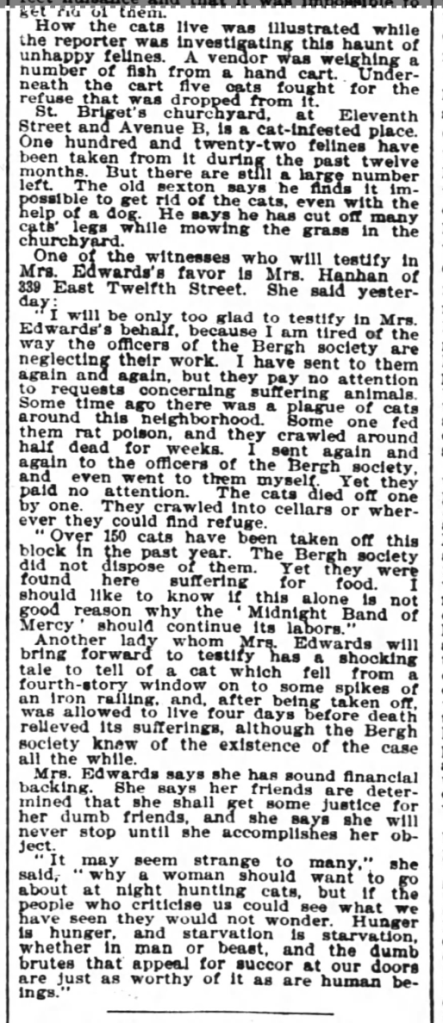
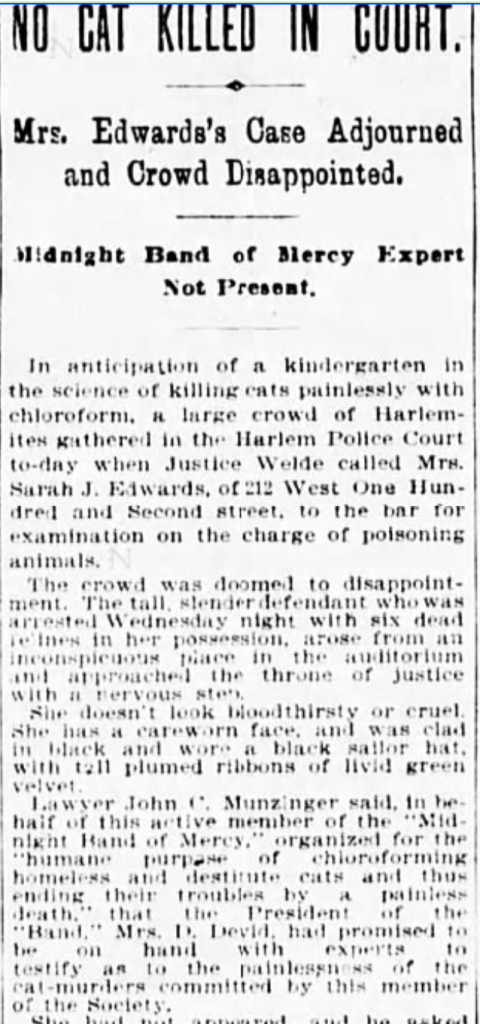
Sarah Edwards was left to prove that her killing was humane, and offered, in the court room, to demonstrate her technique, hence the headline below. The case was temporarily adjourned due to lack of a reliable witness.

In the end, Sarah Edwards was fined 10 dollars for killing the cats and a staunch warning printed for any person looking to duplicate efforts was published across the papers of New York, authored by ASPCA president John P. Haines.

Sarah then stated very publicly that she would no longer work within the boroughs, but instead take her humane services to the “summer places” such as Asbury park. Sarah didn’t make further headlines, but now and again, suspicion of the Band working would arise in the form of dead cats laid neatly on the doorsteps of homes across Manhattan.
When it was all said and done, investigative reporter Nellie Bly, quite well known for her deep dive journalistic pieces, published an expose on the whole of the incident in one of the most…interesting…papers in the whole of New York at that time, The World. The piece below was published on December 31, 1893. It’s also linked here.
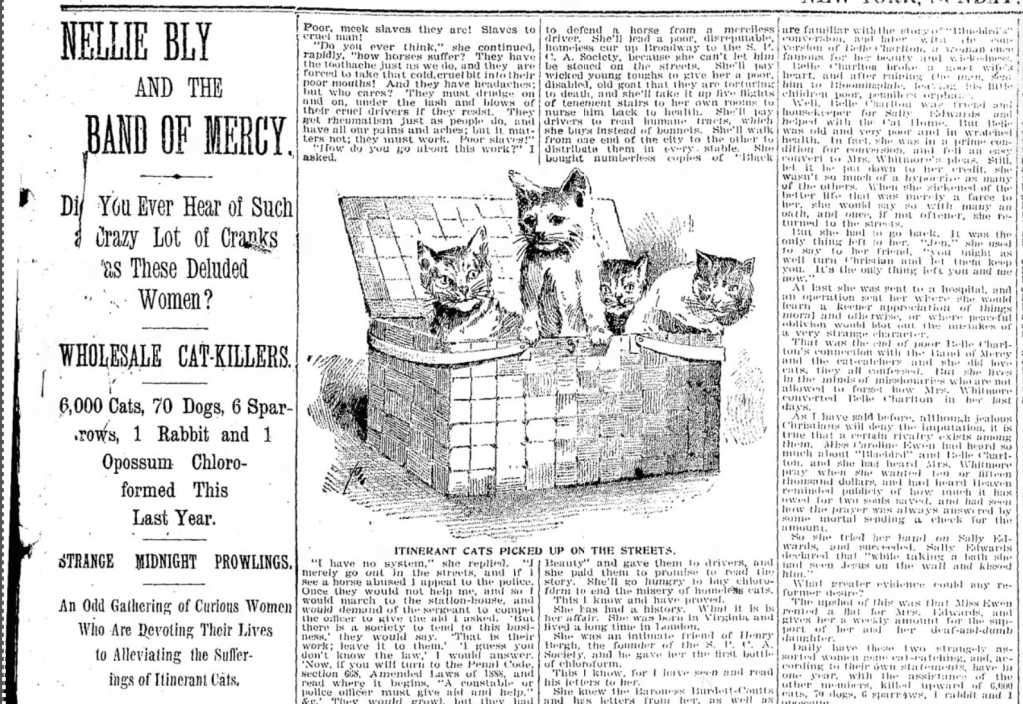


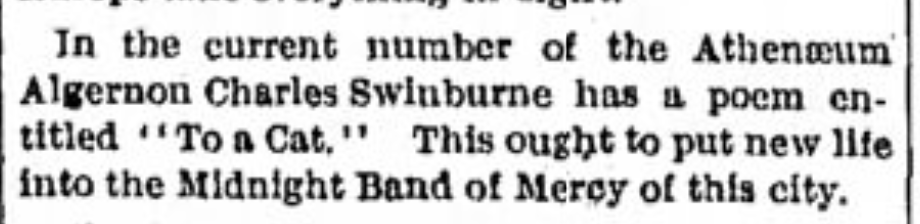
And despite all the horror that accompanied these events, of course the media had to throw some quips. Here are some of the notable ones.


I hope you’ve enjoyed this extremely odd tale. Given the timing, it’s extremely likely that it had great influence on the ASPCA’s decision to choose to intake cats into their shelters…making it one of the more pivotal cases to impact our movement. As always, please leave me your thoughts!
-Audrey
 Barking at the Knot