
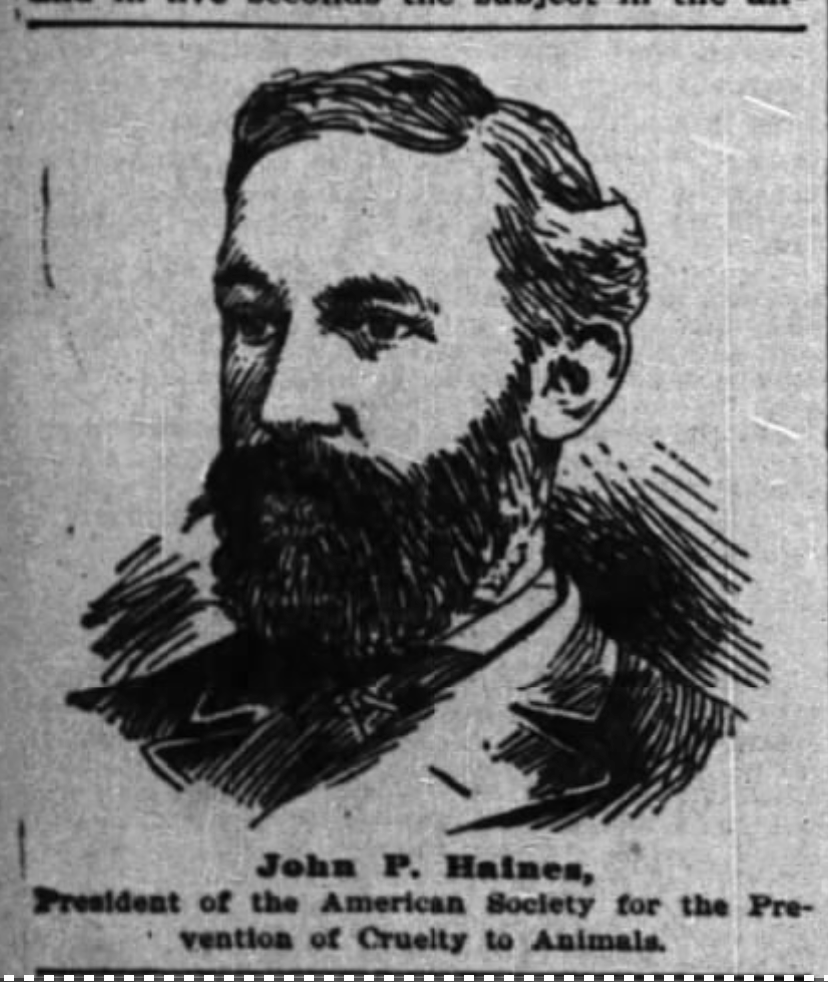
In 1895, the ASPCA had taken over animal control for the city of New York, with John P. Haines at the helm as the President of the organization. This cemented a path for a public – private model where animal shelters provided not only animal control services like rounding up of strays and management of dangerous dogs, but also animal protection functions and the beginnings of a (marginally) more humane system of caring for animals entering shelters.
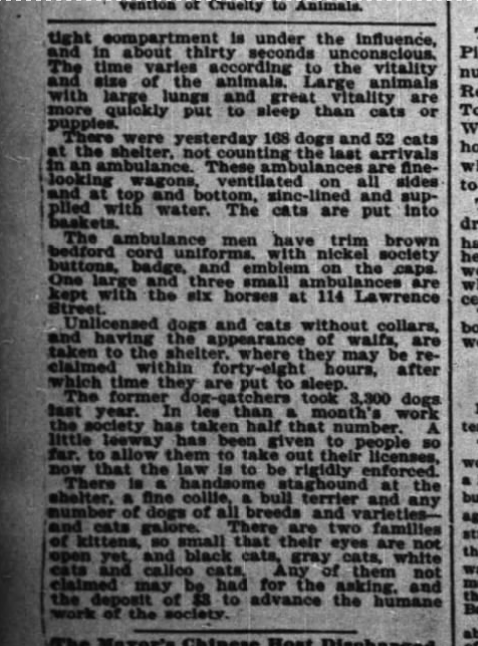
Shortly following the opening of their Manhattan building, they opened a second shelter in Brooklyn, and a tour of the facilities was covered in the Saturday, September 14 edition of the New York Times. At this time, this was the most modern animal shelter ever created – a totally new and innovative concept. That aside, it’s intention was also to be a temporary location, while “five acres are sought” for a “handsome brick structure.” It was donated and was originally an old stables for a railroad company.
I’ll post the article below in it’s entirety for your review, but would like to point out a few nuances that make the shelter “more humane.”
The shelter features animal housing in “zinc lined kennels” with air panels between. This is a change from impound models that used communal housing for dogs, generally either just open air or cinderblock, until they were killed. While these dogs were co-housed, it seems they were kept at a reasonable population per pen, there were multiple pens, and males and females were separated.
The dogs and cats are fed a quality diet consisting of “cornmeal, oatmeal, dog biscuits, bones and scraps.” This is the first time I’ve seen a description of the animal food used in shelters, and that in and of itself is very interesting. Within the prior model, they most likely would not have been fed or watered at all – this is consistent with all I have read aside from one piece where it describes “the dogs will not be fed offal.”
The “death chamber” is a point of pride on the tour, which discusses the “painless” death they are able to bring about through the use of “illuminating gas.” While this is obviously awful, it’s worth noting WHY it was a point of pride. Previous to this, animals were often killed in extremely inhumane ways by the dog catchers, with clubs or by slamming smaller dogs on the ground. Henry Bergh’s concept of “cruelism” was much at the center of the focus of providing a more humane death. Essentially, witnessing cruelty of any sort, including the sort that befell stray animals, was a mar on society that led to cruelty manifesting in other forms. Removing the death from the public eye was quintessential to removing that mar. This unfortunately also set animal shelters on a path of lack of transparency around shelter death, a topic I’ll cover at another time.
You’ll also note the change of language from “wagon” to “ambulance,” and from “stray” to “wandering” in the caption under the engraving. I speculate that this was an attempt toward more humane language.

You also could adopt from the shelter for 3 dollars, although their marketing could use some help. They were touting the “more valuable” dogs.

Finally, stray cats are now admitted to the facility, which is new. When animal control was in the hands of New York City, cats were not generally rounded up as. matter of course. However, as the population became more dense, livestock animals were removed from the city center and sanitation expanded, the way that cats were living with people changed and complaints began to rise from nuisance behaviors like fighting, yowling, etc. This led to the ASPCA’s contract including admission of cats.
Enjoy the article – I’d love to know what you see!
-Audrey


 Barking at the Knot