Barking at the Knot has the intention of being a historical archive for animal welfare professionals so that we can best understand our past. That being said, it’s also a little bit of a playground for me to talk about things that no one (read: my husband) is all that interested in hearing about on a daily basis. I’m pretty into animal welfare history, but I’m REALLY into rabies history. Rabies is, to me, the absolute most fascinating thing on the planet. However, I do try not to fill this blog with irrelevant rabies stories because, well, that’s weird. But this one is relevant!
Recently I got myself what I consider to be a REALLY good present. It’s a subscription to Newspapers.com, which is a historical archive for almost 30,000 newspapers. I’ve been gleefully reading newspapers and searching “rabies” and “hydrophobia” for the past couple weeks.
This morning while drinking my coffee, I searched the term hydrophobia and clipped a story from 1865 that I thought I could use to illustrate how confused folks where about whether or not an animal was rabid.
Brief lesson: In 1865, there was no known cure for hydrophobia (but plenty of weird remedies) and people absolutely did not understand what caused it, other than that it sometimes came from dog bites. Did all dogs have rabies? Did being scared of a dog cause rabies? What if a dog bit a cow, and then you drank the milk?
It was really, really scary because dying from hydrophobia was one of the worst imaginable deaths. It’s notable that from the time of the bite of a rabid animal, depending on the location and severity of the bite, symptoms take weeks or months to develop. In that time, you were just waiting to see if you would get sick and die.
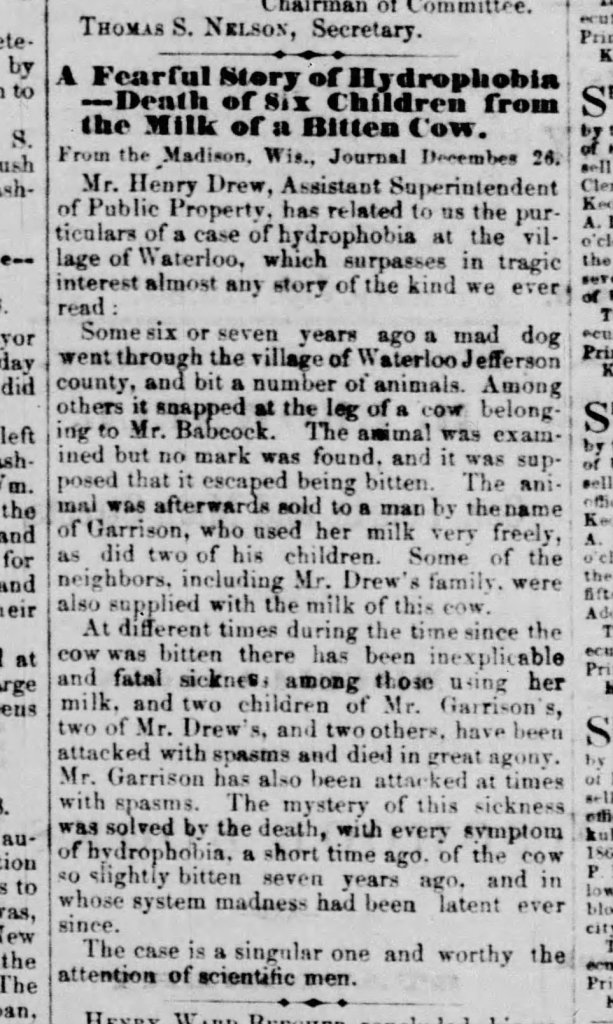
The gist of this story that I clipped was that a cow had been bitten by a dog in Iowa “six or seven years ago” and since the time of the bite, 6 children who had drank the milk of the cow had died, supposedly from hydrophobia. Now, obviously, the cow probably didn’t have hydrophobia. If any of my vet friends read this, I’d love some theories on if the cow’s milk could have killed 6 children over several years with whatever-all it might contain.
In 1865 these kinds of stories were pretty common, so I didn’t think much of it. And stories making multiple newspapers was also pretty common. But as I scrolled, I realized that the story of this probably not rabid cow was absolutely EVERYWHERE – it was definitely unusual. I decided to find the original story, or at least the earliest one I could see in this archive, and I *THINK* it’s this one, which is a direct reprint from The Madison Journal. That paper itself seems to be gone, but a paper called The Daily Gate City, in Kenokuk, Iowa reprinted this on December 29, 1865.
You’d think they would have stopped drinking the milk.
Anyway, the point here is that this cow story was reprinted, to my count, in the papers that survived in this archive, one hundred and eighteen times, everywhere from Canada to Vermont, to Nevada and Pennsylvania. The details don’t change, although sometimes the pieces get shorter or the paper adds a little spin in the form of “Sad” or “Terrible” as a headline. Some of the last ones, printed in February, get a little more vague.
Still, why is this cow story interesting? One reason is the last line of the original story: “The case is a singular one and worthy of the attention of scientific men.”
In this this time period people were absolutely desperate to understand hydrophobia and find a cure, so in a sense, this was a call to action. This was an attempt to inform people who were studying hydrophobia about a case that had happened that seemed notable.
In addition to that, it’s a great example of the types of sensationalist stories that Victorians loved to read in their papers. In this time period the steam powered printing press had recently made newspapers much more accessible, and they were desperate for content to print. With this, stories about hydrophobia abounded and made the problem seem much worse than it actually was. Many of the supposed “deaths by hydrophobia” like this cow story obviously were not related at all to rabies. But the FEAR of hydrophobia was perpetuated this way, greatly increasing the public’s fear of stray dogs.
This directly led to pressure on governing agencies to round up ALL stray dogs as dangerous.
I hope you’ve enjoyed this random bonus cow post this week. There’s a few clipped examples below of the story.
-Audrey
Chicago:

Pittsburgh:
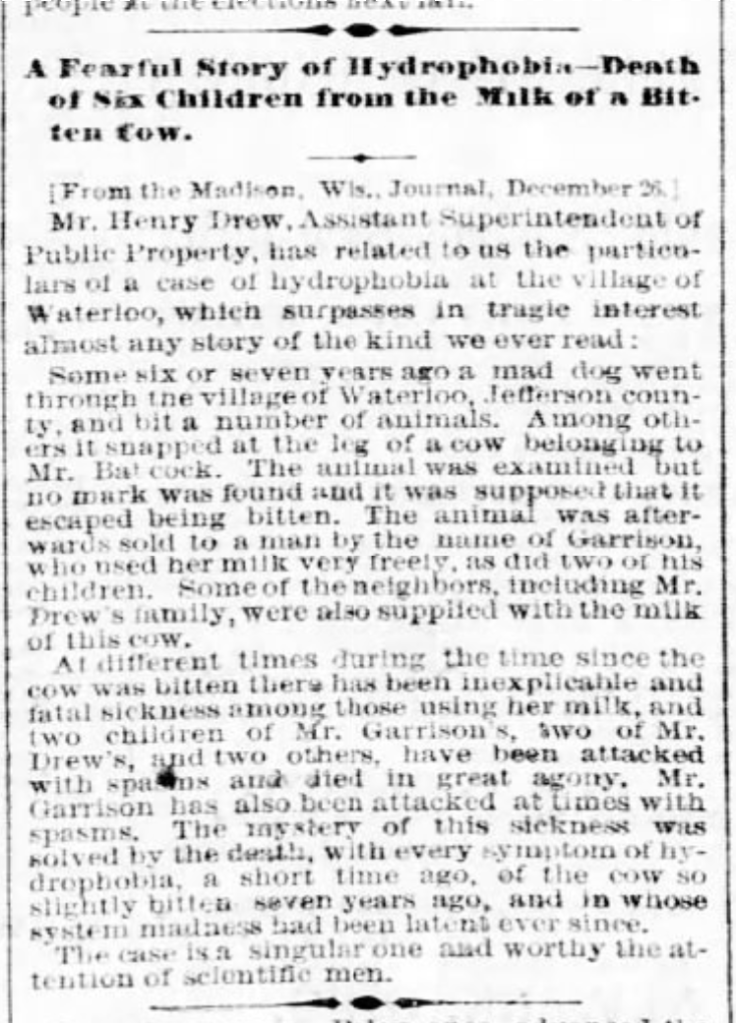
San Francisco:

 Barking at the Knot