
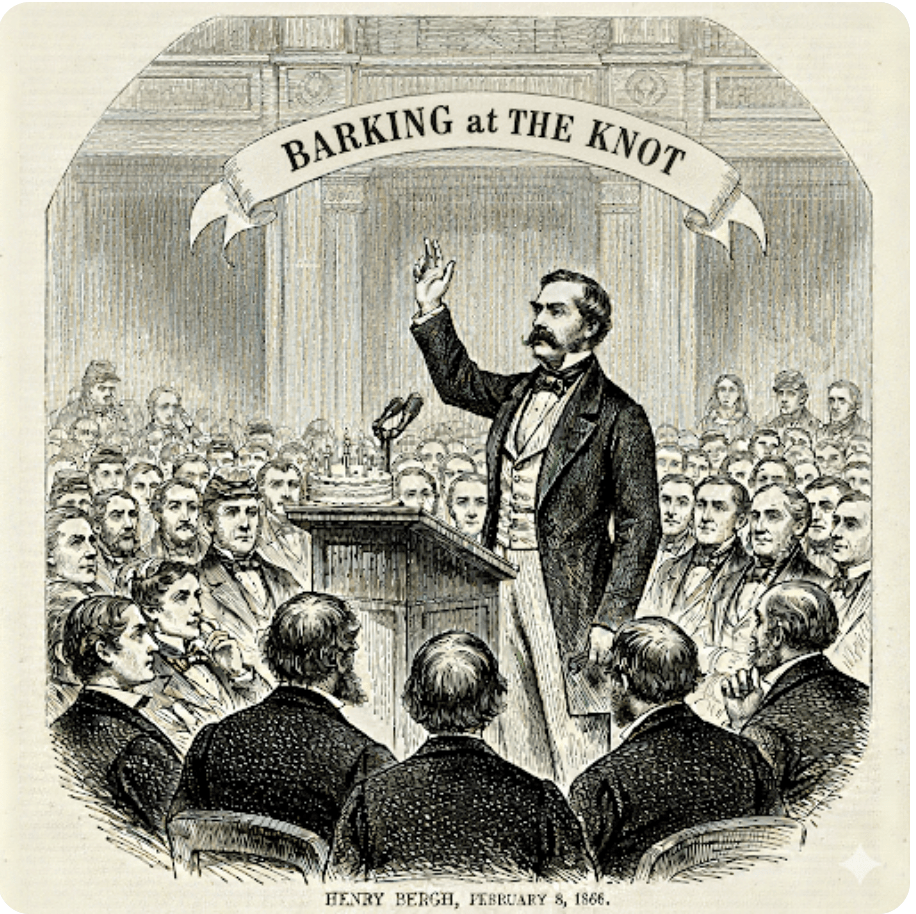
Good morning from Washington State, where I’m writing to you from a Hilton Home2 and resolutely staying on east coast time. It’s 4 am. I’m here to visit some animal shelters for work, and this morning I get to do one of my favorite activities, which is to unpack the history of the humane movement for the purposes of teaching change management. Fun fact, if you ever want me to do any kind of animal welfare history talk for your animal shelter, the answer is always yes. This is why we have zoom. Email me, I live for this. audrey.lodato@gmail.com.
Anyway – this week is ASPCA founder Henry Bergh’s birthday! He would be 211 years old on August 29th.
Several times this week in my reading, I saw mention of Henry Bergh’s famous Clinton Hall speech, and I thought that might be a fun topic to write about.
Before Henry Bergh returned from this time as a diplomat to Russia in 1865, he had a pivotal meeting with the 2nd Earl of Harrowby, Dudley Ryder. The Earl was significant in the operation of the Royal SPCA in England, serving as it’s president from 1861 to 1878.
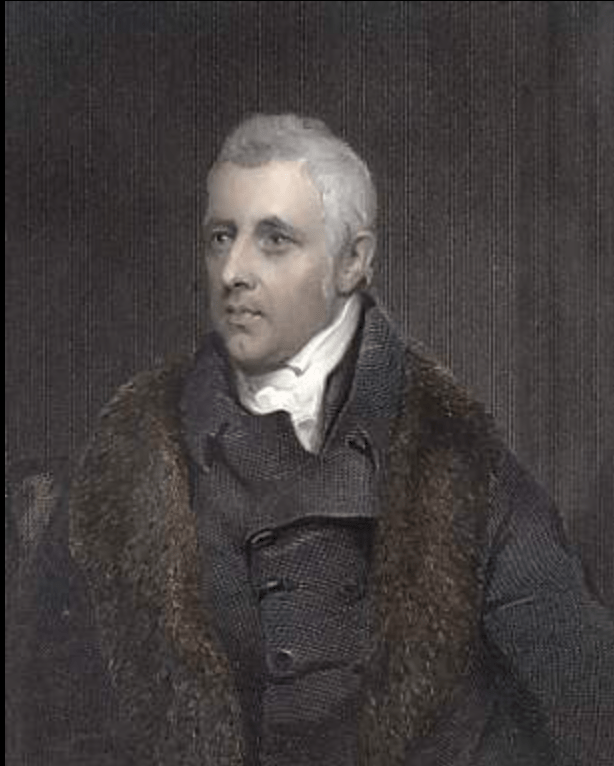
Mr. Bergh had sought this meeting to understand how the Royal SPCA had been formed, and he carried with him back to New York foundational ideas for how London’s Society could be duplicated in the United States. Upon his return and like any good grasstops advocate, Mr. Bergh began his mission by meeting with people of influence who could help him accomplish his goals. These meetings included high society members, wealthy potential donors, and other people of significant political sway. When he felt that he had gathered a sufficient amount of support, he gathered these individuals, including NYC Mayor Hoffman and Department store mogul A.T. Stewart, on a storm swept February night in what is now the West Village. The venue was Clinton Hall; Here he gave a speech called “Statistics Related to the Cruelty Practiced Upon Animals.”
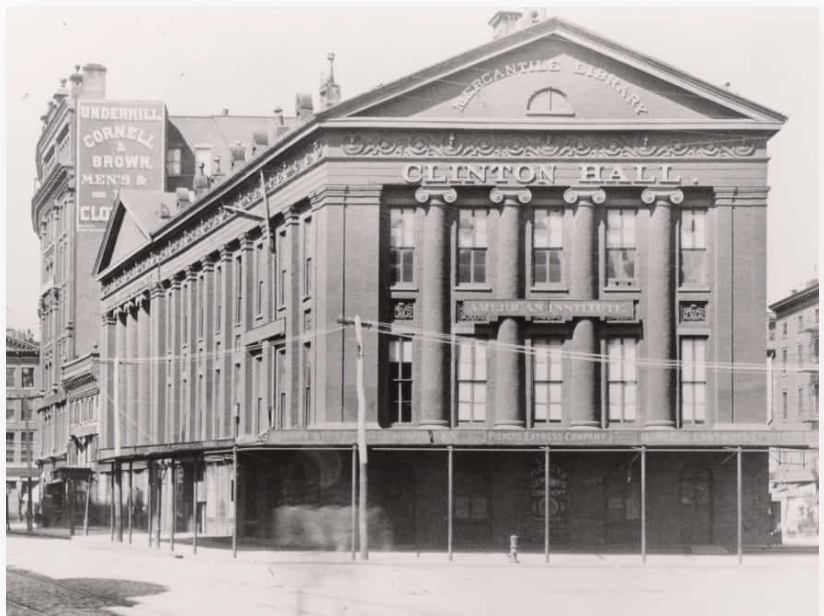
And while the STORY of the speech is well documented, finding the speech itself is unfortunately impossible – it just wasn’t interesting enough at that time to have been preserved. There are, however, some excerpts and documentation that remain of this night scattered about and I’ve done my best to round them up.
“This is a matter purely of conscience; … it is a moral question which cannot be disregarded by any people with safety to their dearest interest.”
-Henry Bergh
It’s also been quoted this way: “This is a matter purely of conscience; it has no perplexing side issues. It is a moral question in all its aspects.”
The most complete coverage of the speech appeared in The Sun, on February 9 of that year. The article CAN be located on some archives but it’s almost unreadable. I’ve transcribed it below to the best of my abilities. My eyes will never be the same.
AMERICAN GEOGRAPHICAL AND STATISTICS – Re: Society – Cruelty to animals.
A special meeting of this society was held last evening to listen to an interesting paper by Henry Bergh, Esq, late Secretary of Legation of the United States to Russia, on “Statistics relating to cruelty to animals.” He gave some personal experiences of some scenes of cruelty which he had witnessed in some parts of europe, and drew a dismal picture of some moral effects which bull fighting, dog fights, cock fights and numerous other modes of cruelty practiced have upon the communities. He had witnessed them in Spain, where the population included ladies of the highest rank applauded the terrible butcheries of the animals of each other as if it were something sublime. He traced the low moral and physical conditions of that country today to this love of cruelty to dumb animals. Mr. Bergh then gave a short history of the work accomplished by the London Society for the Prevention of Cruelty to Animals during the 28 years of it’s existence, and read the names of many of it’s patrons and members (illegible) is the Queen, the Prince and the Princess of Wales, the Dukes of Devonshire, Bucclough (sp?) and others with a long list of lords, earls, and (illegible), male and female, including the wealthy Mr. Burdette Coutts. During the Society’s existence, it has prosecuted to conviction and punished 10,000 cases of aggravated cruelty to animals, and last year it caused the arrest of 974 cases, of whom 872 had to pay a fine while the rest were otherwise punished. The society, by tracts, placards and other means, has so far worked up public opinion on the subject that aggravated cases are not very common now. Mr. Bergh now called off the names of a number of prominent men in this city who have signified their intention and readiness to inform such a society in this country, among whom were Mayor Hoffman, Horace Greeley, A.T. Steward, R.L. Stewart, M. O’Roberts, (illegible) and Henry Grinnell, M.S. and J.P. Beach (sp?) and others, and stated that measures are soon to be taken to form an organization.
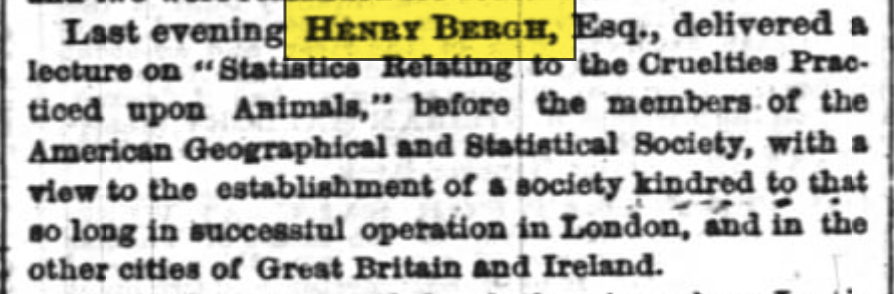
There was also a brief sentence in the New York Times – Pardon the highlight. I bought myself a new archive subscription and I can’t figure out how to get rid of that. Also, it’s four in the morning.
Following his speech, it’s been said that Mr. Bergh asked attendees to sign a “Declaration of Animal Rights,” although a 2020 investigation found that no such document could be proved to exist. In reality, what’s likely is that either a petition or letters of support were gathered, and it’s these documents that were taken forward to Albany to ask for the charter. By April 10 of this same year, Mr. Bergh had the charter in hand, and just a few weeks later, also our first anti-cruelty law. Talk about effective!
What’s notable about this night is that his speech primarily focused on the effects of cruelty on society itself. He would later call this concept that cruelty in the public eye degrades society “cruelism” and it would be foundational in his later work. It further reinforces that the very early advocacy work of the humane movement was less vocal about the rights of the animals themselves and more vocal about the effects that witnessing this cruelty had on society. While Bergh himself was widely known to be a firm believer in cruelism, others in the early movement were more concerned for the individual animals and their suffering. It’s interesting to think about whether the concept of cruelism was used a bit of a spin to bring people around to the concept of kindness and humane treatment.
In any case, the Dark and Stormy night of February 8, 1866, was important to our movement. I’d love to know what you think of this article. And if anyone does any further research and finds anything else about this night, let me know. I’d love to preserve anything that’s found by including it here.
-Audrey
 Barking at the Knot