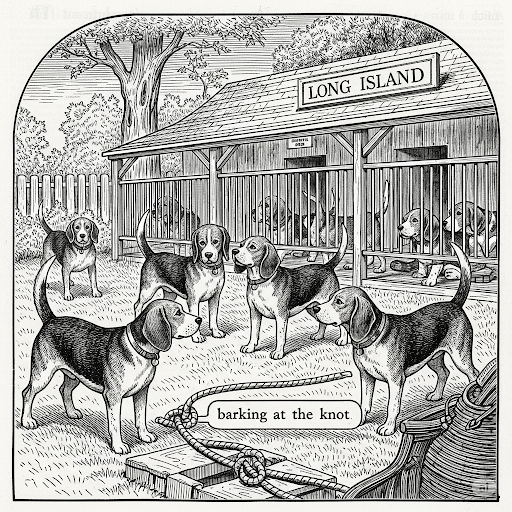
This week in Barking at the Knot, I’m offering a complete reprinting of a New York Times article from 1984 which takes a look at the state of animal shelters on Long Island. This piece gives a thorough snapshot of one location during a pivotal point in time in animal shelters.
With resources such as spay surgeries and vaccinations becoming more available and awareness around the poor conditions in shelters growing, articles like this one started to bring accountability to the way that animal shelters operated by informing the public about what was happening inside shelter walls in their own communities. You’ll notice how much was societally acceptable then that we have managed to overcome, and how much unfortunately remains the same.
In the next couple weeks, my intention is to publish a series of articles from the 1970s, 80s, and 90s looking at some of the more interesting stories from this timeframe. I hope you will enjoy them.
As an aside, I recently had some BATK stickers printed and gave some out to friends for fun. Someone made the suggestion that I include them on the site available for sale. So, if you’d like a BATK sticker (and who wouldn’t want a weird sticker with a rabid beagle?) you can order one here for a couple of bucks.
-Audrey
Efforts Increase to Save Unlicensed Dogs
Patrick Boyle, February 19, 1984 – originally published in the New York Times
IN Caroline Meyer’s Seaford home is a black cocker spaniel named Inky, who, according to state law, should be dead. The animal was in the Hempstead Town Dog Pound last year, pregnant and in line to be put to sleep. But members of a humane society took her from the pound on the morning she was to be killed. Now Inky and the five puppies she had the next day have homes.
Inky had been found wandering unleashed and was brought to the pound to face a fate shared by thousands of dogs on the Island every year. But she benefited from the fights and changes taking place over efforts to keep such dogs alive, or at least to care for them properly until they are killed.
As part of those efforts, Nassau and Suffolk County municipalities have budgeted more than $3 million for animal control this year. Brookhaven Town plans to construct a pound this year for $2.1 million. Southold will double the size of its facility, and a private organization is scheduled to build the first dog shelter in the Town of East Hampton, at an estimated cost of $250,000.
Every town and city on the Island except East Hampton has a leash law, and a state law requires dogs be tagged. The most common problem caused by unfettered dogs, according to shelter directors, is automobile accidents, sometimes fatal, which result when drivers attempt to avoid hitting an animal. Also, some unleashed dogs are reported to scare or bite people.
The director of the Southampton pound, Gail Bliel, said that packs of dogs occasionally attacked poultry farms, killing as many as 400 ducks at a time. Packs are also reported in Islip, where town workers sometimes chase them with tranquilizer guns, and in East Hampton, where they chase deer.
The dogs are frequently killed, most often by automobiles. The director of the Islip pound, Matthew Caracciolo, said that last year the town picked up 1,000 dogs killed by vehicles. A member of Animals in Distress of Amityville, Joan Primiano, said, that ”the winter is especially hard” because the dogs often cannot find food or withstand the cold.
Those dogs that do arrive at a shelter alive and well may or may not stay that way. The humane organizations have varying resources and philosophies, sometimes putting them into conflict with one another.
Municipal shelters, which reported handling 36,000 dogs in Nassau and Suffolk Counties last year, generally have ”hideous reputations,” said Bess Hawkins, director of Humane Enforcement of Regulations on Shelters.
The director of the Brookhaven pound, Irene Abramowitz, said it was designed to house between 30 and 40 animals, but has 200. The overcrowding ”causes quite a few health problems,” she said. ”The facility here is very antiquated.”
Mrs. Abramowitz said she hoped that the new shelter would be completed next summer and that it would accommodate the same number of dogs that the town handles now. The Town of Southold, which reports handling 325 dogs annually, is doubling the size of its pound.
”The place we have is a disaster,” said the director of the shelter, Gladys Csajko. ”We’re terribly overcrowded.”
Perhaps the most frequently criticized pound is the privately operated Hampton Animal Shelter in Bridgehampton, which is run by Corrina Videla. It was raided by the American Society for the Prevention of Cruelty to Animals in 1965 and 1979, charged by the Town of Southhampton with improper care of animals in 1965 and 1976 and investigated by the State Attorney General’s office and the County Health Services Department in 1981. On several occasions, according to local newspapers, small piles of dead dogs have been found on the property.
The controversy stems from Mrs. Videla’s policy of taking in any animals and never killing them. Other pounds almost always set limits on the number of animals they hold at one time and kill extremely old or sick dogs.
Mrs. Videla, who did not return several telephone calls, has argued that it is more humane to take and keep alive all dogs she is given or finds, no matter what their health or the conditions at the shelter, rather than let them wander or turn them over to a town pound, where they may be killed.
Although the charges against Mrs. Videla have sometimes resulted in fines and in dogs being taken from her, many charges have been dropped. Her pound has been operating since 1955.
There are criticisms of municipal shelters as well, mostly involving poor sanitary and health conditions, inadequate efforts to find homes for the dogs and inhumane methods of killing them.
But changes are taking place at some of the Long Island facilities aside from the construction of larger pounds.
”We’ve come a long way from when dog pounds were just impounding agencies,” said the director of the Smithtown pound, Roberta Cohen. ”Most of the shelter directors are changing their ways.”
Directors throughout Nassau and Suffolk said that if they received a dog with a license, they would try to reach the owner by telephone or registered letter. And although state law mandates that unlicensed dogs in pounds be killed after 7 days and licensed dogs after 12 days, most shelters said they regularly extended the waiting periods. If an owner cannot be found, efforts are frequently made to have a dog adopted, especially if it is young and attractive.
The senior dog warden of Babylon described killing animals as ”a last resort.”
In Islip, Mr. Caracciolo has been holding a black and tan German shepherd since last October, when it was brought in by someone who found it wandering.
Mrs. Cohen said that when the time approaches to kill what she believes is an adoptable dog, she takes the animal home and offers it to neighbors. ”A lot of times that works,” she said. ”I always give a dog a chance. I’m not supposed to.”
When municipal pounds do not or cannot find a home for an animal, humane societies step in. Sonny Chotland of the Animal Rescue Fund of the Hamptons said her organization spent $200,000 a year to house and find owners for animals brought to it by individuals or taken from the custody of the wardens in Southampton and East Hampton.
Groundbreaking began last December for ARF’s animal shelter in East Hampton, which along with Shelter Island is the only Long Island town without a pound.
The Humane Enforcement group, Animals in Distress and the League for Animal Protection all reported going to pounds, sometimes on the day animals are to be killed, and taking them to homes or kennelswhile initiating adoption efforts. Such intervention by AID, Mrs. Primiano said, saved Inky and her puppies.
Puppies, purebreds and extremely attractive dogs are the easiest to be adopted, although the groups occasionally try to place dogs that are old, blind or deaf. ”We’ve had some dogs four or five months now,” said Ada Winter of the league.
The volunteer organizations report finding homes for several hundred dogs a year. The largest humane societies on the Island, the North Shore Animal League in Huntington and the Bide-a-Wee Home Association shelters in Wantagh and Westhampton, report the adoption of thousands of dogs annually. Most of the pets are brought in by owners who no longer want them, with some being taken from pounds.
Thousands remain unclaimed. ”You know an old, old dog is never going to get adopted,” Mrs. Cohen said.
”For every one we save, 10 get put to sleep,” Mrs. Primiano said.
The methods of killing those dogs have been as controversial as the methods of caring for them, and are also changing. Several years ago, New York State outlawed the decompression chamber, in which a dog’s oxygen supply was depleted. The pounds turned to putting dogs in small rooms or boxes and killing them with carbon monoxide.
Some humane societies argue that this is still traumatic for dogs. The method is used by four municipalities – Oyster Bay, which reported in December that it decided to abandon the practice; Riverhead, which is considering a similar move; Huntington, and Islip.
Other towns and cities have switched to injections of a fast-acting chemical, usually sodium phenobarbital. It is far more expensive than gas, and some argue that it is not always less painful. Councilman John Lombardi of Riverhead, who is the Town Board’s liaison aide with the pound, said the injections were extremely painful if not inserted in precisely the right spot.
The senior dog warden in Huntington, Richard Austin, said euthanasia by gas was painless, pointing out that ”more people commit suicide by carbon-monoxide poisoning than by any other method.”
Those dealing with animals appear to agree that the root cause of the dog problem is what Mrs. Cohen called ”irresponsible pet owners.”
”If only we could educate the people,” said the East Hampton dog warden, Henry Chapman.
Many shelters follow the theme used by George Richmond, director of the North Hempstead pound, who tells pet owners to ”love ’em, license ’em and leash ’em.”
”You’re not doing the animal or anyone else a favor by saying, ‘We’re in the country, let him run,’ ” Mrs. Bliel of Southampton said.
Some towns and humane societies offer to pay part or all of the cost for spaying or neutering. Bide-a-Wee alters all its animals older than six months.
The pounds usually ask a series of questions to determine someone’s ability to care for an animal. But there is nothing to prevent lying, and it is difficult to turn someone down when there are many dogs waiting to be adopted or be killed.
”Municipalities cannot be selective when they’re trying to place a dog,” Mr. Caracciolo said.
Mrs. Hawkins said that people who received dogs as Christmas gifts often did not want them. They were turned over to pounds or let loose in another neighborhood. She also said a lot of dissatisfaction appeared to arise when dogs become a year old.
”The puppy is no longer cuddly,” she said. ”It’s getting to be a full- grown dog now. It’s causing more problems.”
”It’s not a dog problem,” Mr. Caracciolo said. ”It’s a people problem.”
 Barking at the Knot