

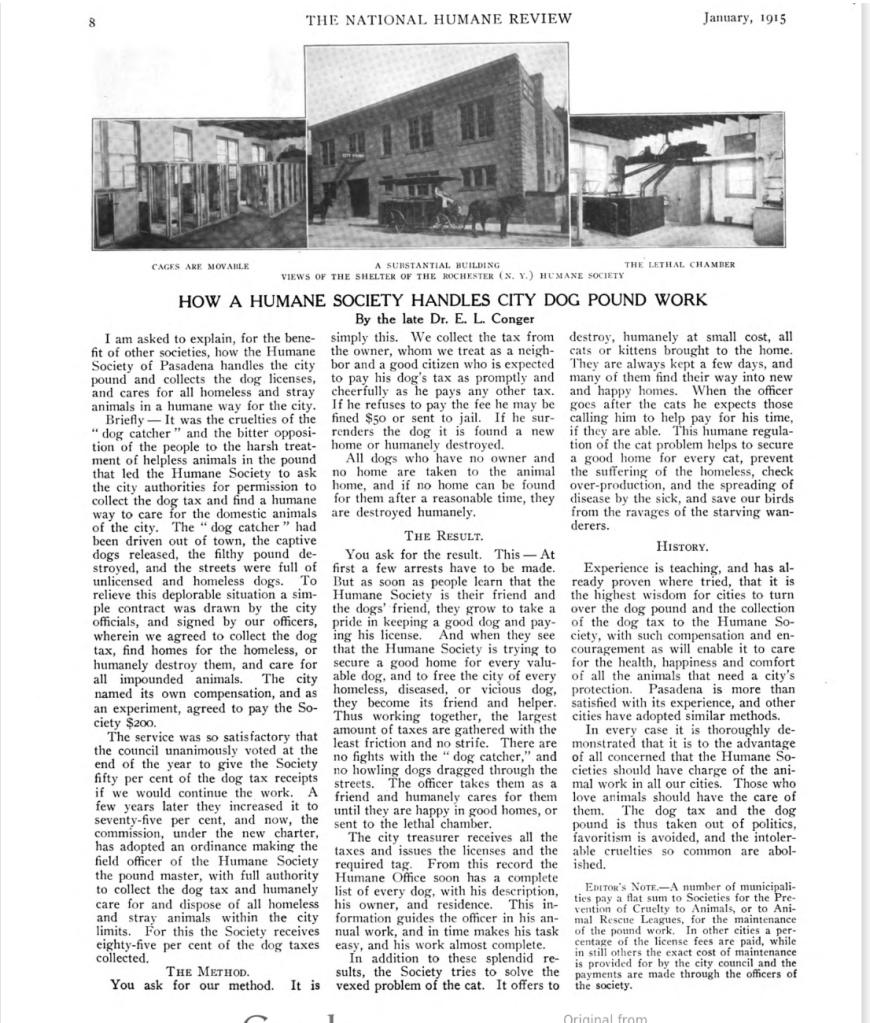
Today, I am bringing you a brief article from the January 1915 edition of The National Humane Review, which was the monthly periodical of the American Humane Association.
I recently attended a gathering where someone asked why killing animals in shelters continues to be an acceptable solution for population control. I answered that question by saying that we’ve always had a path of permission. In fact, we’ve actually celebrated it being a practical solution for animal management since the beginning of our movement.
This article is a great example of what daily work looked like in the context of 1915, when we didn’t have access to the solutions we have today. It’s unimaginable to even think about running a shelter that prioritized live outcomes with the parameters they worked within. No spay and neuter, no veterinary care, no vaccines, no lifesaving programs, no microchips, no TNVR, no technology, no management software.
As the humane movement evolved and these resources have become available and even required in some places, the killing for space and time has drastically decreased, but the path of permission to kill animals remains; We’ve never taken away permission to do what isn’t always needed. There’s also no requirement, even today, for animal shelters to offer the lifesaving programs we know often eliminate time and space euthanasia.
This is, perhaps, a slightly “political” post within the movement, but it’s not intended to be that way. I raise it simply to ask what you think we would build now if we were starting from scratch, with the resources we have today?
Comments on today’s contribution are very welcome.
-Audrey
 Barking at the Knot
One response to “How the Early Humane Movement Set a Precedent For Killing Animals”
This is such a thought-provoking question, one that I imagine I’ll be reflecting on not just today, but likely throughout the rest of my career.
LikeLike