
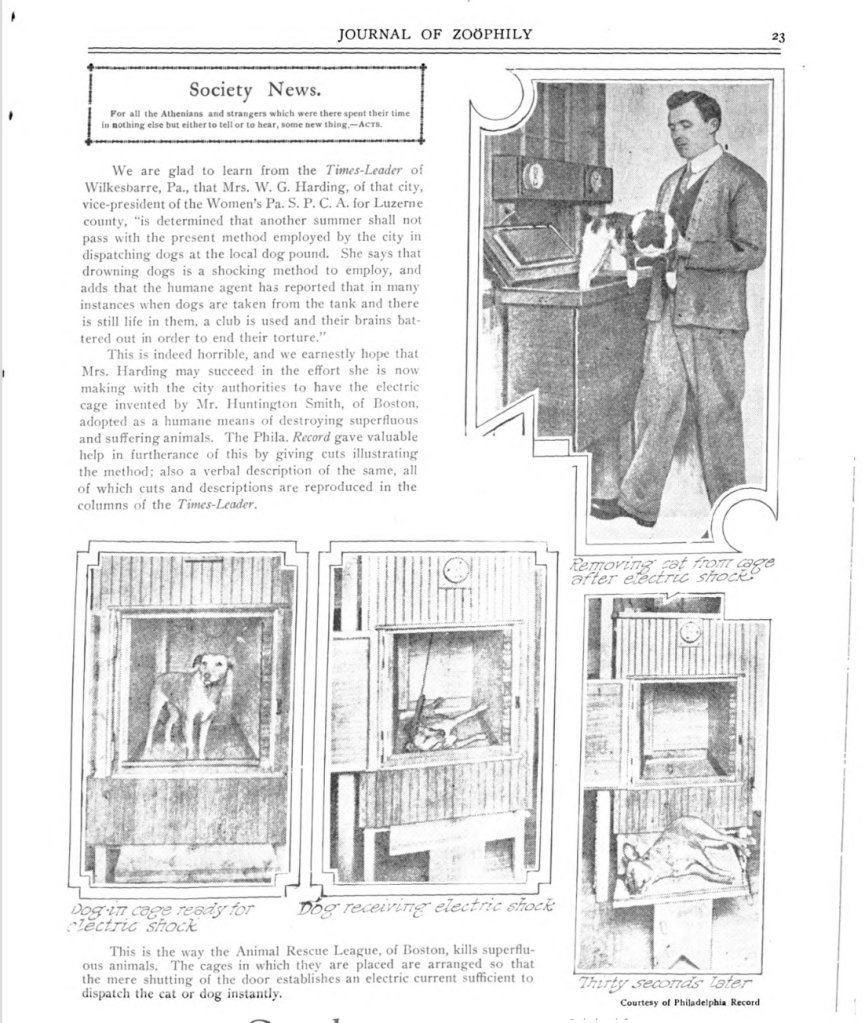
In the Journal of Zoophily’s May of 1912 issue, between a quote from Abraham Lincoln (“With malice toward none and charity toward all.”) and an article about the recent tragedy of the Titanic, is an article from its editor-in-chief, Caroline Earle White. She is reporting on the Third Conference of the Anti-Vivisection Societies of the Eastern States, held the 15th of April in Boston. The article describes the conference, its attendees, and a visit to Animal Rescue League, where a new invention is seen. The automatic electric cage is described as “a small, attractive looking closet, large enough for a dog to stand up in comfortably. It is well lighted and ventilated, and above the door is placed a mirror in which one can see the actions of the animal about to be killed.” Caroline continues to describe the closet, the inspiration behind it’s creation (lightning), the painless deaths of several animals placed into it. She calls it a “most valuable discovery.” I will share the entirety of the article below.
If you are one of the few people who regularly read this blog, you know by now that there is no one who fought harder for the rights of animals than Caroline Earle White. She is the very essence of our movement.
Last week, I had the pleasure of conversing with someone who wisely is including a historical timeline of the animal welfare movement within a report. She asked about gas chambers – did I have any photos? I thought of this article and sent it along, and I thought I would also share it today.
For me, this article is the perfect piece to include within a timeline, because it’s a pristine example of what the movement began fighting for; Our first animal cruelty laws were only advocating that no animal experience “Unnecessary cruelty.” In 1912, not many people had any qualms about the facts that some animals would experience some treatment they surely would not have chosen for themselves – like being killed in an electric closet, for example. It was a given, at least in American culture, that animals were only present for the benefit of man. Horses were for working, cows were for eating, and dogs were for hunting and guarding and maybe companionship. All animals were there to serve us, and this is primarily because we believed all animals were beneath us; The Christian fundamental belief that God gave us dominion over all the birds, animals and earth. Treating them humanely only meant preventing suffering.
When you look at the electric closet, or, for that matter, the gas chambers, the poisonings, and the drownings that used to occur in the name of being humane, it’s easy to be horrified because we’ve raised the bar away from that. Unnecessary cruelty now means something different. We’ve transitioned to understanding dogs and cats (at least) as valued family members. We’re horrified at the electric closet because we know now that we could do better. But it doesn’t mean that they were doing wrong in 1912. It means they were doing what they thought was the right thing.
Today, we have new things that allow us succeed in a new level of compassion and care for companion animals. What constitutes unnecessary cruelty has changed. We have vaccines, spay and neuter, microchips, foster programs, adoption processes, pet food pantries, veterinary medicine. Some of these very things were radically opposed in their implementation.
I’m sharing this to say that this is what our movement continually does; we raise the bar. As we have more resources, as we get better, as we learn, as we grow, we can do better for the animals in our care.
Imagine if we did not choose to change?
I work with shelters, and I say often to shelter leaders that we need to continually question everything we’re doing. It doesn’t mean we were wrong; It means we are evolving. There is a long history within the movement of fear of change. There is also a long history of changing.
-Audrey


 Barking at the Knot
One response to ““Automatic Electric Cage””
[…] the movement focused on what we felt was most beneficial to pets and people; humanely killing pets so they would not be cruelly killed on the street, and also keeping the messy business of killing away from the public eye to avoid societal […]
LikeLike