
Of all the founders of the animal welfare movement, none were so colorful in their public application of the first anti-cruelty laws as Henry Bergh, the founder of the American Society for the Prevention of Cruelty to Animals in New York. Fairly, he had a right to be colorful with the law; He is the one who wrote most of it. Still, the way he chose to go about bringing public awareness to early enforcement is one of the most interesting things about the first days of the movement, and much of why he did what he did has to do with his theories on how cruelty to animals influenced society. That’s what we will take a look at today.

I’d argue that no animal welfare figure is more well documented than Henry Bergh, so I’ll spend very little space on his biography and trust that if you’d like more information, you can readily find it. You might see the book list page of this very website as a starting point. (You might also want to read about how he aspired to be a writer; His plays are terrible.)
Henry Bergh was born in 1813 in New York City into a very wealthy ship-building family. He briefly entered his father’s ship building business before attending college at Columbia. He left before he finished his degree, went to Europe and lived a life of substantial leisure for some years before his eventual appointment by President Lincoln as a diplomat for the United States in Saint Petersburg, Russia.
While in Spain with his wife, he witnessed the horrific disembowelment of horses during bullfighting and subsequently, the laughing and clapping of small children during the event. This disturbed him greatly, and was a memory he kept with him and thought of often. Later, while back in Russia, he observed repeatedly how Russian carriage drivers were particularly cruel to their horses and mules and began to intervene in these beatings himself.
These incidents and others he witnessed (and publicly objected to) stayed with him, forming his foundational beliefs about the inherit nature of man to be cruel, and what he felt was the effect of animal cruelty on society as a whole. As time went on, he began to articulate these beliefs more clearly as “Cruelism.” Cruelism, loosely defined, is the concept that cruelty to animals results in the degradation of society. Someone who is cruel to his horse, for instance, may also go home and beat his wife. The more that we accept cruelty and have cruelty present in the public eye, the more society becomes hardened to seeing it, the more it becomes accepted, the more it becomes ingrained as part of our moral fabric.
Henry Bergh returned to the United States and in 1866 worked to found the American Society for the Prevention of Cruelty to Animals (ASPCA) in New York. Just six days after the charter forming the Society was signed, on April 16, one of the first anti-cruelty laws with any true substance was also enacted, giving animals their first real protection against intentional cruelty.
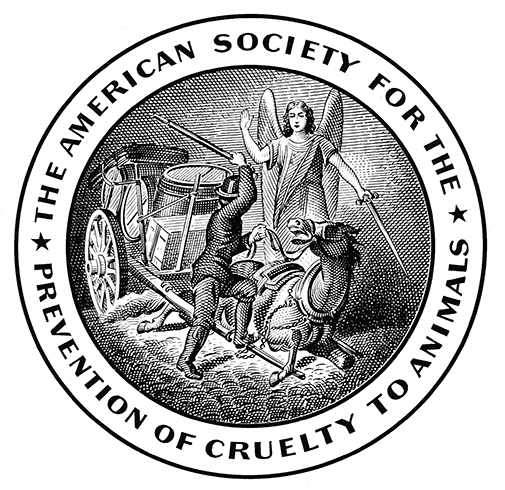
A particularly interesting ASPCA factoid is that the seal of the new organization was created as an engraving by Frank Leslie, of Frank Leslie’s Illustrated Newspaper, a popular New York City periodical. The seal is still in use today and was inspired by Henry Bergh’s carriage horse experiences in Russia.
While most of the original societies of animal welfare passed anti-cruelty laws in their cities, the way that making change was approached differed from place to place and person to person. It’s notable that Henry Bergh led the intial charge, but the movement unfolded with many petals of influence.
Overarchingly, the primary view was that of moral suasion; that of persuading society to act a different way based on a set of factors. Caroline Earl White of Philadelphia believed that there was good in every person and that by presenting them with facts and logic, that good would do its work and people’s better nature would prevail. George Angell of Boston believed that above all, education, particularly for youth, was key to changing the hearts and minds of people. Henry Bergh took a very different view; That the best way to change the hearts and minds of the public was through very public enforcement of the law. You may have heard of Henry Bergh referred to as “The Great Meddler.” This fantastic and well deserved title came to be because he did not hesistate to insert himself directly into any situation he felt was unjust, and to use that situation to his advantage by drawing the attention of as many as possible to the crime.
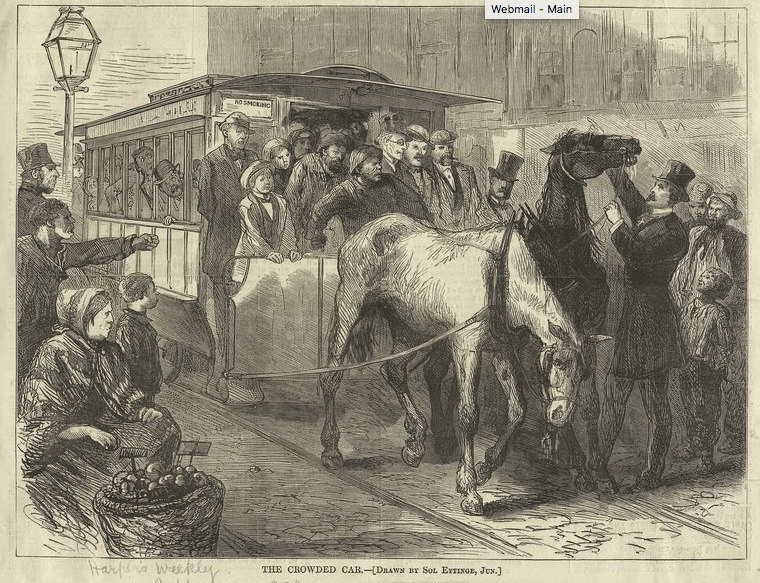
When we hear of his early advocacy, we tend to think of carriage horses, and it was true that he very commonly stopped horse carriages in the street to inspect the horses and sent lame or injured horses back to their stables, arresting the drivers. The carriages in New York City ran on tracks, and he was known to delay the whole system for hours by stopping one carriage in the middle of the street. And when this happened, not only would he send the carriage back, but he would also give what was known as a “curbside speech” to all surrounding the incident, encompassing his beliefs of cruelism and man’s responsibility animals. He often amplified these incidents through partnerships with media, making sure that the incidents received due attention and that people knew that if they broke the laws, there would be consequences. He also took on the Vanderbilt family, who owned some of the carriage lines and stables, arguing first privately and then publicly for reform for conditions the horses were kept in.
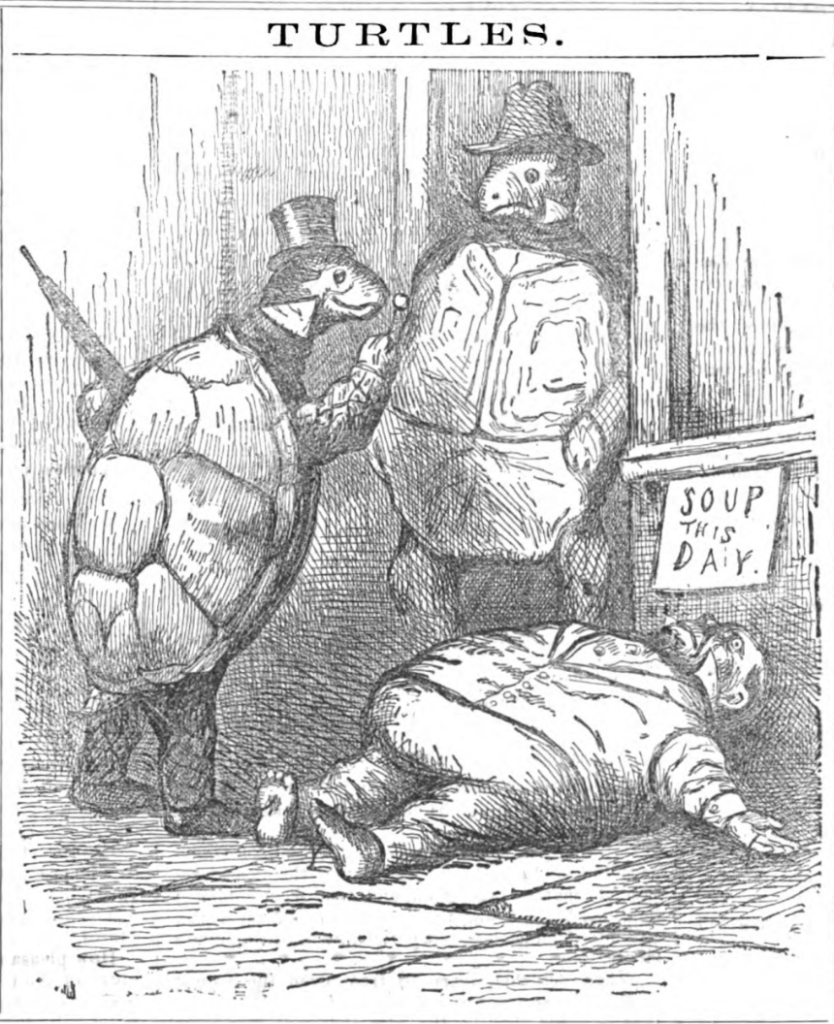
His tact of finding an opportunity to both prevent cruelty in the moment and draw attention to the issue through media played out over and over again throughout his lifetime. Shortly after the anti-cruelty laws passed, he famously boarded the docked ship of Captain Nehemiah Calhoun, which was importing green sea turtles, commonly eaten in turtle soup clubs, into the city. There was a long established (horrible) practice of shipping the turtles on their back, roped together with holes cut through their fins. Bergh brought attention to this by arresting the Captain and bringing the case to trial. He did not win the case itself (which devolved into an argument over whether or not a turtle was an animal) but what he did succeed in doing was creating a city wide media spectacle that almost everyone in the city followed, and therefore considered. He created a situation where society took time to think about the suffering of the turtles, the food that they eat, what those food-animals endured, and whether that aligned with their morals.
Whether it was advocating against passenger pigeon shoots, dog fighting, snakes eating live rabbits in front of children at P.T. Barnum’s museum, bison hunting, slaughter house reform, or of course, the improvement of treatment of the city’s stray dogs, always at the forefront was the very public elevation of the effect of cruelty on our society tied to punishment of those who enacted that cruelty.
Henry Bergh succeeded in making people think about how we treat animals. For many people, it may have been the first time they had ever considered animals at all. He never missed an opportunity to speak in public, never missed an opportunity to communicate his beliefs. From the streets of New York City to his sparsely furnished Broadway and fourth offices, he managed to lay a foundation for the future of our movement.
 Barking at the Knot