
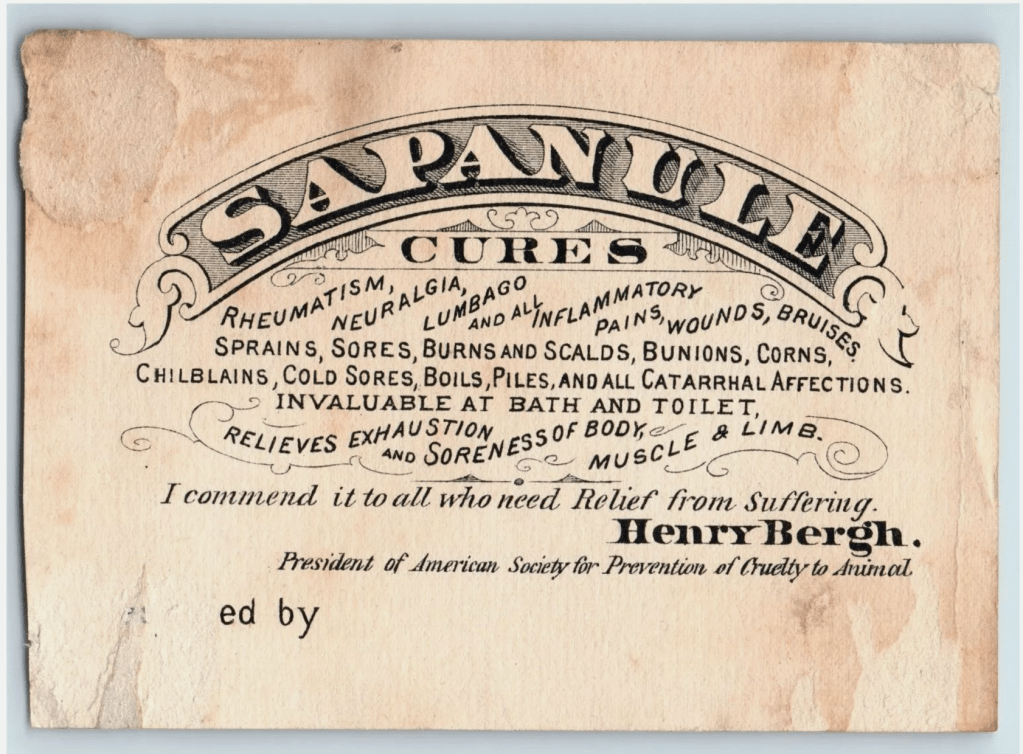
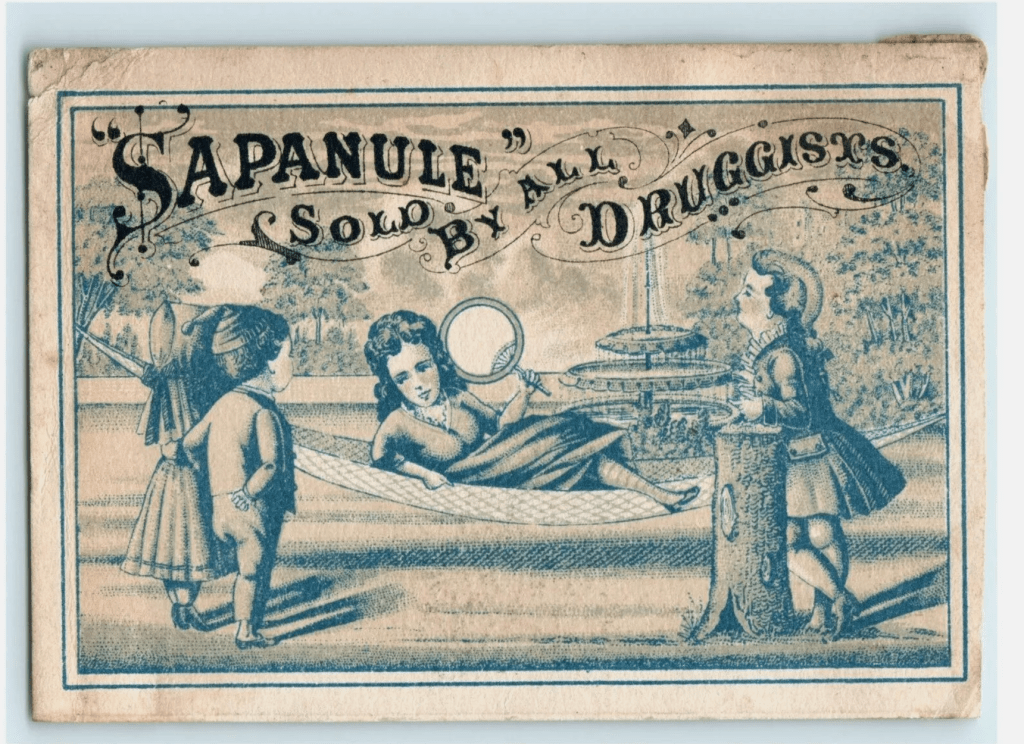
This is a “quack cure” medicine advertisement from 1890. I got it on Ebay, and this particular one is pretty readily available, meaning you can have one too.
At first glance, it’s so much like those other advertisements of the late Victorian period, focused on selling a product promising a cure-all for any number of conditions. However, this particular card has an interesting under-layer. There is an “endorsement” from Henry Bergh, founder of the ASPCA, on the back.
What may not be entirely obvious is that this card and corresponding medicine was produced during the middle of the raging and very public argument over whether or not the rabies vaccine was effective at preventing hydrophobia (rabies in people.)
Since Pasteur’s rabies treatment was founded on germ theory, which was still not widely accepted, many people thought that it was very unlikely to work. Many were skeptical of the concept of germs, which were introduced as tiny living things that could not be seen and made you sick. A large population of people also remained steadfast to the theory that sickness was caused by miasma, or “bad air” entering the body and causing lesions internally. This was something that was much more physically tangible and easily understood by the people of that time and dovetailed with what they knew to be true of the human body. Therefore, logically to them, the cure must be focused on driving the poison from the body and healing the internal wound; a “vaccine” made from the spinal cords of rabid rabbits seemed incredibly unlikely to help in the best case scenario and incredibly weird and like witchcraft in the worst.
One of the people who was most loudly and strongly against the vaccine was Henry Bergh. A steadfast germ theory denier publicly, Bergh also took tremendous issue (rightly) with the cruel ways animals were treated in order to produce the vaccine itself. Bergh leaned hard into the miasma theory in the media and widely promoted “vapor baths” as a cure…among other miscellaneous things.
On this advertising card “Henry Bergh” states this product promotes “relief from suffering.” While it’s likely false that Bergh actually promoted this product at all and the maker was simply capitalizing on the sensationalized hydrophobia vaccine debate, what IS true is the suggestion here that this “cure-all medicine” could be used to also cure hydrophobia. Did Henry Bergh truly support this cure-all drug? Is it true that Bergh internally believed that the vaccine was effective, and only publicly denied it because of his objection to the cruelty involved in production? Did his awareness that his role as an influential public figure in the animal welfare space would be a source of truth and influence whether people sought the vaccine for themselves? We may never really know the full extent of his influence.
-Audrey
 Barking at the Knot